



Use Wozber and land your dream job
Create Resume
No registration required
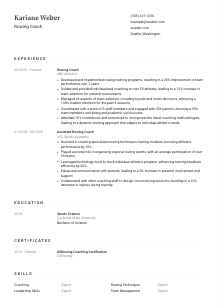
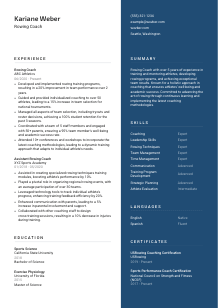
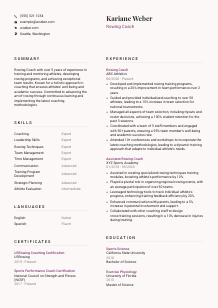
Navigating the waters, but your resume is drifting? Propel your credentials with this Rowing Coach resume example, created with Wozber free resume builder. It shows how to sync your crew-leading skills with job requisites, ensuring your career sails smoothly to the finish line!
Rowing coaches are trusted with more than technique. They shape training blocks, make roster calls, manage athlete development across a season, and often play a direct role in team culture, well-being, and academic balance. A resume for this field needs to show that you can run a disciplined program and improve performance, not simply that you have spent time around the sport.
The first screen often hinges on whether your coaching background matches the level, language, and standards of the opening. Using Wozber's free resume builder helps you organize that experience into an ATS-compliant resume that mirrors the posting's terminology, from training program development to athlete feedback and team selection, so hiring teams can quickly see your coaching scope and results.
For a Rowing Coach, the header should do one practical job well. It should confirm who you are, how to reach you, and whether you meet any immediate logistical requirements, without cluttering the page or distracting from your coaching record.
Use your full name in a larger, clean font so it is easy to find at a glance. Keep it simple and professional. In coaching searches, reviewers often scan fast between certifications, experience level, and location, so your name should anchor the page without any decorative styling.
Place "Rowing Coach" directly under your name if that is the role you are pursuing. This creates immediate alignment with the opening and helps ATS matching. If your current title is "Assistant Rowing Coach" but you are applying for a lead coaching role, your experience can show progression while the headline keeps the target role clear.
Include a phone number and a professional email address that you actively monitor. Coaching hires can move quickly around tryout timing, seasonal planning, or interview scheduling, so accuracy matters. One typo in your number or email can cost you a conversation.
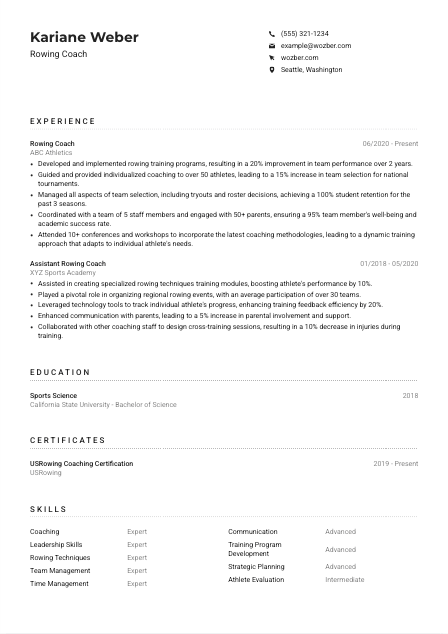
If the posting includes a location requirement, list your city and state in the header. Here, Seattle, Washington is specifically requested, so showing that detail removes an immediate question about availability. Treat this as a tailoring move for the opening, not a rule for every coaching resume.
A LinkedIn profile or personal website can help if it adds something useful, such as coaching history, regatta results, athlete development work, or program information. Make sure any linked page matches your resume dates, titles, and overall level of professionalism.
Your personal details should confirm the basics quickly and support the hiring decision, especially when the role includes location or communication requirements. Once the header is clean and accurate, the rest of the resume can stay focused on coaching outcomes.




This is the section that carries the most weight for a Rowing Coach. Hiring teams want to see how you plan training, improve boat speed, develop athletes, manage selection decisions, and work with the wider support network around the team.
Read the job description closely and underline the work that defines the role. In this case, that includes building training programs, giving individualized feedback, running team selection, and coordinating with staff and parents. Those responsibilities should show up in your experience bullets in plain coaching language, not vague leadership statements.
Start with your most recent coaching position and include title, organization, and dates. This helps reviewers track your progression from assistant or support roles into broader program responsibility. For rowing, recent experience matters because training methods, athlete monitoring practices, and equipment standards continue to evolve.
Each role should show what you were responsible for and what changed because of your work. Useful bullets often cover performance improvement, athlete development, retention, injury reduction, roster management, or competition progression. The sample resume does this well by tying training program design to a 20% improvement in team performance and individualized coaching to stronger tournament selection results.
Quantify results where the numbers are natural. That might mean athlete count, retention rate, qualification rate, race performance, selection outcomes, attendance, or academic well-being measures. Metrics help hiring teams understand scope. Coaching "over 50 athletes" or improving training feedback efficiency by 20% says much more than "worked with many rowers."
Choose examples that match the level and responsibilities of the role you want now. A school-based coaching opening will care about athlete development, communication with parents, academic support, and team culture alongside race results. If a bullet does not strengthen your case as someone who can run or support a rowing program effectively, cut it.
Your experience section should make your coaching style and results visible through training outcomes, athlete development, and program management. When the bullets line up with the posting's real responsibilities, your background reads like a direct match rather than a generic sports resume.
Education matters in rowing coaching when it supports how you train athletes, manage performance, and apply sound sports science principles. Keep this section straightforward, while making sure it reflects the academic background the role asks for.
Before editing this section, confirm the educational requirement in the posting. Here, the employer asks for a bachelor's degree in Sports Science, Exercise Physiology, or a related field. That tells you what should be most visible near the top of the section.
List each degree with the institution, degree name, field of study, and graduation year. That is usually enough. Clean formatting helps both ATS parsing and human review, especially when the hiring team is quickly checking whether you meet minimum qualifications.
When your academic background directly supports coaching performance, make that connection easy to read. A Bachelor of Science in Sports Science and a Master of Science in Exercise Physiology both strengthen a rowing coaching application because they support training design, conditioning, recovery, and athlete monitoring.
Relevant coursework, research, or projects can be useful if they deepen your coaching profile. Topics such as biomechanics, exercise testing, strength and conditioning, or sport psychology may add value, especially earlier in your career. Keep them brief and include them only when they reinforce the target role.
Honors, scholarships, or leadership in university athletics can support your story if they still feel relevant to the coaching level you are targeting. If you already have several years of strong rowing coaching experience, those details should stay secondary to your track record with athletes and programs.
Your education section should confirm that you meet the academic requirement and reinforce the technical side of your coaching background. Keep it clear, relevant, and easy to verify.
Certifications carry real weight in coaching because they show formal preparation, current standards, and continued professional development. For rowing roles, they can also determine whether you clear the first screening step at all.
Check whether the employer asks for a specific coaching certification. In this case, a valid USRowing coaching certification or equivalent is required, so that credential should appear prominently. Do not bury a mandatory certificate under less relevant courses or general fitness credentials.
List rowing-specific and coaching-specific certifications ahead of broader credentials. A USRowing Coaching Certification should lead because it speaks directly to sport knowledge, coaching standards, and role eligibility. Additional certifications in performance coaching or conditioning can follow as supporting qualifications.
Include issue dates and, when relevant, active or renewal status. That matters for certifications that need to stay current. A date range such as "2019 - Present" quickly tells the employer that the credential is active and maintained.
Rowing programs change with advances in technique, training load management, recovery methods, and athlete support. Continuing education, workshops, and new certifications show that your coaching methods are current rather than fixed. That is especially useful when a posting mentions professional development as part of the role.
A well-ordered certificates section shows that you meet required credentials and stay engaged with modern coaching practice. For rowing roles, that combination strengthens both eligibility and trust.
The skills section should reflect how you actually coach. For a Rowing Coach, that means sport-specific expertise, athlete management, and the communication skills needed to lead a team through training, selection, and competition.
Read the posting for both direct and implied skills. Here, the obvious ones include rowing techniques, training program development, communication, leadership, and team selection. Those should shape your list more than generic terms that could appear on any sports resume.
Lead with capabilities that connect directly to the role's day-to-day work. Strong examples include rowing technique instruction, athlete evaluation, training plan development, team management, performance tracking, and parent or staff communication. The sample resume also uses practical terms like "Training Program Development" and "Athlete Evaluation," which translate well in both ATS and human review.
Avoid filling this section with every soft skill you can think of. Choose the strongest mix of technical coaching knowledge and people leadership. A shorter list with relevant items such as leadership, rowing techniques, communication, and strategic planning is more persuasive than a long list of broad traits with little connection to the program's needs.
Your skills section should read like the toolkit of someone who can lead training, evaluate athletes, and manage a rowing program well. Relevance matters more than volume here.
Language skills are usually a supporting section for coaching resumes, but they still matter when the role depends on clear instruction, athlete communication, and coordination with families or staff. Present them plainly and in the right order.
Start with the posting itself. This one requires the ability to express yourself clearly in English, so English should appear first in your language section. That directly addresses a stated requirement and removes doubt about day-to-day communication in training, meetings, and athlete feedback.
If English is your native language, say so. If it is fluent or professional working proficiency, use the level that accurately reflects your ability. For a coaching role, the distinction matters because instruction, safety communication, and performance feedback need to be precise.
Additional languages can strengthen your profile, especially in programs serving diverse athletes and families. Keep them concise and include a clear proficiency level. In the sample resume, Spanish adds useful context without distracting from the primary English requirement.
Do not overstate your level. Terms such as "Native," "Fluent," "Intermediate," and "Basic" are enough. Honest language ratings help employers understand where you can confidently coach, communicate, and build trust.
For most rowing coaching roles, languages support the application rather than define it. Include them, but do not let this section overshadow more important areas such as coaching experience, certifications, and athlete outcomes.
A clear language section confirms that you can instruct, guide, and coordinate effectively. For this role, strong English communication should be immediately visible.
The summary should introduce you as a coach in a few tightly written lines. It needs to connect your experience, coaching focus, and measurable results to the level of program you want to join.
Before writing the summary, identify what this coaching job emphasizes most. Here, the priorities include training program design, athlete guidance, team selection, and communication across the program. Your opening lines should reflect that mix rather than giving a broad statement about being passionate about sport.
Open with your title and years of relevant experience. That gives the reader immediate context. For example, "Rowing Coach with 5+ years of experience" is stronger than a generic adjective-led introduction because it establishes level right away.
Use the next lines to highlight results or strengths tied to the role. That could include improving team performance, mentoring large athlete groups, managing selection processes, or supporting athlete well-being and academics. The sample summary works because it combines measurable coaching experience with a clear approach to athlete development.
Aim for three to five lines. Focus on the points that best match the target job, and leave the rest for the experience section. A summary should give the hiring team a fast read on your coaching level, program impact, and professional approach.
A sharp summary helps the reader understand your coaching profile before they reach the first bullet point. Keep it aligned with the posting, grounded in real outcomes, and specific enough to sound like your career, not anyone's.
A Rowing Coach resume works when it shows how you train athletes, improve results, manage a program, and meet the role's required standards. With each section tailored to the posting, the hiring team can quickly see your coaching level, certifications, and fit for the environment.
Wozber's free resume builder can help you shape that content into an ATS-friendly resume format, and Wozber's ATS resume scanner can highlight missing requirements, keyword gaps, and section-level alignment before you apply. The final result should make one thing easy to judge: you are ready to lead rowers with structure, technical depth, and sound athlete support.




