



Use Wozber and land your dream job
Create Resume
No registration required
Drawing up game plans, but your resume is fumbling at the line of scrimmage? Tackle this American Football Coach resume example, created with Wozber free resume builder. Learn how to huddle your coaching prowess with job requirements, so your career never gets sacked behind the line!
Football coaching is judged in the meeting room long before kickoff. Hiring teams want to see how you build game plans, run productive practices, develop players across a season, and keep standards high when results, injuries, and lineup decisions put pressure on the staff. Your resume should make that coaching identity visible quickly.
A tailored resume helps separate a true football coach from a generic sports leader by surfacing the right language around scheme, practice structure, athlete mentorship, and player safety. Wozber's free resume builder helps shape that experience into an ATS-compliant resume that mirrors the posting without sounding forced, so the first read makes your coaching scope and level clear.
For coaching roles, the top of the resume often answers practical questions before anyone reads your record. Can the school or organization reach you easily, do you match the role title, and are there any location issues that could slow the process? Keep this section clean, professional, and aligned with the posting.
Place your name at the top in a slightly larger font so it stands out immediately. For a coach, name recognition matters when athletic directors, hiring committees, or operations staff are reviewing multiple candidates and moving quickly between resumes.
Add "American Football Coach" directly under your name when that is the role you are targeting. This keeps your positioning clear and helps ATS systems connect your resume to the opening, especially if your past titles include Head Coach, Assistant Coach, or Coordinator.
Include a reliable phone number and a professional email address. Double-check both. Coaching searches often move around schedules, practices, and travel windows, so the easiest resume to respond to has an advantage.
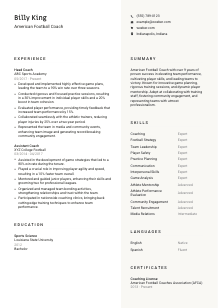
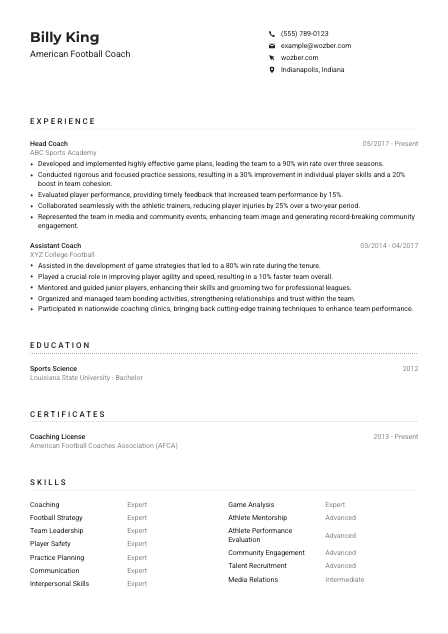
If the employer names a location requirement, reflect it clearly in your header. Here, listing Indianapolis, Indiana shows an immediate match to a stated condition rather than leaving the reader wondering about relocation. Use that tactic when location is part of the screening process, not as a default for every application.
If you have a website or profile that adds real coaching value, include it. A profile that shows program results, media appearances, coaching philosophy, clinics, or player development work can reinforce your resume, as long as it is current and consistent with the experience you list.
Your personal details should remove friction. At a glance, the employer should know who you are, what coaching role you do, how to contact you, and whether any practical requirement needs follow-up.




This is the section that carries the most weight for an American Football Coach. Schools and programs want more than a list of employers. They want to see competitive results, player development, practice leadership, staff collaboration, and the level of football environment where you have coached.
Before you rewrite bullets, study the job description for the coaching work that matters most. Here, the emphasis is on game plans, practice sessions, player evaluation, trainer collaboration, and public representation. Those priorities should shape which accomplishments move to the top and which details stay out.
List roles in reverse chronological order and make the scope of each job easy to understand. Head Coach, Assistant Coach, Coordinator, or position-specific roles each signal a different level of authority in planning, decision-making, and athlete management. That progression helps hiring teams place your experience at the right competitive level.
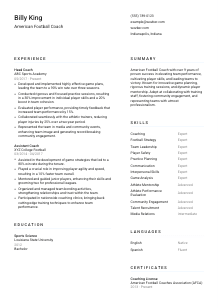
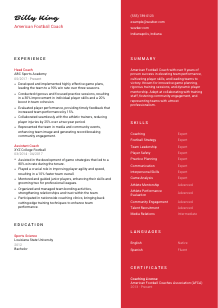
Each bullet should show what you led, improved, or influenced. For football coaching, that often means win rate, player skill gains, unit performance, team cohesion, lineup decisions, recruiting impact, or successful implementation of a scheme. In the sample resume, "Developed and implemented highly effective game plans, leading the team to a 90% win rate over three seasons" works because it ties strategic work to a clear competitive result.
Numbers make coaching performance more concrete when they reflect real program outcomes. Win percentage, improvement in player speed or agility, reduced injuries, advancement of athletes to higher levels, attendance growth, or community engagement are all stronger than vague claims about success. The example's 30% player-skill improvement and 25% injury reduction show both performance and player care, which is exactly the kind of range many programs want to see.
Cut anything that does not strengthen your case as a football coach. Hiring teams care far more about practice planning, film work, athlete development, game-day adjustments, staff coordination, and leadership under pressure than unrelated side duties. If an experience bullet does not help explain how you run a team or improve performance, replace it with one that does.
Your experience section should make it easy to picture you in charge of preparation, development, and performance. When your bullets connect football decisions to measurable outcomes, your coaching record becomes much easier to trust.
Education is rarely the headline for an experienced coach, but it still matters because many organizations use it as a baseline requirement. Present it clearly, and let it reinforce your foundation in sports science, physical education, athlete development, or a related field.
Start by checking the degree language in the posting. This opening asks for a bachelor's degree in Physical Education, Sports Science, or a related field, so your education section should make that match obvious if you have it.
List the degree, field of study, school, and graduation year. Keep it simple. For coaching resumes, this section should be quick to scan so the reader can confirm credentials and move back to your practical football experience.
When your degree directly supports coaching, do not bury the field of study. A Bachelor in Sports Science, like the one in the sample resume, reinforces knowledge of training, performance, conditioning, and athlete development in a way that fits the role naturally.
Extra detail can help early-career coaches, especially if it relates to biomechanics, kinesiology, strength and conditioning, leadership, or sports psychology. For candidates with 5+ years of college or professional coaching experience, those additions usually matter less than results on the field.
If you held roles or completed projects tied to coaching, athlete performance, or program leadership, you can mention them briefly. Keep the focus on details that support football coaching, not on filling space with unrelated campus activity.
This section should confirm that you meet the education requirement and support the technical side of your coaching background. Clear, direct entries are enough.
Certifications matter in coaching for two reasons. They show that you meet formal requirements, and they also reflect your responsibility for athlete welfare. In football, that second point carries real weight because player safety and emergency readiness are part of everyday program leadership.
Some football coaching jobs require a state credential, organizational license, or specific safety certification. This posting asks for a valid coaching certification or license if required, so include yours clearly when it applies rather than assuming the employer will infer it.
Prioritize certifications tied directly to coaching authority, player safety, and compliance. A coaching license belongs near the top, and CPR or First Aid certification is especially relevant in a sport where contact, injury response, and sideline readiness are part of the job.
List issue dates and renewal status when they help show that your credentials are active. That is especially useful for licenses and safety certifications. In the example, showing an ongoing AFCA coaching license immediately supports eligibility and professional standing.
Use this section to show that you stay current with the profession. Coaching clinics, updated certifications, and safety renewals reflect a coach who keeps learning about techniques, athlete care, and evolving best practices instead of relying only on past seasons.
A well-built certificates section reassures the employer that you meet formal standards and take player protection seriously. In football hiring, both matter.
A football coach's skills section should read like the core tools of the job, not a generic leadership checklist. Focus on the abilities that shape practices, game preparation, player decisions, staff coordination, and communication with athletes and the public.
Start with the job description, then translate it into skill categories that reflect how football programs actually operate. Here that includes football strategy, practice planning, player evaluation, team leadership, communication, mentorship, and collaboration with trainers around player health and rehabilitation.
Do not list only broad people skills. Football hiring also depends on tactical and operational ability. Pair terms like football strategy, game analysis, and practice planning with leadership, communication, and athlete mentorship. The sample resume handles this well by combining on-field expertise with team leadership and player safety.
A shorter, better-targeted list is usually stronger than a long inventory. Keep the skills that support the role's actual demands and drop anything too generic or too far removed from coaching impact. Every item should reinforce how you prepare teams, develop players, or manage performance.
Your skills list should sound like it belongs to a football coach who runs practices, studies opponents, develops athletes, and leads a staff. That level of specificity carries far more weight than general traits alone.
Language ability matters in coaching because instruction has to be understood quickly. Whether you are teaching technique, correcting assignments, speaking with families, or handling media responsibilities, communication is part of performance management, not a side detail.
If the posting specifies language ability, list it first. Here, strong English proficiency is required, so English should appear at the top of the section with an honest level such as Native or Fluent.
Additional languages can strengthen your resume when they help with player communication, recruiting, community outreach, or media interaction. Spanish, for example, may be worth listing if you can use it comfortably in real coaching or relationship-building situations.
There is no need to pad this section. Add languages that genuinely expand your ability to work with athletes, staff, or the wider community. If a language has no practical use in your target environment, it does not need to appear.
Use simple labels such as Native, Fluent, Advanced, or Intermediate. Coaching depends on trust and clarity, so this is not the place to exaggerate. Honest levels help employers understand whether you can instruct, converse, or represent the program effectively.
For some programs, multilingual ability supports recruiting pipelines, family communication, community events, or player support. Mention that advantage when it is real, but keep the section grounded in practical coaching use rather than treating languages as decoration.
List the languages you can actually use in a football environment and make English proficiency unmistakable when the posting asks for it. That is enough to make this section useful.
The summary should tell the reader what level of coach you are, what kind of football work you have led, and what results tend to follow your leadership. For this role, a vague leadership statement will not do much. A sharper summary points to strategy, player development, team performance, and program presence in just a few lines.
Read the posting first and decide which themes belong in the opening paragraph of your resume. For this role, the clearest themes are football strategy, training sessions, athlete development, leadership, and collaboration around player health and public representation.
Start with your title, years of experience, and level of competition. "American Football Coach with 9+ years of experience at the college level" tells the reader far more than a generic statement about passion or dedication. If you have worked across college and professional settings, say so.
Use one or two concrete strengths that connect to outcomes. The sample summary works because it references team performance, player skill development, game planning, and mentorship rather than relying on broad leadership language alone. That gives the reader a quick picture of how you coach and what improves under your direction.
Aim for 3 to 5 lines with no filler. This is a quick read at the top of the page, so every phrase should pull its weight. If a line does not clarify your coaching level, football strengths, or measurable impact, cut it.
Your summary should make a hiring team expect a disciplined, experienced football coach with a clear record in strategy, player development, and team leadership. If those points are visible in a few lines, the rest of the resume has a strong opening.
A polished American Football Coach resume should show how you prepare teams, improve players, manage risk, and lead under competitive pressure. When you tailor each section to the posting, the hiring team can quickly see your coaching level, your football expertise, and the results you have produced.
Wozber's free resume builder helps turn that experience into a clean ATS-friendly resume format, and its ATS resume scanner can help you align your wording with the role's actual requirements. The finished resume should make one thing easy to judge: you can step into the program and coach with authority from day one.