



Use Wozber and land your dream job
Create Resume
No registration required
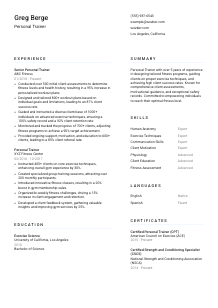
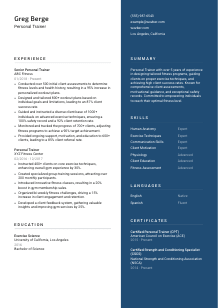
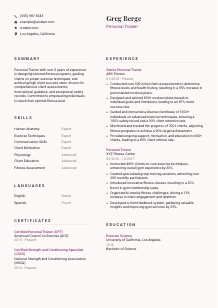
Sculpting killer abs, but your resume feels out of shape? Check out this Personal Trainer resume example, created with Wozber free resume builder. Learn how to show off your fitness skills in line with job requirements, so your career gains are as solid as your bicep peaks!
Personal training work is judged in the gym, not on paper, yet hiring teams still need a resume that proves how you coach safely, individualize programs, and keep clients progressing. Generic fitness language falls flat here. Employers want to see how you assess movement and health history, adjust plans around limitations, and turn client goals into measurable outcomes such as retention, adherence, referrals, or target achievement.
A tailored resume changes the first read from
Personal training starts with trust and clear communication, and your header should reflect that same professionalism. This section is simple, but it still needs to match the role closely, especially when the employer has a location requirement or wants an immediately recognizable title.
Use your full name as the clearest line at the top of the page. Keep the formatting clean and readable, the same way you would present instructions to a client during an assessment or exercise demo.
Place "Personal Trainer" directly under your name if that is the role you are applying for. This helps frame the rest of the resume around coaching, assessments, program design, and client progress rather than around a broader fitness background.
List a phone number and email address you check regularly. Missed calls and outdated contact details can stall an interview quickly, especially in fitness hiring where schedules move fast and employers may be filling client-facing slots on short notice.
If a role requires you to be based in a specific area, state your city and state clearly. In this example, Los Angeles, California belongs in the header because the employer asks for local availability. That is a tailoring move, not a rule for every personal trainer resume.
A LinkedIn profile, training site, or professional portfolio can help if it shows certifications, specialties, client education content, or gym experience that matches your resume. Make sure the information, dates, and branding line up with what you submit.
Your personal details should make it easy to contact you and immediately place you in the right lane as a personal trainer. Keep the section clean, current, and aligned with any stated location or title requirements.




This is where a personal trainer resume earns attention. Hiring managers look for proof that you can assess clients, build programs around real limitations, teach technique correctly, and keep people engaged long enough to see results.
Review the posting and pull forward the positions that best reflect one-on-one coaching, fitness assessments, workout programming, progress tracking, and client education. If you have worked across gyms, studios, wellness settings, or sports performance environments, lead with the experience closest to the training model in the job ad.
List your positions in reverse chronological order with job title, employer name, and dates. In fitness hiring, clear chronology helps employers understand your training volume, the level of clients you have worked with, and how your coaching responsibilities have grown over time.
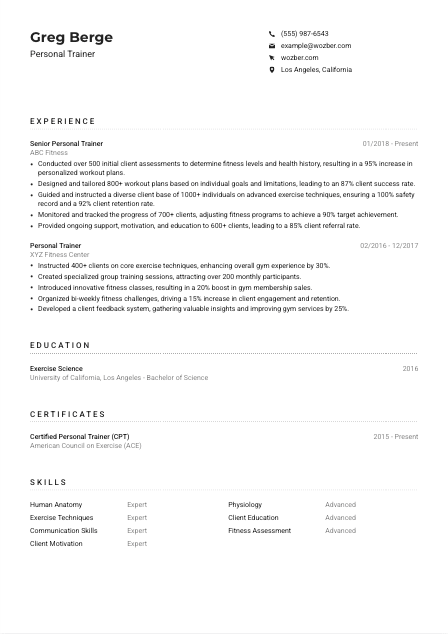
Focus each bullet on work that matters in personal training: conducting consultations, building individualized plans, cueing exercise form, modifying sessions, improving adherence, or educating clients on sustainable habits. The sample resume does this well by showing assessments, tailored programs, technique instruction, progress monitoring, and ongoing client support instead of generic gym duties.
Quantify your work with metrics that belong in this profession. Useful examples include number of client assessments completed, program volume, retention rate, referral rate, target achievement, class participation, or safety record. Figures like 500 assessments, 800+ workout plans, or a 92% retention rate give hiring teams a clearer picture of your scale and effectiveness than vague statements ever could.
Every bullet should strengthen your case for the job you want. Remove lines that focus on unrelated admin work unless it directly supports scheduling, member engagement, or service growth in a way that matters to the role. Keep the section centered on coaching quality, client outcomes, and the kind of environment you can handle.
A personal trainer's experience section should read like a record of assessments completed, programs delivered, clients retained, and progress achieved. When the bullets stay tied to coaching practice and measurable outcomes, your value is much easier to understand.
For personal trainers, education often backs up the technical side of the work. A degree in exercise science, kinesiology, or a related field tells employers you understand anatomy, physiology, movement principles, and training methodology beyond basic gym instruction.
If the job asks for a bachelor's degree in Exercise Science, Kinesiology, or a related field, make sure that information is easy to find. In the example resume, a Bachelor of Science in Exercise Science directly matches the requirement and should be listed clearly without extra wording.
Include your degree, school, field of study, and graduation year or date. Keep the layout easy to scan so the employer can quickly confirm that you meet the academic requirement.
Your field matters when the role emphasizes human anatomy, physiology, and exercise technique. Spell out a relevant major rather than relying on abbreviations alone, especially when the degree directly supports program design and safe coaching practice.
Most experienced trainers will not need a long course list, but it can help early-career candidates. Include modules such as biomechanics, exercise physiology, nutrition, or motor learning if they strengthen your case for assessment-based coaching or specialized populations.
Honors, research, athletic involvement, or university fitness leadership can add value if they connect to training practice. Keep it brief and relevant. The point is to reinforce your foundation in movement science, not to overload the section.
This section should quickly confirm that you have the academic background to coach responsibly and understand the science behind programming. Keep it concise, relevant, and easy to verify.
Certifications carry real weight in personal training because they show current professional standards, practical knowledge, and commitment to safe instruction. When a CPT is required, this section should answer that requirement immediately.
If the posting calls for a Certified Personal Trainer designation from a recognized institution, place that credential first. Name the certification fully and include the issuing organization, such as ACE, NASM, NSCA, or another recognized body when applicable.
Add certifications that support the kind of coaching you provide, such as strength and conditioning, corrective exercise, nutrition coaching, or special population training. Prioritize credentials that strengthen your ability to assess clients, design programs, and instruct safely.
Fitness certifications often require renewal, so dates matter. Show when the certification was earned and, if relevant, that it remains current. That helps employers confirm you are maintaining professional standards.
Ongoing education matters in a field where training methods, recovery guidance, and client needs keep evolving. If you have recent coursework or added credentials, include the ones that sharpen your current coaching profile rather than listing everything you have ever taken.
For a personal trainer, certifications are more than extra credentials. They tell employers you meet baseline professional requirements and continue to invest in safe, effective coaching.
A useful skills section does not read like a fitness buzzword list. It should highlight the technical knowledge and client-facing abilities that matter in day-to-day coaching, from anatomy and exercise instruction to motivation and communication.
Start with the language in the job description. For this role, that includes human anatomy, physiology, exercise techniques, communication, client motivation, and personalized program design. Mirroring the employer's wording helps your resume stay aligned for both human review and ATS screening.
Personal training requires both. Technical skills show you can assess movement and build safe, effective plans. Interpersonal skills show you can coach adherence, explain form clearly, and keep clients engaged through setbacks and plateaus.
Choose skills that are reinforced by your experience, education, or certifications. In the example, items like Human Anatomy, Exercise Techniques, Fitness Assessment, Communication Skills, and Client Motivation all connect back to the actual work described in the experience section, which makes the list more credible.
When this section is tailored well, it quickly tells an employer whether you have the technical base and coaching presence to work with clients safely, effectively, and consistently.
Language skills can matter more in personal training than candidates sometimes expect. Clear instruction, motivational coaching, health history discussions, and exercise cueing all depend on communication that clients understand in the moment.
If the role specifies strong English skills, make that visible in this section. A level such as Native or Fluent works well when it accurately reflects your ability to explain technique, discuss limitations, and build trust during consultations.
Additional languages can be valuable in gyms, private studios, community wellness settings, and diverse metro areas. They are especially useful when your client base may include people who are more comfortable discussing goals, injuries, or exercise instructions in another language.
Choose clear levels such as Native, Fluent, Intermediate, or Basic. Overstating ability can become a problem quickly in a client session where safety cues and health information need to be communicated precisely.
Some markets make certain language skills more useful than others. In a city like Los Angeles, Spanish can strengthen rapport with a wider range of clients, but that is an example of local tailoring rather than a standard requirement for every personal trainer role.
List languages when they improve your ability to coach, educate, and retain clients. In this profession, communication is part of service delivery, not just a nice extra.
A well-chosen language section can reinforce your ability to instruct clearly and connect with diverse clients. Keep it factual and tied to the environments where you work.
Your summary should quickly tell the employer what kind of trainer you are, how much experience you bring, and what outcomes tend to follow your coaching. This is one of the best places to connect your background to the exact demands of the role.
Start with your title, years of experience, and the kind of training work you do best. For example, you might position yourself around individualized programming, client assessments, strength coaching, corrective exercise, or behavior-focused fitness support depending on your background.
Weave in the qualifications that the job emphasizes, such as assessment-based coaching, knowledge of anatomy and physiology, exercise technique instruction, and strong client communication. This gives the reader an immediate match between your profile and the role.
Aim for a short paragraph that covers your experience, core strengths, and one or two outcome indicators. The sample summary works because it mentions tailored fitness programs, proper exercise guidance, client success rates, and safety rather than broad statements about passion for wellness.
Use wording that reflects how you work with clients. Motivation, education, accountability, and safe progression all belong here when they are part of your actual practice. Keep the language grounded in how you coach, not in generic enthusiasm.
A strong summary gives a hiring manager a fast read on your coaching background, technical knowledge, and client results. Keep it brief, role-specific, and aligned with the kind of training work you want next.
A personal trainer resume should show more than interest in fitness. It should show how you assess clients, prescribe training responsibly, teach form, track progress, and keep people moving toward their goals. When each section is tailored to that work, employers can quickly see whether you are ready for their floor, studio, or client roster.
Use Wozber's free resume builder to organize your experience into an ATS-friendly resume format, then refine the language with its ATS resume scanner and AI tools so your qualifications line up naturally with the posting. The finished resume should make one thing clear right away: you know how to coach clients safely and help them get results.




