



Use Wozber and land your dream job
Create Resume
No registration required
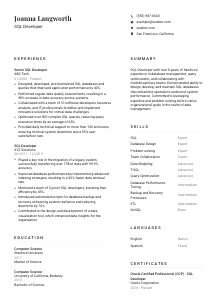
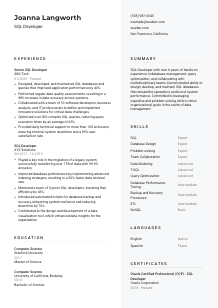
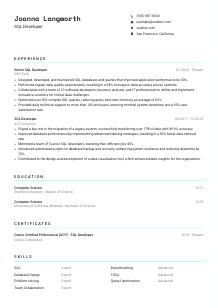
Writing queries, but your resume isn't returning results? Check out this SQL Developer resume example, created with Wozber free resume builder. It shows how to present your code-savvy career to match job criteria, ensuring your professional journey has the perfect join with the right opportunity!
SQL Developer hiring usually turns on practical database work, not broad software claims. Teams want to see whether you can write reliable queries, shape data models that support real applications, improve query performance, and keep data quality under control when systems start to scale. Your resume should make that operating range visible quickly.
When the resume mirrors the language of the posting, database-focused work is easier to sort from general development experience, especially in an ATS-compliant resume. Wozber's free resume builder helps you line up SQL keywords, data management terminology, and readable structure so hiring teams can immediately see where you've handled optimization, data integrity, and cross-functional support.
For SQL Developer roles, the header does a simple but important job. It tells the employer who you are, how to reach you, and whether obvious screening points like location and role alignment are already covered.
Use your full name in the largest text on the page so it is easy to find in both a quick recruiter review and an exported ATS record. Keep the styling clean and professional, the same way you would keep a production database object clearly named and easy to reference.
Place the exact role title under your name when it accurately reflects your background. If you are applying for an SQL Developer job, use "SQL Developer" rather than a broad alternative like "Software Engineer" or "Data Specialist." That small adjustment helps ATS matching and tells the reader your experience is centered on database development.
Include a current phone number and a professional email address. If you also share a LinkedIn profile or portfolio site, make sure it supports the story your resume tells, whether that is database projects, reporting work, ETL pipelines, or optimization work across business systems.
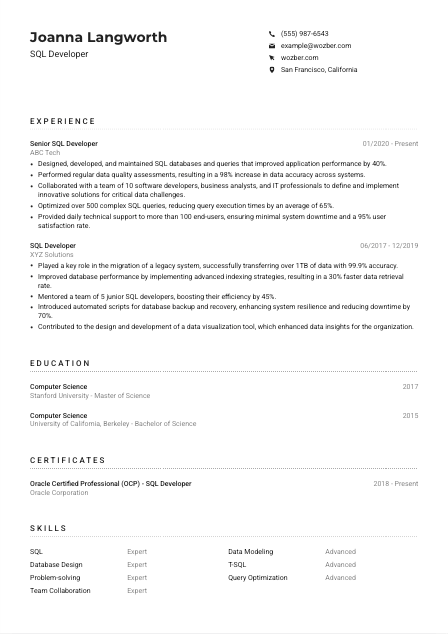
Some SQL Developer postings screen early for where you can work from. In the example here, listing "San Francisco, California" answers that requirement immediately. If a posting mentions on-site work, hybrid expectations, or relocation, include the city and state when it helps remove doubt.
A useful link might point to a polished LinkedIn profile, a GitHub repository with stored procedures or data scripts, or a project page showing reporting or migration work. Skip anything sparse or outdated. For this profession, outside links should reinforce your command of SQL environments, not distract from it.
This section should answer the basic screening questions without friction. When your title, contact details, and location are aligned from the start, the reader can move straight to the database work that matters most.




Experience is where SQL Developer resumes usually win or lose attention. Hiring teams look for the kind of work you handled in live environments: query development, database design, performance tuning, data quality fixes, migration support, backup processes, and collaboration with engineers or business teams who depend on accurate data.
Before editing your bullets, isolate the work the job emphasizes. In this posting, that includes SQL development, database management, data modeling, performance tuning, backup and recovery, data cleansing, and collaboration with software developers and analysts. Those should shape which achievements you lead with and which details you cut.
List roles in reverse chronological order with job title, company, and dates clearly separated. That format helps both recruiters and ATS systems follow your progression from junior database work to more complex ownership, whether that includes production support, schema design, tuning large query sets, or leading migration efforts.
Write bullets around what changed because of your work. SQL Developer hiring responds well to specifics such as faster query execution, higher data accuracy, better application responsiveness, lower downtime, smoother migrations, or stronger recovery processes. The example resume does this well with achievements like optimizing more than 500 complex SQL queries and improving execution time by 65%.
Numbers matter here because database work is often measured through speed, accuracy, scale, and system stability. Use metrics tied to your real scope, such as percentage improvements in performance, data volumes migrated, reduction in downtime, user counts supported, or accuracy gains after data cleansing. A line like "improved application performance by 40%" is far more convincing than saying you "enhanced efficiency."
Trim bullets that do not strengthen your case for database development. Prioritize accomplishments tied to SQL, T-SQL, stored procedures, indexing, data modeling, query optimization, ETL support, reporting logic, backup automation, or cross-team troubleshooting. If you worked on a broader software project, emphasize the data layer contribution rather than describing the whole product.
A hiring manager should be able to see what systems you supported, what database problems you solved, and what improved after your changes. When your experience section reads like production work rather than task lists, your SQL credibility becomes much easier to trust.
Education is usually a verification section for SQL Developer roles, but it still matters. Employers often want to confirm that you have the academic grounding for database design, systems thinking, and structured problem-solving, especially when the posting asks for a degree in Computer Science, Information Systems, or a related field.
If the posting calls for a bachelor's degree in Computer Science, Information Systems, or a related discipline, make that easy to find. In the example, both the bachelor's and master's degrees in Computer Science support the requirement well. Put the most relevant degree information in a standard format so it is visible in seconds.
List the degree, school, field of study, and graduation year or date. This is not the place for long descriptions unless you are early in your career. Clean structure helps the employer confirm educational qualifications quickly while keeping attention on your database experience.
If your degree title is adjacent rather than exact, clarify the relevance through the field name or coursework. Subjects like database systems, data structures, information systems, software engineering, and data modeling are useful context when your academic path is not labeled exactly as the posting states.
Add relevant coursework only when it strengthens your case. This is especially helpful for junior candidates, career changers, or applicants whose professional history is still thin. Courses in database design, SQL programming, distributed systems, or data warehousing can help connect your education to the daily work of the role.
Short courses, university extensions, or structured learning in areas like performance tuning, cloud databases, ETL, or administration can support your candidacy, especially if the target job expects broader database ownership. Keep these additions relevant to production data work, not general tech topics.
This section does not need flair. It needs accuracy and relevance. Once your degree alignment is clear, the employer can spend more time on the part that usually drives the decision: how you work with databases in practice.
Certifications are not required in every SQL Developer search, but the right ones can reinforce depth in a crowded candidate pool. They are especially useful when they point to hands-on database knowledge, platform familiarity, or continued growth in optimization, modeling, and administration.
Choose credentials that support the work named in the posting. For SQL Developer roles, that usually means SQL, database development, database administration, cloud database platforms, or data engineering tools. The Oracle Certified Professional credential in the example is a strong match because it directly supports SQL-focused expertise.
A short list of targeted certifications is better than a long list of unrelated training. Prioritize credentials tied to query writing, schema design, performance tuning, backup and recovery, or platform-specific database work over broad certificates that do little to strengthen your technical profile.
Certification dates help the reader understand how current your knowledge is, especially in tools or platforms that evolve over time. If the credential remains active, say so clearly. That is particularly helpful for certifications tied to vendor ecosystems or versioned technologies.
SQL Developer roles often expand into data pipelines, cloud environments, reporting platforms, or resilience planning. If your certifications reflect that wider range, they can support seniority. Keep the connection practical by choosing learning that improves your ability to build, maintain, and optimize data systems.
Relevant credentials can strengthen your technical profile, especially when they align with the database platforms or performance work in the job description. They work best as confirmation of expertise that your experience section has already demonstrated.
The skills section should read like the toolkit behind your database results. For SQL Developer roles, that means balancing core technical abilities with the practical collaboration skills needed to work with developers, analysts, IT teams, and end-users who rely on accurate and responsive data.
Pull the exact capabilities the posting asks for, then match them against your real experience. Here, the essentials include SQL, data modeling, database design, performance tuning, optimization, backup and recovery, problem-solving, and collaboration. Those belong near the top if they are genuinely part of your work.
Every major skill should connect to a project, system, or result elsewhere on the resume. If you list query optimization, the experience section should show reduced execution times. If you list database design or data quality assessment, include bullets that show schemas built, integrity issues fixed, or reporting accuracy improved.
Group your strongest and most relevant abilities first instead of trying to inventory every tool you have touched. A concise list that includes SQL, T-SQL, database design, data modeling, query optimization, ETL, backup and recovery, and performance tuning is easier to trust than a bloated list with weak relevance. The example resume gets this mostly right by leading with SQL and database design before broader extras like NoSQL.
This section should confirm that you already work with the database concepts and processes the employer needs. Keep it specific, keep it honest, and make sure the strongest skills connect directly to the outcomes described in your experience.
Language requirements are usually straightforward for SQL Developer roles, but they still affect hiring. Clear communication matters when you are translating business questions into queries, explaining performance issues, documenting data fixes, or supporting users who depend on accurate reporting.
If the posting says you must operate in an English-speaking environment, list English clearly and give an honest proficiency level. This matters because SQL Developers often work across technical and non-technical teams, where requirements gathering and issue resolution depend on precise communication.
Put the required language first, then add others by proficiency. In the example, English appears before Spanish, which makes sense because English is the working requirement. That ordering keeps the section aligned with the job while still showing broader communication range.
Extra languages can be useful in multinational teams, vendor coordination, user support, or documentation contexts. They are rarely a deciding factor for a pure SQL role, but they can help if the work involves distributed stakeholders or business users across regions.
Stick to familiar levels such as Native, Fluent, Intermediate, or Basic. Vague wording makes this section harder to interpret. A straightforward scale gives recruiters and hiring managers a realistic sense of how you will communicate in meetings, support tickets, and written documentation.
For most SQL Developer applications, languages should support the rest of the resume rather than compete with your technical profile. Include them cleanly, satisfy the stated requirement, and let your database work remain the main focus.
Once the required language is visible and additional languages are presented clearly, this section has done its job. It supports your candidacy without pulling attention away from the SQL, optimization, and data management work that defines the role.
The summary is your opening snapshot. For an SQL Developer, it should quickly establish years of experience, the kind of database work you handle, and the business or system impact of that work. This is where you frame your profile before the reader reaches the detail below.
Before writing the summary, review the posting and identify the few priorities that deserve top billing. In this case, those include SQL development, database management, data modeling, performance tuning, data quality work, and collaboration with technical stakeholders. Use those themes to decide what belongs in your opening lines.
Start with your title and years of experience, then define your main area of work. A useful summary might establish that you are an SQL Developer with 6+ years of experience in database design, query optimization, and production data support. That gives the reader immediate context without wasting space.
Choose highlights that match the job's priorities and are supported elsewhere in the resume. Strong examples include improving system performance, raising data accuracy, handling large migrations, automating backup and recovery, or supporting cross-functional teams. The sample summary works because it combines years of experience with database management and measurable operational value.
Aim for three to five sentences. Skip generic claims about being passionate, dynamic, or results-driven unless they are tied to actual database outcomes. A concise summary with role-specific language will do more for ATS optimization and human review than a paragraph full of broad software clichés.
A clear summary helps the employer read the rest of your resume through the right lens. By the time they reach your experience, they should already understand your level, your database focus, and the kind of SQL work you are ready to own.
Once each section reflects real SQL work, your resume becomes much easier to evaluate for the demands of the role: query performance, database design, data quality, reliability, and collaboration across technical teams.
Use Wozber's AI resume builder and ATS resume scanner to align your wording with the posting, strengthen missing keywords naturally, and deliver an ATS-friendly resume format that keeps your database experience easy to read. The final result should make one thing clear fast: you can build, optimize, and support the data layer the team depends on.




