



Use Wozber and land your dream job
Create Resume
No registration required
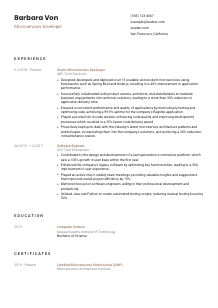
Weaving complex services, but your resume feels microscopic? Check out this Microservices Developer resume example, created with Wozber free resume builder. It shows how to align your distributed design skills with job requirements, and take career strides that rival the agility of your microservices!
Microservices work gets judged in production, where service boundaries, resilience, latency, and deployment reliability matter every day. That reality should shape your resume. Hiring teams want to see whether you have actually built and improved distributed systems, not just touched backend code. Your resume needs to make architecture decisions, service ownership, and performance outcomes easy to spot.
Screening for this kind of role often starts with one practical question: can this candidate build services that hold up under real load and fit into a modern cloud stack? Wozber's free resume builder helps you tailor that story into an ATS-compliant resume with the right terminology, structure, and priorities, so cloud platforms, frameworks, testing discipline, and collaboration with product and architecture teams come through clearly.
For engineering roles, the personal details section is mostly functional, but small mismatches here can create avoidable friction. Keep it clean, accurate, and aligned with the posting so the hiring team can move quickly from your header to your technical background.
Use your full name in a slightly larger font than the rest of the header. This is basic, but important. In technical hiring, recruiters and engineering managers often scan dozens of resumes in sequence, and a clear header keeps your application easy to reference during reviews, interview scheduling, and scorecard discussions.
Place
List a reliable phone number and a professional email address. Engineering hiring moves quickly once a team sees the right stack and project background, so broken contact details can stall momentum for no good reason. Skip casual email handles and make sure every link you include actually works.
When a posting names a location requirement, reflect it clearly in your header. Here, San Francisco, California is specifically requested, so including city and state helps remove a basic screening question early. For other Microservices Developer roles, do this according to the posting, especially when onsite, hybrid, or regional eligibility affects the hiring process.
A LinkedIn profile, GitHub account, or personal site can strengthen your application when it shows service design work, APIs, cloud deployments, technical write-ups, or code samples. Keep it relevant. If the link leads to outdated projects or generic placeholders, leave it off. Any online presence should reinforce the same stack and level of ownership shown in your resume.
This section does not need personality statements or extra detail. It needs accuracy, role alignment, and any required location information, so the reader can move straight into your experience with no distractions.




This is the section most likely to decide whether you move forward. For Microservices Developer roles, employers look for proof that you can design services, ship them, improve them, and work effectively with the people around the architecture, from product owners to platform teams.
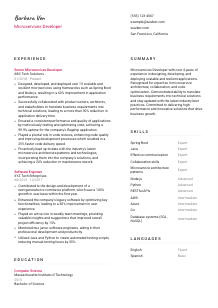
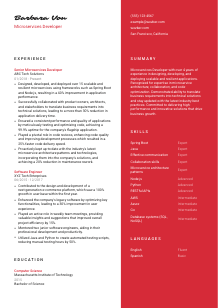
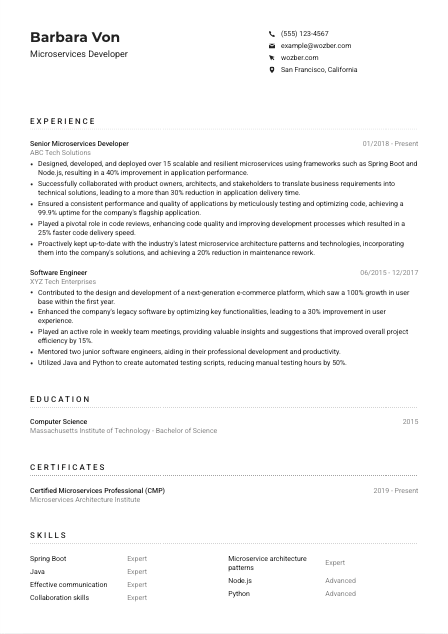
Prioritize roles and bullets that show actual work in service decomposition, API design, cloud deployment, resilience, testing, and performance tuning. If you have experience with Spring Boot, Node.js, Java, Python, Go, AWS, or Azure, bring those details into the first few bullets where they are easiest to find. In the example resume, the strongest opening bullet works because it combines architecture scope, frameworks, and outcome: 15+ microservices built with Spring Boot and Node.js, tied to a 40% performance improvement.
List your most recent role first, then work backward. For technical candidates, this helps reviewers understand your current stack, your latest level of ownership, and whether you have moved from implementation into design and review responsibilities. A progression from Software Engineer to Senior Microservices Developer, for example, says more when the bullets show broader architecture responsibility, stronger delivery outcomes, and deeper collaboration across teams.
Numbers matter when they reflect how backend systems are actually evaluated. Include metrics such as performance gains, uptime, deployment speed, reduction in delivery time, defect reduction, service count, or maintenance savings. The sample resume uses this well with outcomes like 99.9% uptime, 25% faster code delivery, and a 30% reduction in application delivery time. Those are the kinds of measures that make architecture and coding work feel concrete.
Replace broad statements like
Microservices roles often involve constant refinement: tightening service boundaries, improving observability, reducing latency, updating patterns, and making deployments easier to manage. Include bullets that show this kind of iteration. The example's note about adopting newer microservice patterns and cutting maintenance rework by 20% is effective because it shows technical judgment, not just task completion.
Your experience section should read like someone who has shipped and supported real services. Focus on architecture decisions, measurable outcomes, cloud and framework context, and the way your work improved system behavior or delivery performance.
Education usually will not carry the application on its own for a Microservices Developer, but it can quickly confirm that you meet the formal requirement. Present it clearly and let it support the technical story built in your experience section.
If the role asks for a Bachelor's degree in Computer Science, Engineering, or a related field, list that information plainly. The sample resume does this well with a Bachelor of Science in Computer Science, which directly satisfies the requirement. There is no need to over-explain it when the match is already clear.
Use a consistent structure: degree, field, school, graduation year. Recruiters and hiring managers should be able to confirm your academic background in seconds. Technical resumes work best when the structure stays predictable, especially when ATS parsing is involved.
Most experienced developers do not need a long coursework list. Add it only when it supports the target role, such as distributed systems, cloud computing, operating systems, networking, databases, or software architecture. This matters more for early-career candidates or when your experience section is still light on microservices work.
Honors, hackathons, research, or engineering competitions can help when they reinforce backend or systems-oriented strengths. A distributed systems project, cloud-native capstone, or API-intensive internship is more relevant here than unrelated campus activities. Keep the emphasis on work that points toward service design, problem solving, and software delivery.
Microservices architecture changes faster than most degree programs do. If your most relevant learning comes from cloud training, internal architecture initiatives, or newer tooling, surface that in certifications or experience rather than forcing it into education. Use this section for the academic baseline and let newer technical growth appear where it has the most weight.
Keep this section concise and credible. Once the degree requirement is covered, your resume should return quickly to the frameworks, cloud platforms, engineering outcomes, and service ownership that define current Microservices Developer hiring.
Certifications are not always required for microservices roles, but they can strengthen your profile when they reinforce architecture knowledge, cloud capability, or continued growth in distributed systems work. The key is relevance, not volume.
List certifications that support the work named in the posting, such as microservices architecture, AWS, Azure, containerization, or backend platform engineering. In the example resume, Certified Microservices Professional is a useful addition because it backs up the candidate's experience with a credential in the same area.
A short, relevant certification list is stronger than a long list of generic course completions. Remove certificates that do not relate to backend engineering, distributed systems, cloud services, API development, or software quality. Hiring teams care more about whether the credential reinforces your technical profile than how many logos you can display.
For certifications with expiration windows, renewal cycles, or version relevance, include dates so the reader can see the credential is active. This is especially useful for cloud certifications, where platform services and best practices evolve quickly.
When your certificate list reflects recent learning, it helps position you as someone who keeps up with service patterns, platform changes, and architecture practices. That matters in microservices environments where deployment models, observability standards, and resilience patterns do not stand still.
A focused certifications section can strengthen your backend profile, especially when it supports cloud-native development or microservices architecture. Keep it current, technical, and clearly connected to the work you want to do next.
For Microservices Developer roles, the skills section should confirm the stack quickly and support what your experience already proves. It also needs to show that you can work across architecture, coding, testing, and team collaboration without turning into a long keyword dump.
Pull the main technical requirements from the job description and make sure they appear naturally in your skills list if you truly use them. Here, that includes frameworks such as Spring Boot and Node.js, languages like Java, Python, or Go, and cloud platforms such as AWS or Azure. This helps both ATS matching and human review, especially when the same tools appear in your experience bullets.
Microservices hiring goes beyond language names. Add skills that reflect how you build and maintain services, such as RESTful APIs, microservice architecture patterns, testing, scalability, resilience, code review, CI/CD, or SQL and NoSQL data work if those are part of your background. The sample resume is on the right track with microservice architecture patterns and RESTful APIs because they connect the stack to the way the work is done.
Cross-functional work is part of the job, so communication and collaboration belong here when they are backed by experience. If you mention them, make sure your work history also shows interaction with product owners, architects, stakeholders, or peer review processes. Soft skills carry more weight when the rest of the resume demonstrates where they were used.
This section should reinforce your case, not introduce a different one. Keep the list aligned with the posting, the systems you have actually worked on, and the way microservices teams build, test, review, and ship software.
Language skills matter in technical roles when they affect documentation, stakeholder communication, sprint rituals, and cross-team coordination. For this opening, English is explicitly required, so treat it as a real qualification rather than a minor extra.
If the role asks for clear English communication, list English prominently and specify your level honestly. For a Microservices Developer, this supports more than conversation. It affects architecture discussions, code review comments, incident follow-ups, and collaboration with product or platform teams.
Additional languages can be worth listing if you can use them in professional settings or if they may help in a global engineering environment. In the example resume, Spanish is a useful secondary detail, but it stays secondary because it is not central to the role requirements.
Use clear labels such as Fluent, Professional Working, Conversational, or Basic. Avoid overstating your level. In collaborative development work, inaccurate language claims can create friction in meetings, documentation handoffs, and stakeholder communication just as quickly as overstated technical skills can.
Some engineering teams work across time zones, vendors, or international customer groups. If additional languages help with support coordination, implementation work, or cross-border teamwork, they can add value. If not, keep the section brief and factual.
For developers, communication skills show up in design docs, backlog clarification, production issue updates, and collaboration across functions. Listing language proficiency makes sense when it supports those day-to-day realities. Keep the section grounded in how software teams actually work.
For this role, English belongs near the top because it directly affects collaboration and execution. Any additional language should be included only if it adds credible value to the way you work with teams, stakeholders, or users.
Your summary should give a fast, accurate read on your level, technical focus, and the kind of systems work you handle well. For a Microservices Developer, that means leading with architecture and delivery, then backing it up with a few well-chosen outcomes or strengths.
Start with a direct line that names your specialty and level of experience. The sample summary does this effectively by stating more than 4 years of experience designing, developing, and deploying scalable and resilient applications. That immediately places the candidate in backend, service-oriented work rather than general software development.
Use specific accomplishments that match the target role, such as building a certain number of microservices, improving performance, reducing delivery time, or supporting high uptime. Keep these examples short, but meaningful. A summary gains credibility fast when it includes production-facing outcomes instead of broad claims about innovation or passion.
If the posting emphasizes cross-functional communication, include that in a way that connects to delivery. Phrases about translating business requirements into technical solutions or working with product owners and architects are stronger than generic statements about being a team player because they show where collaboration happens in the development cycle.
Before you apply, adjust the summary to reflect the employer's priorities. If the role leans heavily toward Spring Boot and AWS, surface that. If it emphasizes Node.js services or cloud-native deployment, make room for those terms. Wozber's AI resume builder is useful here because it can help align your wording with the job description, strengthen ATS optimization, and keep the summary tightly focused on the stack and responsibilities that matter most.
A good summary should tell the reader, in a few lines, what kind of distributed systems work you do, what results you deliver, and how you operate with the people around the architecture. If that is clear, the rest of the resume has a strong opening to build on.
A Microservices Developer resume should make one thing obvious fast: you can design, build, deploy, and improve services that perform well in production. When your experience, skills, summary, and supporting sections all reinforce that story, the hiring team can see both your technical range and your execution level.
Use Wozber to turn that experience into a polished, ATS-friendly resume format with sharper tailoring, stronger keyword alignment, and cleaner section structure. The final document should make it easy to judge your cloud stack, framework depth, reliability mindset, and ability to work across product, architecture, and engineering teams.