



Use Wozber and land your dream job
Create Resume
No registration required
Coding contract conventions, but your resume feels like beta testing? Check out this Freelance Software Developer resume example, built with Wozber free resume builder. Learn how to connect your project prowess to job requirements, coding your career path to success!
Freelance software development is evaluated through shipped work. Clients and hiring managers want to see that you can take a requirement, turn it into stable code, troubleshoot when things break, and keep delivery moving without heavy oversight. Your resume needs to make that practical range visible, from implementation and debugging to documentation, code review, and collaboration with designers or project leads.
A tailored resume helps separate general coding experience from freelance-ready delivery. When your project history uses the same language the job uses, such as deployment, documentation, code quality, and collaboration, it is easier for both an ATS and a hiring team to understand where you can contribute fast. Wozber's free resume builder helps you shape that alignment into an ATS-compliant resume, so your experience reads clearly as client-facing software work rather than a loose list of technical tasks.
This section is brief, but it still does hiring work. For freelance software roles, it should confirm who you are, how to reach you quickly, and whether you meet any practical requirement that could affect availability or eligibility before a reviewer even gets to your code experience.
Use your full name as the clearest visual element at the top of the page. Keep it simple and professional. In a field where portfolios, GitHub links, and project stacks can add visual noise, your name should anchor the page immediately.
Place "Freelance Software Developer" directly under your name when that is the role you are pursuing. Matching the title helps position you correctly for contract and freelance work, especially when recruiters are filtering across software engineer, developer, and consultant profiles.
List a phone number and professional email address you actually monitor. Freelance hiring often moves quickly, and missed outreach can cost you a project. Keep the email clean and businesslike, and double-check for formatting errors before sending the resume.
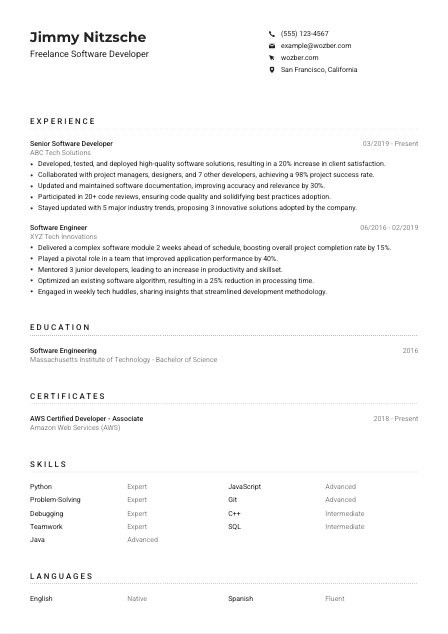
Some freelance roles are remote in practice but still restricted by city, state, or timezone. Here, San Francisco, California is a stated requirement, so showing that location in your header removes an avoidable screening question right away. Only treat location this prominently when the posting makes it relevant.
Add a portfolio site, GitHub, or professional website if it shows production code, shipped projects, technical writing, or client work. A link is especially useful for freelance developers because it gives context beyond job titles and lets reviewers see frameworks, code quality, or product outcomes in more depth.
Your personal details should answer the first operational questions fast: who you are, how to contact you, and whether you meet any immediate requirement such as location. Then the rest of the resume can focus on your software delivery record.




This is the section that carries the most weight for a freelance software developer. Employers are looking for proof that you can build, test, deploy, maintain, and improve software in real environments, while working effectively with product, design, or client stakeholders.
Read the posting for action words and delivery expectations, then mirror them where they accurately reflect your background. In this case, "develop, test, and deploy," "maintain documentation," and "participate in code reviews" are all useful anchors. That language works well because it describes actual software workflows, not vague enthusiasm.
List positions in reverse chronological order with company name, title, and dates. For freelance or contract-heavy careers, make the scope legible. If a role involved backend services, performance tuning, client applications, or team-based delivery, make that visible in the bullets rather than burying it in generic wording.
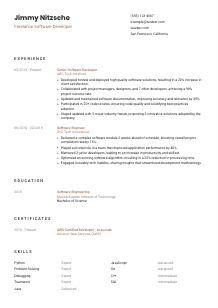
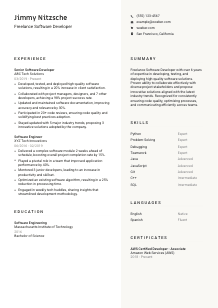
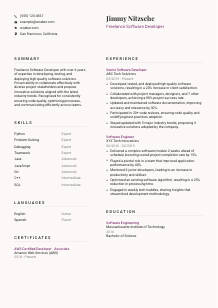
Each bullet should show what you built or improved, how you worked, and what changed because of it. Good software bullets mention releases, performance gains, reduced processing time, adoption of best practices, or delivery speed. The sample resume does this well with results like a 40% performance improvement and a 25% reduction in processing time, which immediately tell a reviewer what kind of technical impact the candidate had.
Choose metrics that make sense for development work: application performance, defect reduction, delivery time, client satisfaction, uptime, code review volume, release success, or documentation accuracy. A line like "participated in 20+ code reviews" works because it connects directly to engineering quality practices, while "98% project success rate" points to dependable execution across stakeholders.
Freelance software resumes benefit from focus. Remove bullets that only describe routine participation unless they reveal technical scope, team contribution, or measurable results. Keep the section tight enough that a reviewer can quickly see your languages, problem-solving strength, collaboration style, and the kinds of systems or features you have shipped.
Your experience section should leave no doubt that you can deliver production-ready software, work through debugging and review cycles, and contribute to project outcomes that matter to clients. That is the standard this role is hired on.
Education will not outweigh delivery history for an experienced developer, but it still matters when a posting names a degree requirement. In software roles, this section should quickly confirm the academic foundation behind your engineering work without taking attention away from recent technical results.
When the job asks for a bachelor's degree in Computer Science, Software Engineering, or a related field, make sure your education section answers that clearly. If your degree is closely aligned, state the field exactly. A Bachelor of Science in Software Engineering, as shown in the example, directly addresses the requirement without extra explanation.
List degree, field of study, school, and graduation year or date. Keep it easy to scan. Hiring teams reviewing engineering resumes are usually moving quickly, and they should not have to decode your academic background from dense formatting.
If you studied software engineering, computer science, or another closely related discipline, keep that field visible. It matters more than decorative details because it connects your formal training to the technical demands of software design, debugging, and implementation.
Coursework, honors, or technical projects can help early-career developers, career changers, or candidates whose degree title is less direct. For someone with 5+ years of experience, keep these details brief and include them only when they support the target work, such as distributed systems, algorithms, or cloud development.
If you have completed later coursework, bootcamps, or specialized training in areas such as cloud platforms, security, or modern frameworks, add it when it supports the kind of freelance work you want next. Continuous learning matters in software development, but only list updates that sharpen your profile for the role.
This section should confirm that you meet the stated academic requirement and have a solid technical base. Once that is clear, let your engineering experience do the heavier lifting.
Certifications are optional in many software development roles, but the right one can strengthen your profile when it supports the kind of systems you build. For freelance work, they can also reassure clients that you stay current with platforms, tools, and professional standards.
Review the posting before listing credentials. This job does not require a certification, so the point is not to add badges for volume. Instead, choose certifications that support the work you want to be hired for, such as cloud deployment, platform development, security, or DevOps-related delivery.
A credential like "AWS Certified Developer - Associate" adds useful context because it supports common freelance development work involving cloud-hosted applications, deployments, and infrastructure-aware coding. Pick certifications that reinforce the systems, services, or environments already reflected in your experience.
Include the issue date and, if relevant, the active period or expiration. This keeps the section accurate and helps a reviewer understand whether the credential reflects current knowledge or older training.
Software stacks change quickly, and stale certifications can weaken the impression you are trying to create. Remove outdated credentials that no longer support your target work, and add newer ones when they reflect real upskilling in tools or platforms clients are likely to ask for.
Certifications should reinforce your technical direction, not distract from it. When they line up with the platforms or delivery environments in your work history, they add useful credibility without taking over the resume.
The skills section should function as a compact technical index. For a freelance software developer, it needs to show language coverage, engineering strengths, and collaboration skills that match the work described in the posting and the systems you have actually built.
Start with the role's explicit requirements. Here, that includes at least two of Java, Python, C++, or JavaScript, plus problem-solving, debugging, communication, and teamwork. These are not filler keywords. They describe how the role will be screened and how the work gets done.
Lead with the languages and capabilities most relevant to the job you want now. If the posting emphasizes Python and Java work, those should not be buried under a long tool inventory. The example resume handles this well by clearly showing Python, Java, JavaScript, and C++, alongside debugging and teamwork.
Do not crowd this section with every framework or tool you have touched once. Focus on skills you can defend in an interview or on a project. A shorter, role-aligned list is stronger than a bloated one, especially when the rest of the resume already shows where those skills were used.
Your skills list should reinforce the experience section, not repeat it blindly. When the languages, debugging ability, and collaboration skills match the work you have already described, the whole resume reads as a coherent engineering profile.
Freelance developers are often expected to explain technical decisions, respond to feedback, and work across functions, not just write code. That makes spoken and written language ability worth stating clearly when the posting mentions it.
If the job states that you must understand and speak English, include English with an honest proficiency level. This is especially important for freelance and client-facing roles where requirements, debugging discussions, and project updates depend on clear communication.
Additional languages can help when you work with international clients or distributed teams, but they are secondary to the stated requirement. Listing Spanish, for example, can be useful if it reflects real working ability and broadens the kinds of clients you can support.
Choose clear terms such as Native, Fluent, Intermediate, or Basic. They are easy for recruiters and clients to understand and avoid overstatement.
Multilingual ability is a bonus, especially in freelance settings with varied stakeholders, but it should stay proportional. Do not let this section overshadow your technical qualifications unless communication across languages is central to the role.
If you actively use another language in client meetings, technical writing, or cross-border collaboration, reflect that. If not, keep the section lean and accurate. Precision matters here as much as it does in your technical claims.
For this kind of role, language proficiency is less about decoration and more about whether you can work through requirements, review feedback, and keep projects moving. Make that easy to understand at a glance.
Your summary should quickly establish the kind of developer you are, how much experience you bring, and what sort of delivery record sits behind the rest of the resume. In software hiring, this section works best when it sounds like a precise technical introduction, not a generic career statement.
Start with your target title and years of experience so the reader immediately understands your level. For example, "Freelance Software Developer with over 6 years of experience" works because it places the candidate in the right market segment from the first line.
Summarize the technical contribution patterns that show up in your experience, such as developing and deploying software, improving performance, maintaining documentation, or supporting code quality through reviews. Keep it tied to recurring work, not a wish list.
Include a few role-defining strengths that map cleanly to the posting, such as proficiency in key languages, strong debugging, or effective collaboration with project managers and designers. The sample summary does this well by combining software delivery, stakeholder collaboration, and innovation without drifting into vague claims.
Aim for 3 to 5 lines. That is enough room to show experience level, technical focus, and the kind of outcomes you deliver. Every sentence should earn its place by clarifying what sort of freelance developer a client or employer would be hiring.
A good summary gives the reader an immediate sense of your development range, delivery style, and collaboration strength. By the time they reach your experience section, they should already know what kind of software work to expect from you.
Once each section is aligned to the role, your resume should read like a developer who can ship code, work with stakeholders, and maintain quality through testing, documentation, and review. That clarity matters in freelance hiring, where clients often decide quickly based on whether you look ready to contribute without a long ramp-up.
Wozber's AI resume builder helps turn that experience into a focused, ATS-friendly resume format, and the ATS resume scanner can highlight missing requirements or weak alignment before you apply. Use those tools to tighten the wording, keep the structure clean, and make your software delivery record easy to judge.




