




Use Wozber and land your dream job
Create Resume
No registration required
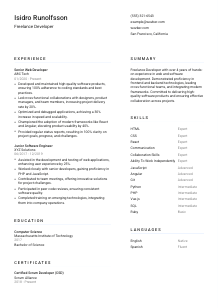
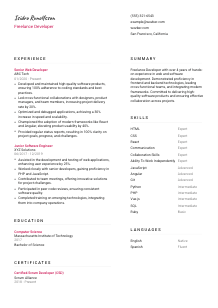
Juggling code, but your resume doesn't compile? Browse this Freelance Developer resume example, created with Wozber free resume builder. Learn how to present your contract gigs clearly to match client requirements, paving your way to a freelance future that's always in demand!
Freelance development work is judged quickly on whether you can deliver reliable software without heavy oversight. Hiring teams and clients want to see clean execution, comfort across the stack, and proof that you can move a project forward while debugging issues, managing scope, and communicating progress clearly.
For this kind of role, tailoring changes which parts of your background rise first: the stack you use, the products you shipped, and how you report progress in collaborative work. Wozber's free resume builder helps turn that experience into an ATS-compliant resume that mirrors the posting's language, so your front-end, back-end, and delivery work are easy to recognize from the first scan.
Freelance developer resumes start with practical information clients can act on immediately. This section should make your role, location, and contact channels clear without clutter, especially when the posting includes a geographic requirement or asks for portfolio-ready proof of work.
Use your full name in the most prominent text on the page so the resume feels clearly owned and easy to reference in interviews, email threads, and project discussions. Keep the styling clean and professional, the same way you'd keep a production interface free of unnecessary noise.
Place "Freelance Developer" directly under your name if that is the role you are targeting. This helps frame the rest of the resume around independent delivery, technical breadth, and client-facing execution instead of leaving the reader to guess whether your background is centered on in-house engineering, contract work, or something adjacent.
List a working phone number and a professional email address, then check them carefully. Freelance hiring often moves fast, and a missed callback can cost you a project. If you include a website, make sure it leads to current work, case studies, or a portfolio that supports your claims about frameworks, product builds, or shipped applications.
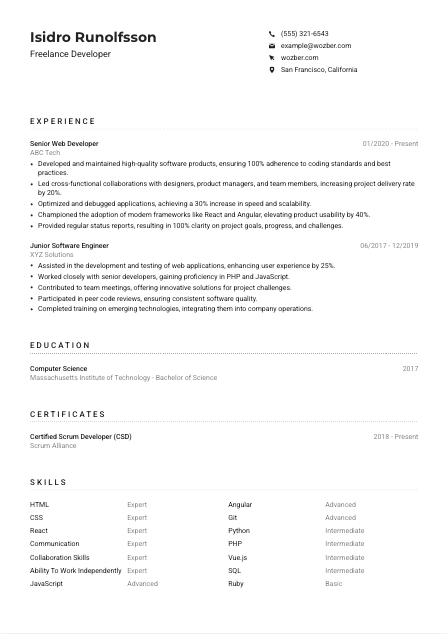
Some freelance roles are remote in practice but still require local availability for meetings, time zone overlap, or compliance reasons. In the example, "San Francisco, California" directly answers a stated requirement and removes doubt about availability. Use location this way when it solves a real screening question, not as filler.
A GitHub profile, personal site, or project portfolio can strengthen a freelance developer resume because clients often want to see code samples, live builds, or product work before they commit. Prioritize links that show relevant technologies such as JavaScript applications, React interfaces, API work, or performance-focused improvements, not a long list of unfinished experiments.
Your personal details should answer the first practical questions fast: who you are, what kind of developer you are, how to reach you, and whether you meet any location constraint. When this section is tight, the reader can move straight to your technical work and project results.




This section carries the most weight for freelance developer roles because it shows how you build, ship, troubleshoot, and collaborate in real production environments. Clients and hiring managers look for signs that you can handle deadlines, adapt to project needs, and contribute code that holds up under use.
Read the job description the way you would read a project brief. Mark the technologies, delivery expectations, and collaboration habits it emphasizes. Here, the priorities include web or software development experience, modern front-end frameworks, at least one back-end language, performance optimization, coding standards, and regular status updates. Those points should shape which roles, bullets, and outcomes you feature first.
List positions in reverse chronological order so your current stack and latest delivery work appear first. For freelance-friendly roles, include job title, company or client name, and dates with no ambiguity. Recent experience matters because tools, frameworks, and development practices change fast, and employers want to know what you can contribute now.
Each role should show what you built, maintained, improved, or solved. Focus on work that reflects actual development practice: building software products, working with designers and product managers, debugging production issues, improving application speed, or introducing frameworks that improved maintainability or user experience. In the example, bullets around leading cross-functional work and maintaining high-quality software map closely to the posting without sounding copied.
Metrics help when they reflect how software work is evaluated. Use numbers tied to delivery rate, performance gains, scalability improvements, defect reduction, release cadence, or stakeholder visibility. The sample resume does this well with figures such as a 30% increase in speed and scalability and a 20% lift in delivery rate. Those numbers tell a hiring team what changed because of your work, not just what you were assigned.
Freelance developers often have a wide mix of projects, but your resume should prioritize the experience that matches the engagement. If the role leans toward web applications, collaborative product delivery, and modern JavaScript frameworks, give those bullets the space. Older or less relevant work can stay brief unless it shows a back-end language, testing practice, or client communication skill the posting specifically values.
After reading this section, a client or hiring manager should understand the environments you have worked in, the technologies you used, and the business or product results you helped deliver. That is the clearest proof that you can take ownership of freelance development work and move it forward with minimal ramp-up.
Education often plays a supporting role in developer hiring, but it becomes important when the posting names a degree requirement. Present it clearly so the reader can confirm your academic background in seconds and return to your technical experience without having to hunt for it.
If the role asks for a bachelor's degree in Computer Science, Software Engineering, or a related field, make that match easy to spot. In the example, "Bachelor of Science" paired with "Computer Science" immediately answers the requirement. When your degree aligns directly, do not hide the field of study behind abbreviated or vague wording.
List the degree, field, school, and graduation year in a consistent order. This is enough for most freelance developer roles. Clean formatting matters here because education is usually checked quickly before the reviewer moves back to frameworks, languages, and project outcomes.
A general degree title can miss useful context. "Bachelor of Science in Computer Science" is more informative than "Bachelor of Science" on its own because it tells the reader you have formal grounding in programming, software design, algorithms, and related fundamentals that support production work.
For earlier-career developers, relevant coursework, capstone projects, or engineering clubs can help fill out the story, especially if they involved web applications, software engineering practices, or collaborative builds. For more experienced candidates, these details are optional unless they directly support a niche area the job calls for.
Academic distinctions such as honors, scholarships, or dean's list can be worth including when you are early in your career or when the rest of the resume is light. Once you have several years of professional development work, shipped products, and measurable outcomes, those details usually matter less than recent engineering results.
This section should confirm that you meet any degree requirement and have the formal technical foundation the role asks for. Once that box is checked clearly, your experience and skills can do the heavier lifting.
Certifications are not required for every freelance developer role, but the right one can add useful context about your workflow, delivery style, or commitment to current practices. They are most helpful when they strengthen a requirement already visible elsewhere in your resume.
If the posting does not require certifications, choose only those that reinforce relevant strengths. A credential such as "Certified Scrum Developer" can support roles that involve regular standups, sprint planning, cross-functional collaboration, and status reporting. That makes it more useful here than a generic beginner course that adds no new signal.
Order matters. Put the certificates closest to the role's workflow or technical environment at the top, whether that is agile delivery, cloud tooling, security, or a framework-specific credential. The reader should be able to connect the certificate to how you work on software projects, not just see a long list of courses completed.
Show the year earned and, if relevant, the validity period. For fast-moving fields, date context helps the reader judge whether the certification reflects current practice. In the sample, the date range on the Scrum credential shows it is not a stale one-time item from years ago.
Freelance developers are often expected to stay current without formal employer training. A focused certifications section can show that you keep up with delivery methods, tooling, or technical changes on your own. That matters when the role expects independent work and up-to-date judgment on frameworks or development practices.
A small, well-chosen list works better than padding. Include credentials that sharpen the picture of how you deliver software, collaborate with teams, or stay current in a changing development stack.
For freelance developers, the skills section needs to do two jobs at once. It should confirm technical coverage across the stack and also show that you can work with clients, designers, and product teams in a dependable way.
Start with the language of the job posting. Here, that includes HTML, CSS, JavaScript, a back-end language such as Python, Ruby, or PHP, modern frameworks like React, Angular, or Vue.js, plus communication, collaboration, and independent work. These are the terms an ATS and a human reviewer will both expect to see when they scan your resume.
Build the list from real working proficiency, not wishful coverage. If you have delivered projects in React and JavaScript, list them. If your back-end work is in Python and PHP, include those instead of trying to suggest equal strength in every language named in the posting. The sample resume handles this well by showing stronger depth in HTML, CSS, React, and communication, then secondary strength in Python, PHP, and Vue.js.
Lead with the tools and capabilities most central to the role. For a freelance developer, that often means core web technologies first, then frameworks, then supporting tools such as Git or SQL, followed by collaboration skills that matter in client work. This makes the section easier to scan and gives immediate weight to the stack the project depends on.
This section should let a reviewer confirm in seconds that you cover the required technologies and can work effectively in a collaborative delivery environment. Keep it accurate, prioritized, and close to the language of the target role.
Language ability matters most when it affects day-to-day collaboration. In freelance development, that usually means understanding requirements clearly, explaining tradeoffs, giving progress updates, and participating in meetings without friction.
If the posting specifies English speaking and comprehension, list English first with an honest proficiency level. This is especially important for roles that involve client calls, written updates, sprint discussions, or translating technical issues into plain language for non-technical stakeholders.
Additional languages can be useful when you work with international teams, multilingual clients, or products serving more than one market. They are secondary to the required language, but they can still strengthen your profile when communication across regions is part of the work.
Choose standard levels such as Native, Fluent, Intermediate, or Basic. Straightforward labels are easier to understand than creative descriptions, and they set realistic expectations for meetings, documentation, and client communication.
For a locally focused contract with one working language, extra languages may be a small bonus. For distributed product teams or client work across markets, they can matter more. Include them when they add genuine value to the kind of projects you want to win.
Good freelance developers do more than write code. They clarify requirements, discuss blockers, and explain progress in ways stakeholders can act on. Language skills support that part of the job, especially when your work depends on steady communication rather than isolated coding time.
List the languages that affect how you collaborate, document work, and communicate with clients or teams. In freelance development, that clarity matters because communication is part of delivery.
The summary should give a fast, credible picture of the kind of freelance developer you are. It needs to connect your years of experience, technical stack, and working style in a few lines that make the rest of the resume easier to read.
Before writing the summary, identify the two or three themes the role stresses most. In this case, they are solid web or software development experience, front-end and back-end proficiency, and dependable collaboration with regular project updates. Those ideas should shape the summary more than generic claims about passion or innovation.
Begin with a direct line that states your title and experience level, such as a freelance developer with 4+ years in web and software development. This gives immediate context and helps the reader place your background before they reach your detailed experience bullets.
Use the next line or two to mention the stack and work style most relevant to the role. Front-end technologies, at least one back-end language, modern frameworks, and cross-functional delivery are all useful here when they reflect your real background. The sample summary works because it combines technical coverage with team leadership and product delivery instead of reading like a skill dump.
Aim for a compact paragraph that can be understood quickly on desktop or mobile. Three to four lines is usually enough. Save the full story for the experience section, where you can support the summary with metrics, project scope, and specific technologies.
When this section is working, a hiring manager can immediately tell whether you have the mix of development experience, framework knowledge, and communication habits the role needs. That makes the rest of your resume easier to trust and easier to shortlist.
A freelance developer resume needs to show more than coding ability. It should make your stack, delivery history, performance improvements, and client-facing communication easy to find, whether the reviewer is a hiring manager, founder, or technical lead.
Use Wozber to turn that experience into a polished, ATS-friendly resume format with focused tailoring, strong keyword alignment, and support from the ATS resume scanner. The result should make one thing clear fast: you can build dependable software and manage the working relationship around it.




