



Use Wozber and land your dream job
Create Resume
No registration required
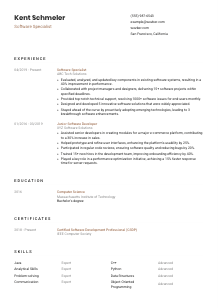
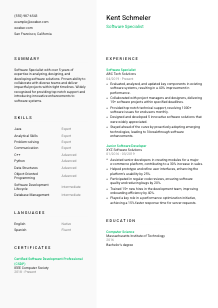
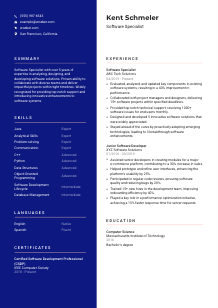
Coding breakthroughs, but your resume feels like a bug in the matrix? Check out this Software Specialist resume example, created with Wozber free resume builder. Learn how to thread your expertise through job requirements, ensuring your software skills shine as bright as the debug alerts!
Software Specialists are often hired into environments where code quality, issue resolution, and system improvement all sit on the same desk. A resume for this kind of work needs to show more than familiarity with software development. It should make clear that you can analyze existing systems, troubleshoot production issues, work with project stakeholders, and ship improvements that hold up in real use.
Screening usually narrows quickly when a resume makes the technical scope easy to read. Wozber's free resume builder helps you align your experience with the posting in an ATS-friendly resume format, so programming languages, support work, and delivery results are visible where hiring teams expect them. That matters when they need to tell the difference between someone who has simply written code and someone who can maintain, improve, and support software in a live business setting.
The personal details section is straightforward, but it still carries hiring value. For a Software Specialist, it should confirm role alignment, location when required, and professional contact points without adding clutter that distracts from your technical profile.
Lead with your full name in a clean, readable format. Keep the presentation simple so the resume starts clearly and remains easy to parse in ATS systems and by recruiters scanning multiple technical applications.
Place "Software Specialist" directly under your name when that matches the role you are pursuing. This creates immediate alignment with the posting and helps position your background around software development, troubleshooting, and system improvement rather than a broader or less relevant title.
List a reliable phone number and a professional email address. Add your LinkedIn profile, GitHub, or portfolio only if those links support the resume with relevant code samples, shipped projects, technical documentation, or product work that reflects your actual experience.
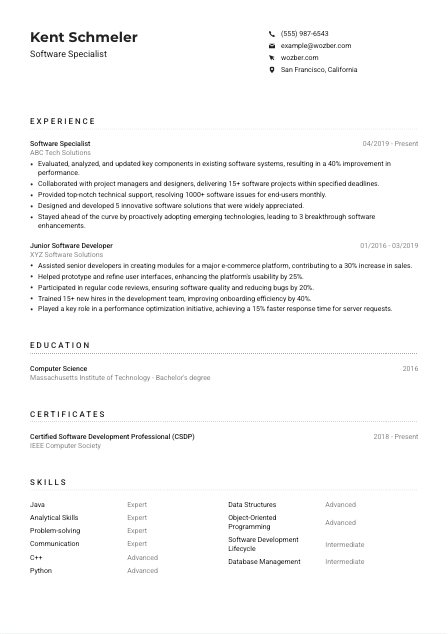
If the employer requires candidates to be based in a certain city or state, show that clearly. In the example, listing San Francisco, California directly addresses a stated requirement and removes any doubt about local eligibility.
Software roles benefit from proof of work. A personal site, GitHub repository, or project portfolio can strengthen your application when it shows application architecture, problem-solving approach, test coverage, APIs, or maintenance work tied to your resume claims. Skip empty links or outdated profiles.
This section should answer the basics fast: who you are, how to reach you, whether you match the target title, and whether any location requirement is covered. That leaves the rest of the resume free to focus on software delivery and support results.




For Software Specialists, experience carries most of the decision weight. Hiring teams want to see how you handled live systems, development work, defect resolution, collaboration, and measurable improvements across products or internal platforms.
Read the posting closely and mark the work that appears repeatedly. Here, that includes evaluating software systems, recommending improvements, collaborating with project managers and designers, supporting end-users, and designing, testing, and deploying solutions. Use those themes to decide which bullets deserve space on your resume.
List each position with company name, job title, and dates in reverse chronological order. For technical resumes, clean structure matters because reviewers look quickly for progression from junior development or support work into broader ownership, stronger delivery scope, and more independent problem-solving.
A Software Specialist resume should show what changed because of your work. Instead of saying you "worked on software updates," show the result, such as improved performance, reduced bug volume, faster response times, or smoother release delivery. The sample does this well with bullets like improving system performance by 40% and resolving 1000+ end-user issues monthly.
Use numbers where they reflect how your work was measured. Good metrics for this role include project count, issue volume, response-time improvements, bug reduction, release cadence, uptime, adoption, or performance gains. Metrics give context to analytical and development work that might otherwise sound routine.
Prioritize experience that shows software development, production support, system analysis, collaboration with delivery teams, and practical problem-solving. If you have older or adjacent experience, keep only the parts that reinforce your ability to maintain and improve software in line with business objectives.
Your experience section should make it easy to trace your technical judgment. A hiring manager should be able to see the systems you improved, the software issues you solved, the teams you worked with, and the measurable effect of your work on delivery or performance.
Education matters most here as confirmation of your technical base. For Software Specialist roles, the degree line often acts as a quick eligibility check before reviewers move on to programming languages, system work, and project results.
If you have a bachelor's degree in Computer Science, Information Technology, or a related field, state it plainly. The example's Computer Science degree maps directly to the posting, which helps both ATS screening and human review move forward without questions about baseline qualification.
List degree, field of study, school, and graduation year. Keep the formatting plain and consistent. Technical resumes benefit from clean structure because recruiters often scan education quickly before returning to experience, certifications, and skills.
If your degree is adjacent rather than exact, use the field name and, where useful, support it with relevant coursework or academic projects. Focus on subjects that connect to software engineering, data structures, systems design, databases, testing, or application development.
Additional coursework can strengthen your profile when it reflects current practice, such as cloud platforms, software testing, secure coding, DevOps workflows, or modern programming frameworks. This is especially useful if your formal degree is older and your recent learning shows technical currency.
Add honors, standout projects, or a strong GPA only when they reinforce your candidacy. Early-career applicants may benefit from listing a capstone, research project, or engineering competition if it demonstrates relevant development work, teamwork, or problem-solving depth.
This section should quickly confirm that you meet the technical education baseline. Once that is established, let the rest of the resume carry the heavier proof through software projects, support outcomes, and tool-specific experience.
Certifications are not always required for Software Specialist roles, but they can sharpen your profile when they support the actual work. They are most useful when they reinforce software development standards, technical depth, or ongoing professional learning.
If the employer names a certification, move that one to the top when you have it. In this case, the Certified Software Development Professional is listed as a plus, so showing CSDP prominently creates clear alignment with the role.
Choose certifications tied to software development, testing, cloud environments, security, databases, or support processes that matter in the target role. Avoid filling the section with unrelated credentials that do not strengthen your case for system analysis, development, or troubleshooting.
List the year earned and, when relevant, the validity period. In software roles, current certifications can signal that your knowledge reflects recent practices, tools, or standards rather than material you learned several years ago and never updated.
Recent or active certifications can help demonstrate that you keep pace with changing languages, frameworks, and delivery practices. That matters in roles where employers expect you to suggest improvements, evaluate new technologies, and contribute to better software outcomes over time.
Certifications work best when they reinforce the technical story already visible in your resume. They should add confidence around your software knowledge, not carry the application on their own.
A Software Specialist skills section should read like an accurate snapshot of how you work. It needs enough technical specificity for ATS matching and enough judgment to show that you understand the blend of development, troubleshooting, and collaboration the role requires.
Pull out the specific tools and capabilities the employer names. For this role, that includes Java, C++, Python, analytical ability, problem-solving, and communication. Use the same terminology when it reflects your background so the match is visible to both ATS software and human reviewers.
List the programming languages, development practices, and support-related strengths that appear in your work history. If you claim Python, Java, software development lifecycle knowledge, or database management, your experience bullets should show where you used them to build, troubleshoot, optimize, or deploy software.
This role combines coding with analysis, support, and team coordination. Include a focused mix of hard skills such as object-oriented programming, testing, debugging, databases, or SDLC knowledge, along with practical collaboration skills that matter when working with designers, project managers, and end-users.
Keep this section tight and defensible. Every listed skill should connect to the role's actual work and be supported somewhere else on the page through a project, certification, or measurable result.
Language skills matter in software roles when they affect documentation, support quality, stakeholder communication, and teamwork. If a posting calls for strong English, treat that as a real job requirement rather than a minor detail.
When the role specifies superior English skills, list English prominently with an honest proficiency level such as Native or Fluent. This is especially relevant for positions involving end-user support, cross-functional collaboration, and technical communication across teams.
Include additional languages if you can use them professionally. They may help in global engineering teams, distributed support environments, or customer-facing technical work, even when they are not explicitly required in the posting.
Use clear labels such as Native, Fluent, Intermediate, or Basic. Precise language levels are more useful than vague claims because they set realistic expectations for meetings, documentation, support conversations, and collaboration.
Extra languages are helpful, but they should remain secondary to core technical qualifications unless the role directly involves multilingual support or international stakeholders. For this position, English carries the main hiring weight.
For Software Specialists, language ability is not separate from the work. It affects how well you explain defects, document changes, translate technical issues for non-technical stakeholders, and support users when software problems need fast resolution.
List languages in a way that supports the job's communication demands. For this kind of role, clear English proficiency helps validate your ability to support users, work across functions, and document software work accurately.
The summary should quickly frame the kind of Software Specialist you are. In a few lines, it needs to connect your years of experience with the technical scope you handle and the outcomes you consistently deliver.
Start with the recurring themes in the posting and reflect the ones you genuinely cover. Here, the strongest themes are software analysis, development, troubleshooting, cross-functional collaboration, and improvement of existing systems. Use those themes to shape the summary instead of writing a generic tech profile.
Lead with your professional identity and years of experience, such as "Software Specialist with 5+ years of experience." That immediately gives context for the rest of the paragraph and helps frame whether you are coming from support-heavy, development-heavy, or hybrid software work.
Follow with the capabilities that matter most for the target role. Good examples include improving software performance, resolving high volumes of user issues, delivering projects with cross-functional teams, or building and deploying new solutions. The sample summary works because it combines development, collaboration, and support in one concise profile.
Aim for a compact paragraph that a recruiter can absorb quickly. Avoid broad claims like "results-driven professional" unless you immediately anchor them in software outcomes, programming work, system improvements, or support volume that make the claim believable.
When this section is done well, the rest of your resume reads with more clarity. The reader should understand within a few lines whether you bring the blend of software development, support judgment, and system improvement the role calls for.
A Software Specialist resume should leave little ambiguity about what you can handle in production, in development, and in support. If the document clearly shows your programming language strengths, system improvement work, troubleshooting scope, and delivery results, hiring teams can assess you much faster and with more confidence.
Use Wozber's AI resume builder to tighten language around the job description, improve ATS optimization, and present your experience in an ATS-friendly resume template that keeps technical details easy to scan. The finished resume should make one thing clear right away: you can contribute to software quality, stability, and delivery from day one.




