



Use Wozber and land your dream job
Create Resume
No registration required
Crafting code, but your resume doesn't compute? Check out this Software Developer resume example, created with Wozber free resume builder. Learn how to match your programming prowess to job specs, coding a career narrative that compiles success as smoothly as your projects compile.
Software development resumes are strongest when they show how you build, improve, and maintain systems in real working conditions. Hiring teams want more than a list of languages. They look for signs that you can turn requirements into reliable software, work through defects, contribute to code reviews, and make sound engineering decisions around performance, scalability, and code quality.
A tailored resume helps separate application-level coding experience from broader engineering ownership. With Wozber's free resume builder and an ATS-compliant resume structure, you can align your wording with the posting's technical language, surface the right tools and outcomes, and make it easier to see whether you match the team's stack, collaboration style, and delivery expectations.
For software developers, the personal details section should be clean, practical, and easy to scan. Keep it focused on information that helps a recruiter or hiring manager contact you, confirm basic eligibility, and quickly connect your profile to the role you're targeting.
Place your full name prominently, then use the exact job title you are pursuing when it matches your background. If the posting says "Software Developer," using that title beneath your name immediately frames your experience in the right lane for both ATS parsing and human review.
Include a reliable phone number and a professional email address that will not distract from your technical credibility. Keep the format simple and recognizable. In software hiring, small presentation details matter because they suggest how carefully you handle documentation and communication.
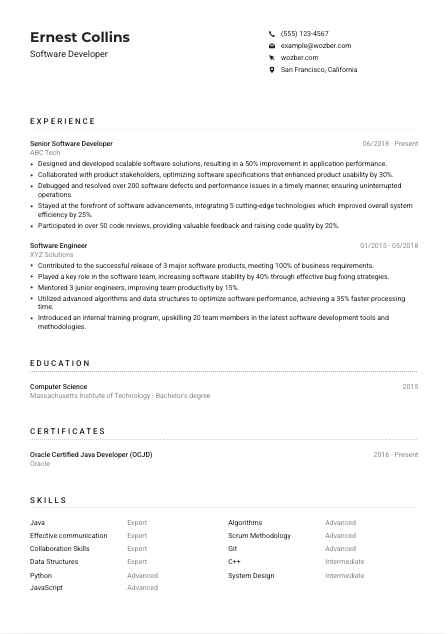
If a role has a location condition, include your city and state clearly. In the example here, listing "San Francisco, California" directly addresses the employer's stated requirement. That kind of detail belongs in this section because it answers a practical screening question right away.
A GitHub profile, portfolio site, or personal technical website can strengthen your application when it shows code samples, shipped projects, open-source work, or engineering writing. Only include links that are current and professional. A strong repository with readable commits, project documentation, and recent activity says much more than a generic profile link.
Do not crowd this area with unnecessary personal information. Software hiring teams care more about whether they can contact you, place you correctly for the role, and review your technical work if you share it. Clean formatting here sets up the rest of the resume well.
Your contact block should answer the basics in seconds: who you are, what role you are targeting, how to reach you, and whether any stated location requirement is already covered.




This is where software developers separate themselves. Hiring teams read your experience section for proof that you have built working software, improved systems under real constraints, and collaborated effectively with product and engineering peers. Specific outcomes, technical context, and measurable results matter here.
Start by identifying the work the employer emphasizes. In this posting, that includes designing scalable solutions, refining business requirements with stakeholders, debugging defects, and contributing to code quality through reviews. Those themes should shape which bullets you keep, rewrite, or move higher in each role.
List your positions in reverse chronological order and describe what you actually built, improved, or maintained. Titles such as "Senior Software Developer" and "Software Engineer" are useful because they map closely to the target role, but the real value comes from the bullets underneath. Show the systems you worked on, the engineering problems you solved, and the team context around that work.
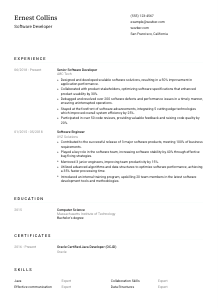
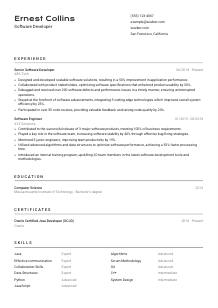
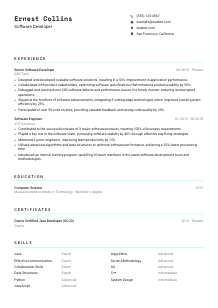
Quantified results help when they are native to engineering work. Performance gains, defect reduction, release delivery, uptime improvements, processing speed, code quality changes, or efficiency gains all give hiring managers a clearer read on your impact. The sample resume does this well with examples like a 50% performance improvement and resolution of more than 200 defects.
Prioritize accomplishments that reinforce software development capability. Bullets about cross-functional collaboration, algorithmic optimization, debugging, reviews, and delivery against business requirements belong near the top because they match what this employer is asking for. Less relevant achievements can stay off the page if they dilute the technical story.
Software teams want developers who can diagnose issues, improve reliability, and maintain standards under delivery pressure. Include examples of debugging production issues, reducing performance bottlenecks, participating in code reviews, or improving maintainability. In the example, code review participation and defect resolution both strengthen the case because they show day-to-day engineering discipline, not just feature delivery.
After reading your experience section, a reviewer should be able to see the scale of your work, the technical problems you handled, and the business or product results your code helped produce.
For many software developer roles, education is a qualification check before it becomes a differentiator. Keep this section straightforward, accurate, and easy to scan so the employer can quickly confirm that you meet the degree requirement and understand your academic foundation.
If the role asks for a Bachelor's degree in Computer Science, Software Engineering, or a related field, place that qualification first and use the exact field name where possible. In the example, a Bachelor's degree in Computer Science directly matches the requirement and should be easy to find.
Include degree, field of study, school name, and graduation year in a simple layout. This is not the place for creative formatting. Clear structure helps both ATS systems and hiring teams verify your academic background without slowing down the read.
If your degree is adjacent rather than exact, such as Information Systems or Electrical Engineering, keep the wording accurate and let the rest of your resume reinforce your software development track. Do not rename your degree. Instead, use your experience and skills sections to show depth in programming, system design, and engineering practice.
If you have limited professional experience, coursework, capstone projects, research, or major class builds can help fill the gap. Include projects that involve relevant languages, algorithms, system design, testing, or application development rather than generic academic detail.
Recent coursework, bootcamps, or technical training can support your profile when they strengthen your alignment with the role. This is especially useful if you are expanding into a new language, framework, cloud environment, or development practice that the job values.
Education should confirm the foundation. Once that requirement is clear, the rest of the resume needs to carry the heavier proof of how you build software in practice.
Certifications are optional in many software developer searches, but the right ones can reinforce a language specialty, platform strength, or commitment to current engineering practice. Use this section selectively so it supports your experience instead of distracting from it.
Choose certifications that strengthen your case for the specific type of development work you want. For example, an Oracle Java credential makes sense when Java appears in the posting or in your recent experience. The value comes from relevance, not volume.
Do not include every course completion badge or expired training item. Software employers will care more about certifications that relate to programming languages, cloud platforms, security, architecture, or delivery practices that matter for the job.
Certification dates help show whether your knowledge is current, especially in fast-moving technical areas. If a credential is active, renewed, or ongoing, make that visible. This gives useful context without adding unnecessary explanation.
If you are currently working toward a certification that supports your target work, you can include it when it is credible and near completion. This can be useful when you are deepening expertise in an area such as cloud development, backend engineering, or a language ecosystem that appears often in your target postings.
A well-chosen certification can sharpen your technical profile, especially when it echoes the languages, tools, or engineering standards already visible elsewhere on the resume.
The skills section should reflect how software teams actually evaluate developers. That means combining technical foundations, programming languages, and practical collaboration skills in a way that matches the posting's requirements and your real experience.
Start with the skills the employer names explicitly. Here, that includes languages such as Java, Python, C++, and JavaScript, along with software best practices, data structures, algorithms, system design, communication, and collaboration. Those terms help shape the shortlist of what belongs on the page.
Every skill you list should connect to a project, role, or accomplishment. If you claim system design, there should be some sign in your experience that you designed architecture, improved scalability, or made engineering tradeoffs. If you list collaboration, your bullets should show work with product managers, designers, or peer developers.
Do not overload the section with every library or tool you have ever touched. Focus on a manageable set of skills that reflects your strongest match for the role. The sample resume gets this mostly right by pairing language proficiency with core engineering topics like algorithms and data structures, plus team-facing strengths such as communication and collaboration.
Your skills section should read like a focused technical profile, not a software inventory. When it aligns with your experience, it gives the employer a faster, cleaner view of where you can contribute.
Language skills matter in software development when they affect day-to-day collaboration, documentation, and stakeholder communication. Keep this section factual and tie it to the actual communication demands of the role.
If the posting specifies English fluency, list English at the top with an accurate proficiency level such as "Native" or "Fluent." That immediately answers an explicit requirement, especially for roles involving written documentation, code review discussion, and cross-functional planning.
Secondary languages can be worth listing when they reflect your real communication range, especially in distributed teams or customer-facing product environments. They are supportive information, not a substitute for technical depth, so keep them in proportion.
Terms such as "Native," "Fluent," "Intermediate," and "Basic" are usually enough. Avoid vague descriptions. Straightforward labels help hiring teams understand how comfortably you can participate in meetings, write documentation, or collaborate across teams.
For some software organizations, extra language capability helps with global engineering teams, regional product work, or communication across support and implementation functions. Mention it when it adds practical context, not just extra decoration.
Overstating language ability creates problems quickly in interviews and on the job. A short, accurate list does the job well and supports the communication side of your developer profile.
A hiring team should be able to see, at a glance, whether you can communicate clearly in the language the role requires and whether any additional fluency adds useful range.
Your summary should quickly explain what kind of software developer you are, how much experience you bring, and what technical strengths or outcomes are most relevant for the role. Keep it specific enough to anchor the rest of the resume.
Read the posting closely and identify the few themes that matter most. In this case, software design, scalable development, debugging, collaboration, and code quality stand out. Use those themes to decide what belongs in your opening lines.
Lead with your title and experience level, then name the type of work you handle well. The example summary does this effectively by positioning the candidate as a Software Developer with more than 7 years of experience designing and developing robust software solutions.
Mention the capabilities that are most relevant to the target role and already supported by your experience section. Good options include improving performance, resolving defects, collaborating with cross-functional teams, or raising code quality through reviews and engineering standards.
A summary should usually be a few sentences, not a full career history. Avoid broad claims like "results-driven" or "passionate technologist" unless the next words explain that through real engineering work, such as backend development, system optimization, or feature delivery at scale.
When this section is done well, the reader immediately understands your level, your engineering strengths, and the kind of software work you are prepared to take on.
A software developer resume works best when each section supports the same story: you can write quality code, solve technical problems, collaborate well, and deliver software that performs reliably. Keep your language close to the job description, use metrics where they reflect real engineering impact, and make sure the stack, responsibilities, and outcomes line up across the page.
Wozber's free resume builder can help you organize that story in an ATS-friendly resume format, while the ATS resume scanner helps you map job requirements to the right sections and tighten your ATS optimization before you apply. The finished resume should make it easy to judge your development experience, technical range, and readiness to contribute from day one.




