



Use Wozber and land your dream job
Create Resume
No registration required
Working in the microscopic world, but your resume feels invisible? Boost your presentation with this Microbiologist resume example, created with Wozber free resume builder. Learn how to showcase your vital microbe-management skills to match job criteria, so your career growth microbiome flourishes under the right conditions!
Microbiology hiring turns quickly on whether your resume makes your lab judgment visible. Hiring teams look past broad science claims and focus on the work itself: how you handle sample testing, organism isolation and identification, method development, equipment control, and compliance in a regulated environment where accuracy and turnaround both matter.
A tailored resume changes how that work is read. When your wording reflects the target lab's testing scope and technical language, an ATS-compliant resume is far more likely to surface the right experience instead of burying it under generic research terms. Wozber's free resume builder helps you align section by section, so the hiring team can immediately see laboratory depth, quality discipline, and readiness to contribute from day one.
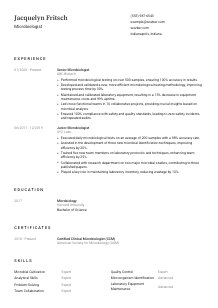
For microbiology roles, the header does one practical job: it confirms who you are, what role you are applying for, and whether basic logistics will slow the hiring process. Keep it clean, professional, and aligned with the position.
Set your name in a clear, readable format so it anchors the page immediately. In lab hiring, resumes are often reviewed alongside technical experience, certifications, and compliance background, so simple presentation works better than decorative styling.
Place "Microbiologist" directly beneath your name when that is the role you are pursuing. Matching the posted title helps frame your background correctly, especially if your previous titles include variations such as Junior Microbiologist, QC Microbiologist, or Research Associate.
Include a reliable phone number and a professional email address. If a laboratory manager wants to move quickly after spotting relevant experience in microbial testing or quality control, your contact information should never create friction.
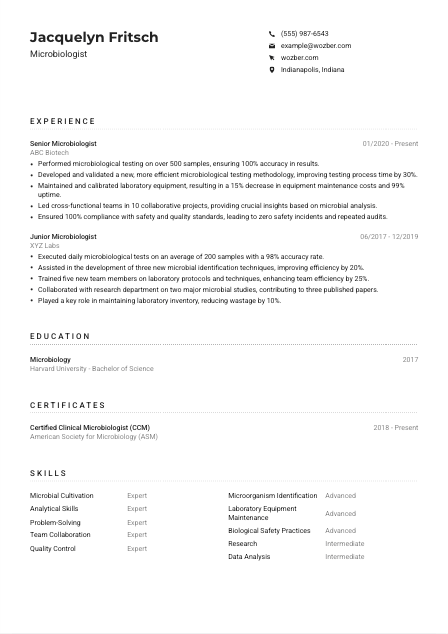
If the employer specifies location or relocation, reflect that clearly in this section. In the example, listing Indianapolis, Indiana directly supports a stated requirement and removes an avoidable question early in the review.
A LinkedIn profile, portfolio, or professional page can help if it expands on publications, lab methods, certifications, or cross-functional project work. Keep it updated so it reinforces the same microbiology experience shown on the resume.
This section should confirm the basics in seconds. Once your name, title, contact details, and location are aligned, the reader can move straight to your laboratory experience without unnecessary doubts.




This is the section most likely to decide whether you move forward. For a microbiologist, employers want to see real laboratory output: sample volume, testing methods, equipment handling, quality practices, research contribution, and the business or operational value of your work.
Start by identifying the work patterns the employer cares about most. Here, that includes microbiological testing, isolation and cultivation work, microorganism identification, method improvement, equipment calibration, and compliance with safety and quality standards. Your experience bullets should answer those needs directly rather than relying on general science language.
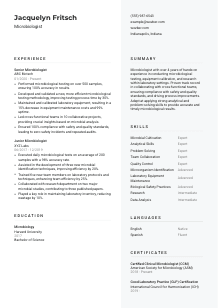
List positions in reverse chronological order with your title, employer, and dates. Under each role, show what you handled in the lab and what changed because of your work, whether that meant processing higher sample volumes, improving turnaround time, supporting validation, or strengthening quality control. The sample resume does this well by tying each role to concrete lab responsibilities and outcomes.
Mirror the terminology of the job description when it matches your real experience. Phrases such as "performed microbiological testing," "conducted research," "maintained and calibrated laboratory equipment," and "ensured compliance" help connect your background to the opening without sounding forced. This is especially useful for ATS optimization when the posting uses specific microbiology terms.
Microbiology work is often measured through sample counts, accuracy rates, validation results, audit outcomes, uptime, turnaround gains, or waste reduction. Use those metrics where you have them. In the example, testing over 500 samples with 100% accuracy and reducing process time by 30% gives a hiring manager a far clearer picture than a generic claim about being detail-oriented.
Prioritize work that demonstrates laboratory discipline, microbiological technique, analytical judgment, and collaboration with quality, research, or production teams. If an older bullet does not help prove your value in a microbiology setting, trim it and use the space for stronger testing, method, or compliance achievements instead.
A microbiologist's experience section should read like a record of reliable lab execution. When your bullets show testing volume, method strength, equipment control, and quality outcomes, the hiring team can judge your contribution with much more confidence.
Education matters in microbiology because it establishes your scientific foundation before the employer reviews your lab history in detail. Keep this section straightforward, but make sure it clearly reflects the degree background the role asks for.
If the posting asks for a bachelor's degree in Microbiology, Biology, or a related field, state your degree in those exact terms where possible. A line such as "Bachelor of Science in Microbiology" immediately confirms a core qualification and reduces ambiguity during screening.
List your degree, institution, and graduation year clearly. For most microbiologist positions, especially after you have hands-on lab experience, this is enough to establish the academic baseline quickly.
The subject matters here, not just the degree level. Make sure the microbiology or related life science field is easy to spot, because ATS filters and human reviewers may both scan this section for direct alignment with the role.
Relevant coursework can help early-career applicants or candidates moving into a more specialized microbiology setting. Courses tied to microbial cultivation, organism identification, biosafety, molecular methods, or lab quality practices can reinforce readiness when experience is still developing.
Honors, thesis work, research projects, or microbiology society involvement can be useful when they connect to laboratory work, experimental design, or scientific communication. Keep these additions focused on material that supports your professional direction rather than filling space.
This section does not need much space, but it does need clarity. When your degree and field are easy to confirm, the reader can move on to the more deciding question: how you have applied that training in the lab.
Certifications are not always required for microbiologist roles, but the right ones can strengthen your profile, especially in regulated, clinical, quality, or method-driven laboratory environments. Use this section to show professional development that genuinely supports your lab work.
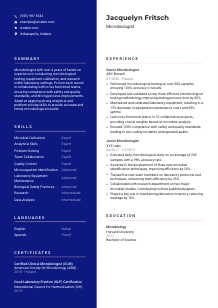
List certifications that connect to microbiology practice, laboratory quality systems, biosafety, or regulated workflows. In the example, Certified Clinical Microbiologist and GLP certification both support trust in technical and compliance-heavy work.
A short list of meaningful credentials is stronger than a long list of loosely connected courses. Choose certifications that reinforce the kind of testing, documentation, and quality standards the employer is likely to care about.
Include the year earned or the active date range so the employer can see whether the credential is current. In laboratory hiring, recent or maintained certification can matter when roles involve ongoing quality expectations or regulated procedures.
Review this section regularly as methods, standards, and regulations evolve. Updated certifications signal that you stay engaged with current laboratory practice instead of relying only on older academic training.
Well-chosen certifications add weight when they support your testing background, quality discipline, or regulatory awareness. Keep the section focused on credentials that strengthen your case for the specific microbiology environment you are targeting.
Your skills section should read like a practical inventory of what you can do in a laboratory setting. For microbiologist roles, that means balancing technical methods with the analytical and communication skills that support accurate testing and cross-functional work.
Read the description closely for both explicit and implied requirements. Here, the obvious items include microbiological techniques, analytical ability, problem-solving, communication, and attention to detail. The responsibilities also point to equipment calibration, quality control, and collaboration with other teams.
Include method-based skills such as microbial cultivation, microorganism identification, microbiological testing, and laboratory equipment maintenance alongside skills like data analysis, documentation, and team collaboration. That mix reflects how microbiologists actually work across testing, reporting, and quality processes.
Avoid turning this section into a full inventory of every scientific tool you have ever touched. Focus on the capabilities most likely to matter in the target role. The sample resume works because it highlights microbiology-specific competencies first, then supports them with analytical and collaborative strengths.
A focused skills list should support what your experience already proves. When the right microbiology methods, lab practices, and problem-solving abilities are easy to spot, your profile feels much more grounded and job-ready.
Language ability is usually a supporting section for microbiologists, but it matters when the posting states a clear requirement or when the role involves documentation, reporting, training, or collaboration across teams. Keep it factual and relevant.
If the employer asks for fluent English, list English clearly with an accurate proficiency level. For a microbiologist, this matters not only for conversation but also for lab documentation, SOPs, deviation reporting, and communicating test results accurately.
Other languages can be worth listing when they support teamwork, training, supplier communication, or multinational laboratory environments. They are a bonus, though they should stay secondary to the required language in the section.
Label each language accurately as Native, Fluent, Intermediate, or Basic. Overstating language ability can create problems quickly in a role where procedural detail and precise communication matter.
Some microbiology positions involve cross-site coordination, international research, or broader manufacturing and quality networks. In those cases, additional language capability can strengthen your profile, especially when paired with reporting or collaboration experience.
This section works best when it supports the actual communication needs of the role. If your language skills help you write clearly, coordinate with diverse teams, or interpret technical information across contexts, they add practical value beyond the label itself.
For this kind of role, language proficiency is useful when it supports documentation and collaboration. Keep the section concise, truthful, and aligned with the communication demands of the job.
Your summary should quickly establish the kind of microbiology professional you are, the environment you have worked in, and the value you bring. Keep it short, but make each phrase earn its place through technical relevance.
Before writing, identify the few requirements that matter most in the target role. For this posting, that means hands-on lab experience, microbiological testing, method development, equipment maintenance, compliance, and communication. Those priorities should shape the summary more than generic claims about passion or work ethic.
Lead with your title and level of experience, then ground it in real laboratory work. The example summary does this effectively by stating more than 4 years of hands-on experience and naming microbiological testing, equipment calibration, and research instead of relying on broad life science wording.
Choose two or three capabilities that map closely to the opening, such as accurate sample testing, process improvement, analytical problem-solving, or quality compliance. This is where you show the kind of contribution a hiring manager can expect from you in the lab.
Aim for a short paragraph that reads cleanly and can be scanned in seconds. A microbiologist summary works best when it sounds like the top line of your lab career, not a compressed list of every skill and responsibility you have ever had.
Your summary should give the reader a sharp first read on your microbiology background. If it clearly states your lab experience, core methods, and quality mindset, the rest of the resume has a strong frame to build on.
A well-tailored microbiologist resume makes your laboratory judgment visible fast. When each section points clearly to testing experience, microbiological methods, equipment control, compliance, and measurable outcomes, hiring teams can see where you will add value.
Use Wozber to shape that content into an ATS-friendly resume template, refine wording with its AI resume builder, and check alignment with an ATS resume scanner before you apply. The final result should make one thing easy to judge: you can produce accurate microbiological work in a real laboratory setting.




