



Use Wozber and land your dream job
Create Resume
No registration required
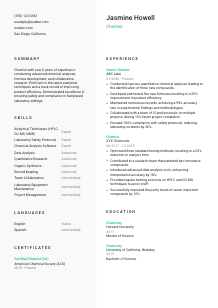
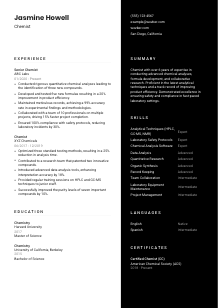
Bonding elements, but your resume lacks cohesion? Check out this Chemist resume example, created with Wozber free resume builder. Learn how to blend your chemical expertise and analytical acumen to match job requirements, crafting a career as reactive and dynamic as your experiments!
Chemist resumes are strongest when they make laboratory work legible to someone scanning quickly. Hiring teams want to see what you actually analyzed, developed, validated, or improved, whether that meant running HPLC and GC-MS, refining formulas, documenting methods, or keeping a lab compliant with safety and regulatory standards. If those details stay vague, even solid research or industry experience can read as generic technical work.
A tailored resume helps separate candidates who have broad science backgrounds from chemists who can contribute in a specific lab environment from day one. Using Wozber's free resume builder to align your wording with the posting and produce an ATS-compliant resume makes it easier to surface the right analytical techniques, recordkeeping habits, and collaboration points early. That gives reviewers a clearer read on your laboratory scope and technical match.
For chemist roles, the contact section does more than identify you. It should immediately confirm who you are, what role you do, and whether any practical requirement such as location is already covered. Keep it clean, accurate, and easy to scan.
Place your name at the top in a readable size so it anchors the page immediately. In technical hiring, reviewers often move fast between qualifications, instruments, and experience, so your header should be unmistakable and professional.
Use the job title directly beneath your name when it matches your background. If you are applying for a Chemist position, writing "Chemist" under your name creates immediate alignment and avoids confusion with adjacent profiles such as Lab Technician, Quality Control Analyst, or Research Associate.
List a phone number you answer and a professional email, ideally in a simple format such as first name and last name. Precision matters in lab work, and small errors here can suggest the opposite. Check every character before sending, especially if you are applying to multiple research or manufacturing employers.
If a role requires local availability, show your city and state clearly. In the example posting, being based in San Diego, California is a stated requirement, so listing that upfront removes a practical objection before anyone reaches your experience section.
Include a LinkedIn profile or personal site if it strengthens your application with publications, project summaries, technical presentations, or a fuller career history. For chemists, that extra context is useful when it reflects real lab work, research outputs, or industry specialization rather than a generic online presence.
This section should answer the basic logistical questions fast: who you are, what role you do, and whether you meet any immediate requirement such as location. Once that is clear, the rest of the resume can stay focused on your chemistry work.




This is where a chemist resume earns credibility. Employers look for hands-on laboratory scope, technical methods, research or product contributions, and proof that you can document work accurately while moving projects forward.
Start by identifying the work that defines the role. For this posting, that includes qualitative and quantitative analysis, formula or material development, recordkeeping, cross-functional collaboration, and safety compliance. Your bullets should reflect those same categories where they match your real background, so the resume reads like direct evidence of relevant lab performance.
List your most recent position first, then work backward with job title, employer, and dates. This structure helps both recruiters and ATS systems follow your progression from bench work to more advanced responsibilities such as method optimization, project ownership, or training junior staff.
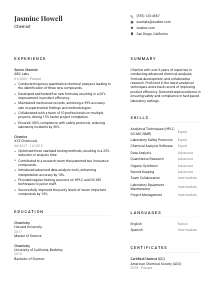
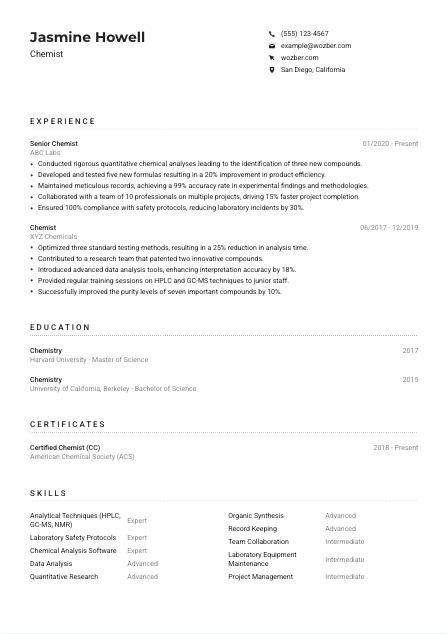
Each bullet should show what you did, how you did it, and what changed because of it. For a chemist, that often means naming the analysis, experiment, formulation, or process involved and then tying it to purity, efficiency, turnaround time, accuracy, or a research milestone. The sample resume does this well with lines such as developing five new formulas that improved product efficiency by 20%.
Use metrics that fit chemistry work naturally: number of compounds identified, reduction in analysis time, improvement in yield or purity, accuracy rates, incident reduction, validation throughput, or project completion speed. The example includes a 99% record accuracy rate and a 25% reduction in analysis time, both of which tell a hiring manager far more than "responsible for documentation" or "helped improve processes."
Prioritize experience that shows analytical techniques, experimental design, method improvement, compliance, and collaboration with scientists, engineers, or production teams. If older bullets do not help explain your fit for laboratory analysis or development work, trim them back. Space is better used on achievements that connect directly to how this employer runs its lab.
A hiring manager should be able to see your technical range from this section alone: what instruments or methods you used, what you improved, how reliably you documented work, and how your results supported research or product goals.
Chemist roles often have clear degree requirements, so your education section needs to confirm the scientific foundation behind your laboratory experience. Present it simply, and emphasize advanced study when it strengthens your profile.
Review the posting for the baseline education requirement and make sure your degree matches that language closely. Here, a Bachelor's degree in Chemistry or a related field is required, with an advanced degree preferred, so listing chemistry degrees prominently helps establish fit immediately.
Include degree, field of study, institution, and graduation year. That is usually enough for experienced chemists. Clear formatting matters because this section is often checked quickly to confirm that your academic background supports the level of laboratory work in the role.
If you hold a master's or doctorate, place it first. Advanced education can strengthen your case for roles involving complex analytical work, method development, formulation research, or deeper interpretation of experimental data. In the sample resume, the Master of Science in Chemistry reinforces the employer's preference for advanced study.
Early-career chemists or candidates shifting into a specialized lab can include selected coursework if it fills an experience gap. Focus on subjects that map to the target role, such as instrumental analysis, spectroscopy, organic synthesis, analytical chemistry, or data interpretation linked to HPLC, GC-MS, and NMR work.
Honors, research projects, theses, publications, or notable lab assistant work can help when they add real chemistry context. Use them when they show technique exposure, publication-quality documentation, or research depth. For more experienced candidates, keep this secondary to professional laboratory results.
This section should quickly confirm that your academic training supports the level of analysis, experimentation, and interpretation expected in the role. If your education is directly relevant, you do not need to overexplain it.
Certifications are rarely the main hiring factor for chemists, but the right one can strengthen a resume by showing recognized expertise, current practice, or commitment to regulated laboratory standards.
Start with the posting. If no certificate is required, use this section to add supporting credentials rather than padding the page. For chemist roles, certifications are most useful when they reinforce analytical practice, quality standards, safety, or professional standing in the field.
List certifications that support the kind of lab work you do. A credential such as Certified Chemist from the American Chemical Society is relevant because it aligns with professional credibility in chemistry rather than a broad, unrelated training course.
Include award or active dates when the credential is current, renewable, or tied to ongoing professional standing. That helps employers see that your training is recent and maintained, especially in environments where procedures, compliance expectations, or instrumentation evolve over time.
As your career develops, add certifications or formal training that deepen your value in areas such as analytical instrumentation, laboratory safety, GMP or GLP environments, quality systems, or specialized chemical processes. Choose additions that support the direction of your work, not just your course history.
A certificate will not replace solid laboratory experience, but it can reinforce your profile when it connects directly to the chemistry work, standards, or methods that matter in the target role.
The skills section should read like the toolkit of a working chemist. Focus on technical capabilities, lab practices, and supporting strengths that are genuinely relevant to the position instead of filling the section with broad science terms.
Separate the hard requirements from the broader working style signals. In this role, that includes analytical techniques such as HPLC, GC-MS, and NMR, plus data analysis, communication, collaboration, and safety compliance. Those are the skills your resume should surface clearly if you have used them in real settings.
Mirror the terminology from the job description where it matches your actual background. For example, "Analytical Techniques (HPLC, GC-MS, NMR)" is stronger and more searchable than a vague label like "instrumentation experience." The sample resume also pairs technical strengths with supporting skills such as laboratory safety protocols and chemical analysis software, which gives the section more hiring value.
Choose skills you can back up through your experience bullets, projects, or education. For chemists, that usually means analytical methods, data interpretation, documentation, formulation work, synthesis, equipment maintenance, quality practices, and team collaboration. A shorter list of credible strengths is far more effective than a long inventory you cannot substantiate.
This section should tell an employer what kind of chemist you are in practical terms: which methods you know, how you work in the lab, and what supporting strengths you bring to research, testing, or product development.
Language ability matters in chemistry when the role involves technical documentation, cross-team communication, training, or work in multilingual research and production environments. Keep this section honest and relevant.
If the posting names a required language, list it clearly with your proficiency level. Here, English is a critical requirement, so it should appear first. For many chemist roles, this matters because reports, SOPs, regulatory documents, and experimental records need to be written and understood precisely.
After the required language, include any others that may help in collaborative or international settings. Additional languages can be useful in multinational labs, supplier communication, research partnerships, or training environments, even when they are not a formal requirement.
Describe your level with straightforward terms such as Native, Fluent, Intermediate, or Basic. Overstating language ability can create real problems in roles that depend on precise reporting, technical reading, or verbal communication about procedures and results.
If part of your chemistry work involved international teams, translated technical documents, bilingual training, or communication across manufacturing and research groups, language skills carry more weight. Mention them because they add operational value, not simply because they are nice to have.
Languages should support your application, not distract from your scientific qualifications. If English is the main requirement and you meet it, list that clearly and keep the rest concise unless multilingual communication is genuinely part of the role.
For a chemist, language skills matter most when they support accurate documentation, safe communication, and smooth collaboration. Present them plainly so employers know exactly what working with you will look like.
Your summary should quickly tell the reader what kind of chemist you are, how much relevant laboratory experience you bring, and which strengths are most relevant to the role. Keep it short, but make every sentence carry technical weight.
Before writing, identify the two or three requirements that matter most in the posting. For this role, that means analytical chemistry, formula or materials development, data interpretation, documentation, and collaboration in a laboratory setting. Your summary should reflect that mix rather than offering a generic statement about being detail-oriented or passionate about science.
Start with a direct line that names your field and years of experience, such as a chemist with 6+ years in analytical and formulation-focused laboratory environments. This gives immediate context and helps distinguish you from broader scientific candidates whose work may be less chemistry-centered.
Use the next lines to highlight the work you are known for. That could include instrument-based analysis, method optimization, product or compound development, regulatory compliance, or strong experimental documentation. The sample summary works because it pairs advanced chemical analyses and formula development with a clear record of improving product efficiency and maintaining safe lab practices.
Aim for 3 to 5 sentences with no filler. A chemist summary should function like a well-written abstract: clear scope, relevant methods, and a useful conclusion about the value you bring. If a sentence does not help explain your lab capability or technical relevance, cut it.
A concise summary helps the reader understand your laboratory profile before they reach the detail below. When it is tailored well, the rest of the resume feels like proof of a clear chemistry specialization.
A strong chemist resume makes your methods, results, and laboratory judgment easy to follow. When your experience shows the analyses you ran, the formulas you developed, the records you maintained, and the outcomes you improved, hiring teams can quickly place your work in the context of their lab.
Use Wozber's free resume builder to organize that experience in an ATS-friendly resume format, then refine the wording with the ATS resume scanner so the right technical terms and requirements are visible where they matter most. The final result should make one thing clear at a glance: you can do the chemistry this role requires.