



Use Wozber and land your dream job
Create Resume
No registration required
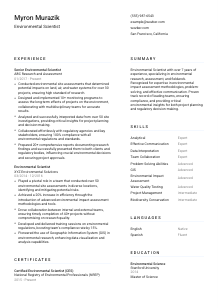
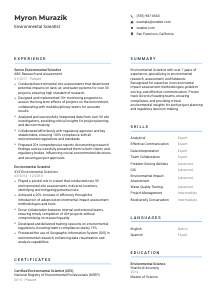
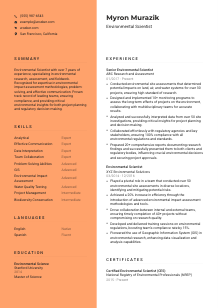
Working with ecosystems, but your resume seems out of its habitat? Explore this Environmental Scientist resume example, built with Wozber free resume builder. Learn how to highlight your scientific insights in ways that match the job's environmental checkpoints, ensuring your green career thrives as naturally as a thriving wetland!
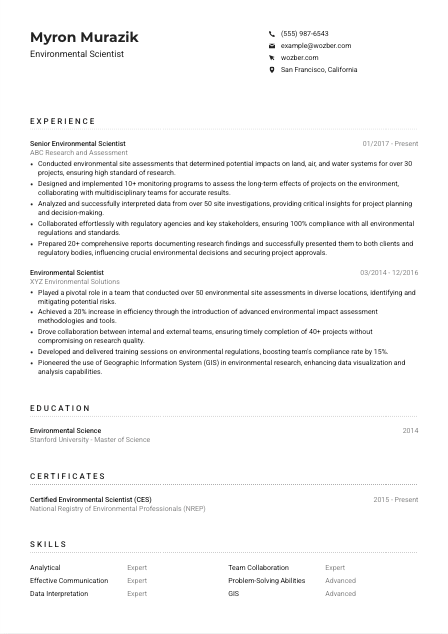
Environmental Scientist hiring turns quickly on whether your resume shows real field and analytical range. Teams want to see that you can assess impacts across land, air, and water systems, interpret investigation data, work within regulatory frameworks, and turn technical findings into reports that clients and agencies can act on.
When that experience is tailored to the posting, the resume becomes much easier to sort in both human review and ATS screening. Wozber's free resume builder helps you align your language with the role, keep an ATS-friendly resume format, and surface the parts of your background that matter most here, such as site assessments, monitoring programs, compliance work, and report writing.
This section does a practical job in Environmental Scientist hiring. It should identify you clearly, confirm that you are reachable for field, office, or client-facing work, and address any location requirement without wasting space.
Use your full name in a larger, clean font so it stands apart from the rest of the document. Environmental consulting teams and research managers often review many resumes in sequence, so your name should be immediately visible and easy to match with your email, phone, and application record.
Place "Environmental Scientist" under your name if that is the position you are targeting. This keeps your resume aligned with the job from the first line and helps when the opening is being screened against closely related profiles such as ecologists, environmental specialists, or compliance analysts.
List a phone number you answer and a professional email address in a simple format. If your work involves field coordination, stakeholder meetings, or regulatory presentations, hiring teams need to know they can reach you quickly and without confusion.
If the employer specifies a city or state, show it. In the example, listing San Francisco, California immediately answers a stated requirement and removes questions about relocation or local availability. Keep this kind of location tailoring for postings that explicitly ask for it.
A LinkedIn profile, portfolio, or professional site can help if it includes useful material such as project summaries, publications, GIS work, technical presentations, or environmental reports. Skip it if the content is sparse or outdated. Every link on the page should deepen the reader's understanding of your environmental work.
Your personal details should answer the basics fast: who you are, what role you do, how to contact you, and whether you meet any location requirement. Once that is clear, the rest of the resume can stay focused on assessments, analysis, and compliance work.




For Environmental Scientists, experience carries the most weight when it connects fieldwork, analysis, regulatory coordination, and written reporting. Hiring teams look for proof that you have handled real sites, real data, and real compliance expectations, not just general research exposure.
Read the posting and mark the recurring responsibilities before you edit your bullets. For this kind of role, that usually means site assessments, monitoring design, data interpretation, collaboration with agencies or stakeholders, and technical reporting. Then shape your experience so those themes appear in your own language, backed by real projects and outcomes.
Start with your most recent role and move backward. In environmental science, this helps employers quickly see your current technical level, whether you are leading assessments, running monitoring programs, managing compliance interactions, or contributing as part of a broader project team.
Each bullet should show what you did, the environmental or business context, and what changed because of your work. The example does this well by tying site assessments to over 30 projects, monitoring programs to long-term environmental effects, and reports to project approvals. That combination of scope and result reads much stronger than generic task lists.
Numbers matter here because they show operational scale. Use counts of assessments completed, investigations analyzed, monitoring programs designed, compliance rates maintained, reports submitted, approvals supported, or efficiency gains from improved methods or tools. Metrics like these show the size and consistency of your contribution.
Prioritize experience that supports the target role, especially work tied to impact assessment, sampling, interpretation, mapping, permitting support, remediation, compliance, or cross-functional environmental projects. If an older role is less relevant, keep the description brief and use the space for stronger examples of scientific, regulatory, or field-based work.
By the end of this section, a hiring team should be able to picture the kinds of sites you have worked on, the data you have handled, the agencies or stakeholders you have dealt with, and the decisions your reporting supported. That is the level of detail that moves an Environmental Scientist resume forward.
Environmental Scientist roles often have a clear degree requirement, so your education section needs to make that qualification easy to confirm. After that, it can reinforce your scientific grounding in ecology, environmental systems, field methods, analysis, or related disciplines.
If the role asks for a Bachelor's degree in Environmental Science, Ecology, or a related field, make that degree easy to spot. In the example, a Bachelor of Science in Ecology directly supports the requirement, while the master's degree adds depth. Use the degree title, field, school, and graduation year in a clear order.
List school, degree, field, and date without extra formatting flourishes. Recruiters and hiring managers often scan this section quickly to confirm core qualifications before returning to experience, so clarity matters more than decoration.
Environmental hiring is full of adjacent academic backgrounds, so specificity helps. "Environmental Science," "Ecology," "Earth Science," or another directly related discipline gives more context than a broad label alone and helps connect your academic training to field assessment and environmental analysis work.
Early-career candidates can benefit from listing relevant coursework, field research, thesis work, lab methods, GIS projects, hydrology studies, or impact assessment assignments. For more experienced professionals, include these details only if they add something your work history does not already cover.
Honors, research assistantships, publications, or field-study projects can be useful if they relate to environmental monitoring, data interpretation, regulatory topics, or ecosystem analysis. Keep them if they sharpen your scientific profile. Leave them out if they distract from stronger professional experience.
This section should confirm that you meet the academic baseline and show the scientific training behind your work. Once those points are obvious, the hiring focus returns to your site experience, analytical judgment, and reporting record.
Certifications are rarely the first thing that decides an Environmental Scientist hire, but they can strengthen your profile when they reflect recognized environmental practice, regulatory knowledge, or continuing technical development. Present them as relevant credentials, not as filler.
Look for credentials that connect to environmental assessment, compliance, sampling, remediation, health and safety, or related scientific practice. A certification such as Certified Environmental Scientist fits naturally because it reinforces professional standing in the field, even when the posting does not list a required credential.
A shorter list of directly relevant certifications is stronger than a long inventory of marginal ones. Choose credentials that help explain your environmental specialization, your familiarity with standards, or your ongoing work in technical and regulated environments.
Include issue dates or active periods for credentials that are current, renewable, or especially relevant to present work. In regulated and technical roles, dates help employers understand whether a certification reflects current practice or older training.
Environmental regulations, assessment methods, and monitoring tools change over time. Relevant certifications can show that you have stayed engaged with the field beyond your degree, especially if your recent work involves compliance coordination, updated methodologies, or specialized technical systems.
Use certifications to reinforce professional credibility and current practice. They should support the story already told in your experience section, especially around assessment methods, compliance work, and technical judgment.
A skills section works best when it reflects how Environmental Scientists actually operate. That means combining technical methods, analytical strengths, and collaboration skills that support field investigation, interpretation, compliance, and reporting.
Start with the language in the posting and identify the abilities tied to the work itself. Here, that includes environmental impact assessment methodologies, analytical and problem-solving ability, data interpretation, communication, and collaboration with multidisciplinary teams. Those terms belong on the resume only when your experience backs them up.
Environmental Scientists need both. Technical skills might include GIS, environmental impact assessment, sampling, water quality testing, data analysis, or monitoring design. Interpersonal skills matter too because the role often involves coordination with project managers, engineers, regulatory agencies, clients, and community stakeholders.
Keep the section focused on what is most useful for the job you are pursuing. In the example, skills such as Data Interpretation, GIS, Environmental Impact Assessment, and Effective Communication support both the scientific and reporting demands of the role. Remove lower-value items if they compete with stronger, more relevant capabilities.
Your skills list should echo the work shown in your experience, not try to replace it. When the right technical and communication skills appear in both sections, your Environmental Scientist profile reads as consistent and credible.
Language ability is a smaller section, but it can matter in Environmental Scientist work that involves field teams, community communication, client meetings, or regulatory coordination. Present it clearly and keep the emphasis on practical proficiency.
Some roles state this directly. Here, fluent English is a clear requirement, so it should appear first with an accurate proficiency level. That matters because the job includes presenting findings, interpreting correspondence, and collaborating across teams and agencies.
Order matters. Lead with the language that directly supports the role, then list any additional languages that may be useful for fieldwork, stakeholder outreach, or work in multilingual communities.
Additional languages can strengthen your profile, especially in public-facing environmental work or projects involving diverse communities, contractors, or regional partners. In the example, Spanish is a useful secondary language because it expands communication range, even though it is not listed as a requirement.
Use plain levels such as Native, Fluent, Intermediate, or Basic. Environmental work often depends on precise communication in reports, briefings, and site discussions, so overstating language ability can create problems later.
Only include languages that you can genuinely use in a professional setting or that strengthen your candidacy for the target role. This section works best when it supports communication needs tied to field coordination, reporting, outreach, or stakeholder engagement.
List language skills in a way that supports the communication demands of the job. For Environmental Scientist roles, that usually means making English proficiency clear first, then adding any other languages that expand your effectiveness in the field or with stakeholders.
Your summary needs to do more than repeat your title. In a few lines, it should establish your level of experience, the kind of environmental work you handle, and the value you bring across assessment, analysis, compliance, and reporting.
Pull out the main themes first. For this role, that means environmental research or fieldwork, impact assessment, data interpretation, communication, and work with regulatory or multidisciplinary teams. Your summary should reflect that mix rather than offering a generic statement about passion for the environment.
Start with a clear line that tells the reader who you are professionally. The example summary does this effectively by stating more than 7 years of experience and naming research, assessment, and fieldwork as core strengths. That immediately gives context for everything that follows.
Bring in important phrases from the posting where they fit your real background. Terms such as "environmental impact assessment," "data interpretation," "site assessments," or "compliance" can strengthen ATS optimization and make your summary sound aligned with the work, as long as they are supported elsewhere in the resume.
Aim for a short paragraph that captures expertise and practical value. Mention the work you do best, the environments you support, and the results you influence, such as project planning, regulatory decisions, risk identification, or long-term monitoring. Four tight lines will usually outperform a broad, abstract introduction.
A well-written summary should make the reader expect solid experience in assessment, analysis, compliance, and communication before they even reach your work history. That is the right opening position for an Environmental Scientist application.
Once each section reflects the actual demands of Environmental Scientist work, your resume starts reading like a project-ready profile rather than a generic science background. Site assessments, monitoring design, data interpretation, agency coordination, and report writing should be easy to find and easy to trust.
Wozber's free resume builder can help you shape that content into an ATS-compliant resume, refine wording with AI-assisted tailoring, and check alignment through its ATS resume scanner. Use those tools to sharpen how your experience is presented, then submit a resume that makes your environmental judgment and field capability clear from the first page.




