



Use Wozber and land your dream job
Create Resume
No registration required
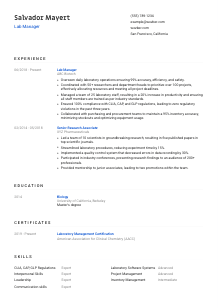
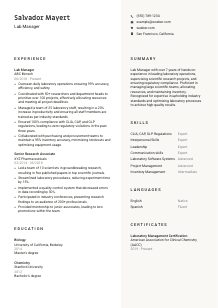
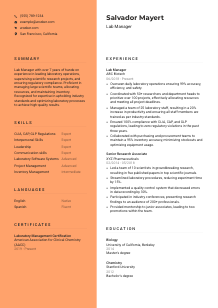
Running experiments but feeling your resume is a mix-up? Check out this Lab Manager resume example, created with Wozber free resume builder. It shows how to calibrate your lab leadership to match job criteria, ensuring your career doesn't undergo any unexpected reactions!
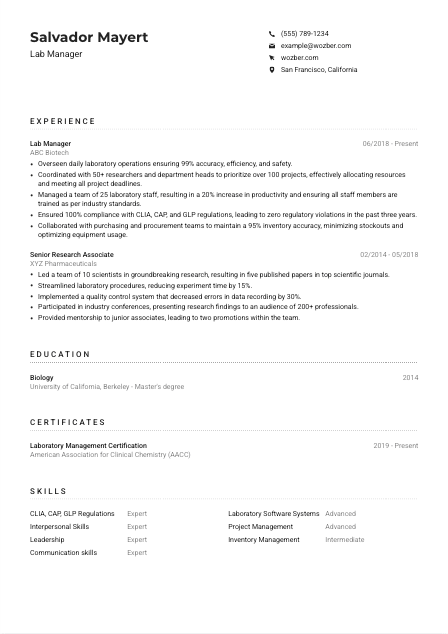
Lab managers sit at the point where scientific work meets operational discipline. Hiring teams look for someone who can keep experiments, testing workflows, equipment, staffing, and regulatory obligations moving without loss of accuracy or safety. Your resume needs to show that you have managed real lab operations, not just supported them, and that you can keep quality standards intact while multiple projects compete for time and resources.
A tailored resume makes that operating range easier to recognize quickly, especially when screening for leadership scope, compliance exposure, and laboratory systems experience. Wozber's free resume builder helps you shape an ATS-compliant resume around the language of the role, so core details like CLIA, CAP, GLP, staff supervision, and project coordination surface clearly before a hiring team decides whether you can run the lab day to day.
This section should identify you fast and remove avoidable friction. For a Lab Manager opening, the basics matter more than flair: the right title, reliable contact details, and any location requirement stated in the posting.
Use your full name in a clean, readable format that stands out from the rest of the page. Keep it professional and easy to scan, since this section anchors the whole document and sets the tone for a role built on organization and precision.
Place "Lab Manager" directly below your name when that is the role you are pursuing. This immediately frames your background around laboratory leadership rather than a broader research or technical profile, which is especially useful if your earlier roles include titles like Senior Research Associate or Scientist.
Include a phone number you answer and a professional email address, ideally in a simple format such as firstname.lastname@domain.com. In lab operations hiring, sloppy contact details can undercut an otherwise strong presentation of compliance, documentation, and oversight discipline.
If the employer specifies a location, include it clearly. In this example, listing "San Francisco, California" directly answers the stated requirement and avoids questions about relocation timing or local availability.
Include LinkedIn or a professional website if it supports your case with publications, laboratory leadership history, certifications, or project work. Make sure the information matches your resume, especially titles, dates, and measurable achievements tied to lab operations or regulatory work.
Keep your personal details clean, accurate, and aligned with the posting. For a Lab Manager resume, this section should confirm that you are easy to contact and already positioned for the scope of the role.




The experience section carries most of the hiring weight for a Lab Manager. Employers want to see how you handled daily operations, supervised staff, balanced competing priorities, maintained compliance, and kept the lab productive under real constraints.
Read the posting for its operational priorities, then bring forward the work that speaks to them. If the role emphasizes daily laboratory oversight, project prioritization, safety, and accuracy, lead with bullets that show you managed workflows, coordinated resources, and maintained quality standards. The sample does this well by opening with operational control, project coordination, and regulatory compliance rather than generic research tasks.
List your most recent role first and work backward. For lab leadership positions, this format makes it easier to see your supervisory growth, such as moving from hands-on scientific work into responsibility for staff management, cross-functional coordination, or lab-wide process control.
Each bullet should show what changed because of your work. Focus on outcomes a Lab Manager is actually hired to deliver: stronger accuracy, better turnaround, smoother project allocation, improved productivity, fewer stockouts, cleaner audits, or stronger team performance. For example, managing 25 staff members and increasing productivity by 20% says far more than "supervised lab team."
Metrics make your scope tangible. Good Lab Manager metrics include accuracy rates, project volume, team size, audit results, turnaround improvements, equipment uptime, inventory accuracy, training completion, or error reduction. In the example, figures like 99% accuracy, 100+ projects, zero regulatory violations, and 95% inventory accuracy give hiring teams a quick read on scale and control.
Prioritize work that supports lab management responsibilities over older or narrower technical detail. Research achievements can still help, especially if they show process improvement, mentoring, or quality control, but the resume should keep returning to the business of running a lab: people, protocols, priorities, compliance, and resources.
Your experience should make it easy to picture you managing the floor, the team, and the standards at the same time. If the bullets show operational range and measurable control, the section is doing its job.
Education matters in Lab Manager hiring because it establishes your technical foundation and often helps distinguish candidates who can lead in regulated scientific environments. Keep the section direct and aligned with the degree level and field the employer asks for.
Pull the educational requirement straight from the job description and make sure your resume answers it clearly. Here, the employer asks for a bachelor's degree in Biology, Chemistry, or a related scientific field, with a master's preferred, so relevant science degrees should be visible without the reader having to search.
List degree, field of study, school, and graduation year in a consistent order. For a Lab Manager resume, clarity matters more than decoration because the section is usually scanned quickly to confirm scientific training and degree level.
Lead with the highest relevant degree, especially if it strengthens your match. In the sample, a Master's degree in Biology followed by a Bachelor's degree in Chemistry mirrors the stated preference well and supports both scientific depth and role alignment.
Coursework, thesis work, or major projects are worth adding only if they connect to the target position. That might include work related to laboratory operations, quality systems, instrumentation, or regulated environments. Skip extras that do not strengthen your management profile.
If you have recent workshops, advanced training, or formal study tied to laboratory compliance, management, or specialized systems, mention them where appropriate. In a field shaped by changing protocols and standards, current learning can support your credibility, especially if your degree is older.
Keep education practical and easy to verify. A Lab Manager resume should show the scientific background the role requires, with higher-level study and relevant specialization visible at a glance.
Certifications can strengthen a Lab Manager resume when they point to regulated lab work, management capability, or specialized operational knowledge. They work best when they support the actual responsibilities of the role instead of filling space.
Look at the posting and identify where a certificate can add weight. For this role, familiarity with laboratory software systems, regulations, and best practices such as CLIA, CAP, and GLP makes compliance-focused or laboratory management credentials especially relevant.
List certificates that connect directly to how labs are run. A Laboratory Management Certification, quality systems credential, or compliance-related training tells a clearer story than a generic professional development course. The example's AACC-issued laboratory management certificate supports supervisory scope and operational responsibility well.
Add the issue date and, if relevant, the active period or renewal status. This is especially useful for certifications connected to current standards, regulated workflows, or ongoing professional maintenance.
If you are moving from senior scientific work into broader lab leadership, targeted certifications can help bridge that shift. Prioritize training in laboratory management, quality assurance, compliance frameworks, or systems administration over certificates that do not relate to staffing, operations, or regulation.
Certificates should sharpen your case for overseeing a regulated lab environment. When they connect directly to compliance, operations, or leadership, they add credibility without distracting from your core experience.
Lab Manager skills need to reflect both scientific operations and people leadership. The best skills section quickly shows that you can run compliant workflows, coordinate resources, work across departments, and manage a team in a demanding lab setting.
Start with the required and repeated language in the job description. In this case, that includes laboratory software systems, CLIA, CAP, GLP familiarity, interpersonal communication, collaboration, multitasking, deadline management, and supervisory ability.
Place the most relevant operational and leadership skills first. For a Lab Manager, that often means regulatory knowledge, leadership, laboratory systems, project coordination, communication, inventory control, and staff development. The sample skills list works because it centers compliance and leadership before secondary capabilities.
Avoid turning this section into a long catalog of every technical ability you have used. Choose the skills that best support the employer's main concerns, then let the experience section prove them. A shorter list of well-chosen lab management skills reads as more intentional and credible.
A focused skills section should confirm that you understand what the lab needs to run well. Prioritize the tools, regulations, and leadership capabilities that support daily operations and compliance.
Language skills matter in lab management when they affect documentation, team communication, training, and coordination with researchers or department leaders. Present them clearly, especially when the posting names a required language.
If the job description specifies a language, list it clearly with your proficiency level. Here, proficient English communication is required, so English should appear prominently because it supports reporting, supervision, training, and cross-functional coordination.
Use clear levels such as Native, Fluent, Intermediate, or Basic. Lab managers often handle SOP communication, performance discussions, incident documentation, and cross-team updates, so accuracy matters more than sounding impressive.
Additional languages can be useful in diverse lab environments, especially for training, team communication, or collaboration across global research groups. In the example, Spanish adds range without distracting from the core English requirement.
Only claim a level you can use in real professional situations. If you list a language as fluent, be prepared to discuss procedures, instructions, or workplace issues in that language.
Extra languages are usually supportive rather than central for Lab Manager hiring unless the employer says otherwise. Include them when they are genuine strengths, but keep the focus on the communication needed to run the lab effectively.
List language skills with the same accuracy you would bring to lab records. For this role, clear English proficiency is essential, and any additional language should support real workplace communication.
The summary should read like a concise operating profile, not a generic introduction. For a Lab Manager, it needs to establish your leadership level, laboratory scope, and the specific strengths you bring to compliance, team management, and day-to-day execution.
Before writing, identify the two or three points the employer cares about most. For this job, that includes daily lab oversight, staff management, regulatory compliance, project coordination, and the ability to handle multiple priorities reliably. Those themes should shape the summary from the first line.
Start with a direct description of who you are professionally. Mention your title or specialty area and your years of relevant laboratory experience so the reader can place your level immediately. The sample summary does this by establishing hands-on lab leadership experience early.
Use the next lines to highlight the parts of your background that match the role's operating demands. Mention leadership of laboratory staff, familiarity with regulated standards, resource allocation, process improvement, or laboratory systems if those are genuine strengths backed by the resume.
Aim for 3 to 5 lines with no filler. Strong Lab Manager summaries use specific language such as laboratory operations, compliance, inventory, staffing, and project prioritization instead of broad claims about being driven or results-oriented.
A good summary should let the reader quickly understand your level, your scope, and the kind of lab environment you can manage. When it mirrors the operational demands of the job, the rest of the resume lands more cleanly.
A Lab Manager resume should show that you can keep scientific work moving under control: accurate operations, compliant processes, reliable staffing, and clear coordination across teams. When each section points back to that standard, your application reads as management-ready instead of technically adjacent.
Use Wozber's free resume builder to shape your content into an ATS-friendly resume format, align your wording with the posting, and refine details with an ATS resume scanner where needed. The final document should make one conclusion easy to reach: you can run the lab with consistency, safety, and sound judgment.