




Use Wozber and land your dream job
Create Resume
No registration required
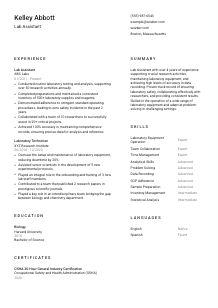
Juggling test tubes, but your resume doesn't mix well? Check out this Lab Assistant resume example, created with Wozber free resume builder. It shows how to crystallize your practical sciences savvy to match job formulas, launching your career as precisely as a pipette's measured drop!
Lab assistant hiring often turns on practical lab habits, not broad scientific interest. Teams want to see whether you can handle routine testing accurately, keep equipment and reagents in working order, follow SOPs without shortcuts, and document results cleanly enough for researchers to trust the data. Your resume should make those day-to-day lab contributions visible from the start.
When that detail is tailored to the posting, the resume reads less like a general science background and more like someone who can step into the bench work quickly. Wozber's free resume builder helps organize that experience into an ATS-friendly resume format, so requirements such as laboratory testing, inventory control, safety compliance, and recordkeeping are easy to pick up in both screening and human review. That makes your operational value clearer right away.
Lab environments run on accuracy, and your header should reflect the same standard. This section is simple, but mistakes here can create friction before anyone gets to your testing experience, equipment handling, or safety record.
Use your full name in a larger, clean font at the top of the page. Skip nicknames unless that is how you are known professionally in publications, lab rosters, or internal documentation. The header should feel as orderly as a well-labeled sample.
Place "Lab Assistant" under your name if that is the role you are pursuing. This keeps your resume aligned with the posting and helps frame your background around lab support, testing, inventory, and SOP-driven work instead of a broader science label.
List a reliable phone number and a professional email address. Double-check every character. If a hiring team wants to ask about your experience with routine analysis, equipment maintenance, or research support, they should not run into a typo first.
If the posting requires local availability, show that clearly. Here, Boston, Massachusetts is part of the requirement, so including Boston in your personal details removes an obvious question early. Treat this as job-specific tailoring, not a rule for every lab assistant resume.
Include LinkedIn, a professional profile, or a research-focused site if it supports your lab background. That might mean coursework, publications, technical projects, or a fuller work history. Keep it consistent with the resume and relevant to scientific work rather than general social links.
Your contact section should confirm professionalism and remove logistical questions quickly. For a lab assistant application, that means clear identity, direct role targeting, accurate contact details, and any location requirement the employer has stated.




This section carries the most weight because lab assistant work is judged through execution. Hiring teams look for signs that you can run routine testing, support research workflows, keep materials organized, maintain equipment, and produce records that others can rely on.
Start by marking the responsibilities and requirements that define the job. For this opening, that includes routine laboratory testing, inventory of supplies and reagents, SOP and safety compliance, collaboration with researchers, equipment use, and detailed recordkeeping. Those themes should shape which bullets you keep and how you phrase them.
Present your most recent laboratory work first. Include your job title, employer, and dates without clutter. If your past titles vary, such as "Laboratory Technician" and "Lab Assistant," the bullets should make the connection clear by emphasizing comparable bench work, protocol support, and equipment responsibilities.
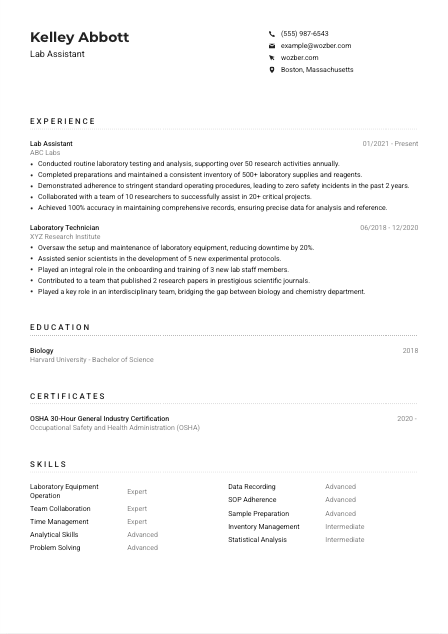
Replace vague task lists with accomplishment bullets that show volume, accuracy, or operational contribution. The sample resume does this well with points like supporting more than 50 research activities annually, maintaining 500+ supplies and reagents, and achieving zero safety incidents over two years. Those details tell a hiring team how you worked, not just what you touched.
Quantify what matters for laboratory work: number of tests run, projects supported, supplies tracked, downtime reduced, protocols maintained, records completed, or safety performance over time. Metrics should feel native to lab operations. A line about reducing equipment downtime by 20% is more persuasive here than a generic claim about being efficient.
Prioritize experience that strengthens your case for this kind of role. Research support, sample preparation, instrument upkeep, documentation accuracy, and cross-team collaboration all belong. If an older role is less relevant, trim it down so the resume stays focused on the work this employer needs covered.
Your experience should show that you can contribute to a working lab without heavy hand-holding. When the bullets reflect testing volume, safety discipline, equipment care, and dependable documentation, the resume reads like a lab assistant already operating at the required standard.
For many lab assistant openings, education is a baseline requirement rather than the main differentiator. It still matters because it confirms your scientific foundation and helps connect your background to the type of lab work, methods, and terminology used in the posting.
If the employer asks for a bachelor's degree in Biology, Chemistry, or a related scientific field, make that information easy to spot. A degree such as "Bachelor of Science in Biology" directly answers the requirement and should not be buried behind extra detail.
List the degree, field, school, and graduation year in a straightforward structure. That makes it easier for both recruiters and ATS parsing to identify your academic qualification quickly, especially when they are screening for a specific science background.
If your degree closely matches the posting, show that exact fit. In the example, a Biology degree lines up well with the stated requirement. If your degree is in a related discipline, keep the wording clear enough that the scientific relevance is obvious.
If you are earlier in your career, relevant laboratory courses, research projects, or capstone work can strengthen the section. Focus on work that connects to testing, data collection, sample handling, instrumentation, or experimental documentation rather than listing every science class you took.
Honors, scholarships, research assistantships, or memberships in scientific organizations can add useful depth when they support your lab profile. Keep these brief and relevant. They should reinforce your scientific training, not distract from your practical laboratory experience.
This section should confirm that your scientific training matches the level of lab work expected. Keep it direct, accurate, and easy to scan so the reader can move quickly from your academic foundation to your hands-on experience.
Certifications matter most when they reinforce how you work in a laboratory. Safety training is especially useful because it shows familiarity with regulated environments, standard procedures, and the discipline required around chemicals, samples, and equipment.
When a job mentions laboratory safety certification, put that credential front and center. An OSHA 30-Hour General Industry Certification, as shown in the example, is a strong fit because it supports the employer's emphasis on SOP adherence and safe lab practice.
List credentials that strengthen your candidacy for lab support work, such as safety, hazardous materials handling, quality systems, or technical instrument training. This section does not need every certificate you have earned, only the ones that connect to the role's operating environment.
Add the issuing body and the date earned, and include validity details if they matter. That gives the credential credibility and shows whether the training is current, which is particularly important for safety-related certifications.
If you are actively adding certifications, choose ones that support the kind of labs you want to work in. Safety refreshers, equipment-specific training, quality control practices, or regulated lab procedures can all strengthen future applications.
Relevant certifications give extra weight to your lab profile, especially when they confirm safe working habits and procedural discipline. For a role built around routine testing and controlled processes, that can be a meaningful advantage.
A lab assistant skills section should read like the toolkit behind your daily work. Employers are looking for practical capability here: handling instruments, following procedures, recording data accurately, solving routine problems, and supporting researchers without disrupting the workflow.
Start with the language in the job description, then match it against what you have actually used. For this role, that includes laboratory equipment operation, inventory management, analytical thinking, problem-solving, recordkeeping, and SOP compliance. Those are stronger choices than broad terms with no lab context.
Lead with hard skills tied to bench work, such as sample preparation, equipment maintenance, data recording, and statistical analysis where relevant. Then add a few soft skills that matter in a shared lab environment, such as collaboration, time management, and communication with researchers or senior scientists.
Resist the urge to turn this into a full inventory of everything you can do. A tighter list is more convincing when each skill connects back to actual laboratory tasks. The example resume works because the selected skills map directly to the posting rather than filling space with generic strengths.
This section should confirm that your background matches the rhythm of lab operations. When the skills are specific, relevant, and grounded in the posting, they reinforce the experience section instead of repeating it in vaguer language.
Communication in a lab is practical. Instructions, safety procedures, experiment notes, and handoffs all depend on clear language, so this section matters when the posting names a required proficiency.
If English speaking proficiency is required, list English clearly and use an honest proficiency level. That directly addresses the posting and supports your ability to follow instructions, discuss results, and maintain accurate records.
Additional languages can be worth listing, especially in research settings with diverse teams, external collaborators, or multilingual documentation needs. They are a bonus, though, not a substitute for the required working language.
Stick to familiar terms such as "Native," "Fluent," "Advanced," or "Intermediate." Clear labels make the information usable at a glance and avoid uncertainty about whether you can actually communicate in a lab environment.
Language skills matter most when they support day-to-day work such as verbal instructions, written documentation, and collaboration across teams. If a second language adds value in your target setting, include it. In the example, Spanish supports broader communication without overshadowing the required English proficiency.
If you are learning another language, include it only when it is relevant and you can describe the level honestly. For most lab assistant resumes, fluent operational communication matters more than listing a language at a very early stage.
For a lab assistant application, languages should confirm that you can communicate safely and accurately in the working environment. Keep the section brief, credible, and tied to the communication demands of the lab.
The summary sets the reading direction for the rest of the resume. For a lab assistant, it should quickly establish your laboratory experience, the kind of support work you handle well, and the standards you work to, especially around safety, equipment, and documentation.
Read the posting closely before writing the summary. If the role centers on routine testing, research support, equipment use, inventory control, and SOP adherence, those ideas should shape the opening lines rather than a generic statement about loving science.
Open with your title and years of relevant experience. A line such as "Lab Assistant with over 4 years of experience supporting research activities" works because it immediately places you in a laboratory context and signals practical familiarity with the work.
Choose strengths that match the employer's priorities. For this posting, that might include operating and maintaining lab equipment, keeping detailed experimental records, supporting researchers across projects, or maintaining strong safety compliance. The sample summary also benefits from mentioning data accuracy and problem-solving in realistic lab terms.
Aim for three to five lines that a hiring manager can absorb quickly. Avoid filler about passion or ambition. Use the space to show the mix of experience, lab discipline, and research support you would bring into the role.
Your summary should make the rest of the resume easier to interpret. When it clearly states your lab background, technical strengths, and working habits, the hiring team can quickly place you in the kind of environment they are staffing.
A lab assistant resume works when it shows dependable execution. That means clear evidence of routine testing, careful recordkeeping, equipment familiarity, safety discipline, and useful support for researchers and scientists.
Wozber's free resume builder helps shape that content into an ATS-compliant resume, and its ATS resume scanner can help you align language from the posting with the right sections of your experience, skills, and summary. Use that structure to make your laboratory background easy to recognize.
When the final resume reads like someone who can step into the lab, follow procedure, and keep the work moving accurately, you are ready to apply.




