



Use Wozber and land your dream job
Create Resume
No registration required
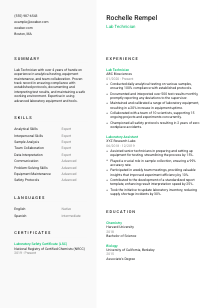
Mixing chemicals, but your resume doesn't react? Check out this Lab Technician resume example, created with Wozber free resume builder. Learn how to clearly measure and present your scientific skills to match job requirements, paving a career path as precise as your experimental results!
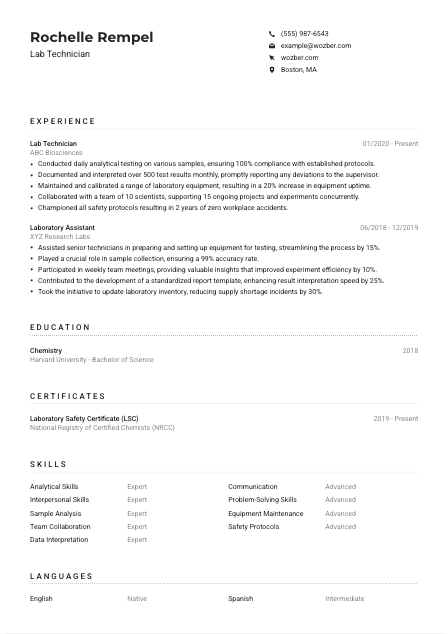
Lab Technician resumes are screened quickly for practical laboratory range. Hiring teams want to see who can run routine and non-routine testing accurately, keep instruments in working order, document results cleanly, and follow safety procedures without creating extra supervision overhead. Vague science language usually hurts candidates here because lab work is judged through protocols, sample handling, data accuracy, and day-to-day reliability.
A tailored resume changes the first read from
generic science background
to clear laboratory relevance. When your wording reflects the posting's mix of analytical testing, equipment calibration, result reporting, and team support, Wozber's free resume builder helps you shape that experience into an ATS-friendly resume format that surfaces the right terminology early. That makes it easier for a hiring manager to see whether you can step into the lab and contribute with minimal ramp-up.
For Lab Technicians, the header does a practical job. It confirms who you are, whether you meet basic location and contact requirements, and whether the role title matches the kind of laboratory work you are targeting. Keep this section clean, direct, and easy to scan.
Your name should be the most visible line on the page. Use standard formatting, not decorative styling, so the document reads cleanly in both human review and ATS parsing.
Place
Lab hiring moves around interview scheduling, shift coordination, and quick follow-up, so your contact details need to be correct and professional.
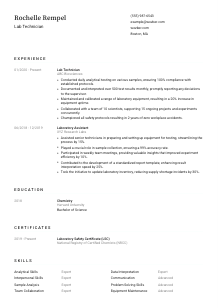
If a posting asks for local availability or relocation, show that clearly in your city and state line. In this example, listing Boston, MA directly answers a stated requirement and removes doubt about relocation timing.
Include LinkedIn or a professional profile only if it supports your application with matching information, certifications, publications, or project work. For laboratory roles, consistency matters more than extra links, so make sure any profile reflects the same titles, dates, and credentials as your resume.
This section should confirm the basics in seconds: who you are, what role you do, how to reach you, and whether you meet immediate logistics such as location. In lab hiring, that kind of clarity helps the rest of your technical background land faster.




This is the section most likely to decide whether your resume stays in the stack. For a Lab Technician, employers look for sample testing, documentation habits, equipment handling, protocol compliance, collaboration with scientists or researchers, and a record of safe lab practice. Spell out the work, not just the job title.
Read the job description like a workflow checklist. Mark the recurring responsibilities such as analytical testing, interpreting results, reporting deviations, calibrating equipment, supporting experiments, and following safety procedures. These are the duties your bullet points should echo with your own experience and wording.
Use reverse chronological order and give each role enough structure to stand on its own: title, employer, and dates. That format helps the reader track your lab progression, whether you moved from laboratory assistant work into full technician responsibility or expanded from routine testing into broader project support.
Each bullet should show what you handled and what came from it. Strong lab bullets often include sample volume, compliance rates, turnaround, documentation quality, equipment reliability, or project support. The example bullet about documenting and interpreting more than 500 test results monthly works because it pairs a core responsibility with scale and reporting discipline.
Numbers are especially effective here when they reflect actual lab performance. Think in terms of test volume, accuracy, protocol compliance, equipment uptime, incident reduction, turnaround time, or the number of active projects supported. A line like
If a past accomplishment does not reinforce testing, documentation, equipment use, collaboration, safety, or analytical problem-solving, move it down or remove it. Lab Technician resumes work best when every bullet points back to how you function in a controlled laboratory environment.
Your experience section should leave little guesswork about the kind of lab you can support and how reliably you work inside protocols. When the bullets show testing scope, instrument care, result reporting, and safe execution, your background reads as immediately usable.
Most Lab Technician roles still use education as an initial filter, especially when the work involves analytical methods, sample integrity, and protocol-driven testing. Present your degrees so the scientific foundation is easy to confirm.
If the posting asks for a bachelor's degree in Biology, Chemistry, Medical Technology, or a related scientific field, put the qualifying degree first. In the example, the Bachelor of Science in Chemistry directly supports the stated education requirement.
List school, degree, field, and graduation year in a consistent order. This helps both ATS systems and hiring teams confirm your academic background without digging through extra text.
Use the exact degree and field wording where possible. If your background is adjacent rather than identical, name the field precisely and let your experience carry the rest. For laboratory jobs, the field of study matters because it points to your grounding in analytical methods, scientific reasoning, and lab coursework.
Recent graduates or candidates with limited lab employment can use relevant coursework, capstone projects, or supervised lab work to show hands-on exposure. Include details only when they connect to testing methods, instrumentation, research support, or data interpretation.
Honors, thesis work, or standout research activity can help when they are directly tied to laboratory discipline or scientific rigor. Keep them if they sharpen your technical profile. Leave them out if they distract from stronger professional experience.
Your education section does not need much space, but it should quickly confirm that you have the academic preparation for structured laboratory work. When the degree, field, and any relevant extras are easy to read, the reviewer can move on to your hands-on experience with confidence.
Certifications are not always mandatory for Lab Technician jobs, but the right ones can reinforce safety awareness, regulatory discipline, and specialized technical preparation. They are especially useful when they connect directly to the lab environment you want to work in.
Look for certificates tied to laboratory safety, quality procedures, specimen handling, instrumentation, or regulated environments. Even when a posting does not require one, a relevant credential can support your case. The Laboratory Safety Certificate in the example is a good illustration because safety compliance is part of the role.
A short list of meaningful certifications beats a long list of loosely related courses. Choose the credentials that support how you work in the lab, such as handling hazardous materials, following SOPs, or maintaining quality standards.
If a certification is current, renewable, or time-sensitive, include the date or validity range. That detail matters in environments where safety or compliance standards need to be current and documented.
Laboratory methods, equipment, and compliance expectations change over time. Updating your certifications signals that you stay current with safety practices and operational standards rather than relying only on older training.
The right certificate tells a hiring team that you understand the conditions of the lab, not just the science behind it. Keep this section focused on credentials that strengthen trust in your safety habits, technical discipline, or specialized lab readiness.
A Lab Technician skills section should read like a practical operating profile. Employers want a quick view of your testing capabilities, equipment handling, data habits, and collaboration in a controlled environment. Keep the list specific enough to be useful.
Start with the language already used in the posting. Here, that includes analytical and problem-solving skills, laboratory equipment proficiency, communication, and collaboration. Those terms should appear only if they reflect your actual experience.
Lead with the skills most central to daily lab work, such as sample analysis, data interpretation, equipment maintenance, calibration, SOP adherence, and safety protocols. Soft skills matter, but they usually land better after the technical core is established. Rochelle's skill list does this effectively by foregrounding analytical and lab-specific abilities.
Organize the section so a reviewer can quickly spot categories such as analytical work, instrument handling, documentation, and teamwork. This is especially helpful when using Wozber's AI resume builder to align your wording with the posting while keeping the structure ATS-friendly and readable.
Every skill listed should connect to something you can demonstrate in experience, education, or certifications. When the section reflects how you actually test, document, maintain equipment, and work with others in the lab, it adds useful precision instead of generic claims.
Language skills matter in laboratory settings because instructions, reporting, safety procedures, and cross-team communication all depend on precision. Include languages when they strengthen your ability to work in the environment described by the posting.
If the posting calls for high English proficiency, make that visible. This requirement is common when the role involves documenting results, discussing abnormalities with supervisors, and following written protocols accurately.
List English first when it is specifically requested and state your level clearly, such as Native or Fluent. The example does this well, which supports both communication and documentation expectations for the role.
Additional languages can help in diverse research teams, clinical environments, or labs with international collaboration. They are a plus, but they should not crowd out more important technical content elsewhere on the resume.
Choose simple levels such as Native, Fluent, Intermediate, or Basic. Avoid vague wording. In laboratory work, precision in labels matters as much in your resume as it does in reporting test results.
Do not overemphasize languages unless the position truly depends on them. For many Lab Technician openings, English proficiency is the main requirement, while other languages serve as an added collaboration benefit rather than a core hiring factor.
This section should confirm that you can read protocols, document findings, and communicate clearly with supervisors and team members. For most Lab Technician applications, that means making English proficiency unmistakable and keeping any additional languages concise.
The summary sits at the top of the resume, so it should quickly establish your laboratory scope, years of experience, and strongest match points for the role. Keep it short, specific, and tied to the actual work.
Before writing, identify the posting's main themes. In this case, those are analytical testing, equipment maintenance, result interpretation, collaboration, and safety. Your summary should touch the areas where your background is strongest instead of trying to cover everything.
Start with a direct professional label and years of relevant experience. The sample summary opens well with
Follow your opening with details that reflect the posting's priorities, such as compliance with protocols, result documentation, instrument upkeep, or safe laboratory practice. This gives the reader a quick map of where your value sits.
Aim for 3 to 5 lines. Avoid generic traits unless you tie them to actual lab work. A summary should read like a compact professional profile, not a personal statement.
When this section is done well, the reader immediately understands your lab environment, your level of responsibility, and the kind of testing and support work you can handle. That creates a sharper opening for everything that follows.
A Lab Technician resume works best when every section points back to the same operational picture: you can test accurately, maintain equipment, document results properly, support ongoing experiments, and work safely inside established procedures.
Use Wozber's free resume builder to shape that story into an ATS-compliant resume, then refine it with targeted wording, clean structure, and role-matched terminology. The finished resume should make one thing easy to judge: how effectively you will perform in a real laboratory setting from day one.