




Use Wozber and land your dream job
Create Resume
No registration required
Mastering inventive ideas, but feel your resume needs a eureka moment? Check out this Innovation Specialist resume example, created with Wozber free resume builder. It shows how to present your visionary skills to match job specifications, paving the way for your inventive spirit to take center stage in your career!
Innovation work gets reviewed through outcomes, not brainstorming language alone. Hiring teams want to see how you move ideas into structured programs, connect research to product or process decisions, and keep cross-functional groups aligned around business priorities. Your resume should make that operating range visible quickly, from facilitation and market insight to partnership-building and measurable results.
A tailored Innovation Specialist resume also needs to clarify which part of the innovation process you actually own. With Wozber's free resume builder and an ATS-compliant resume structure, you can align your wording with the posting's language around ideation, trend analysis, collaboration, and reporting so the reader can immediately place you in the right lane of innovation work.
Innovation hiring often starts with basic alignment checks before anyone gets to your portfolio of ideas. Your personal details should remove friction, confirm the essentials, and present you as someone ready to step into collaborative, business-facing work.
Use your full name as the top line of the resume and make it easy to read. For a role that involves facilitating sessions, presenting findings, and working with senior stakeholders, a clean header supports the same professional standard you would bring to workshops, reports, and leadership updates.
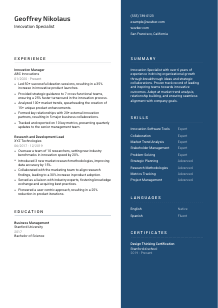
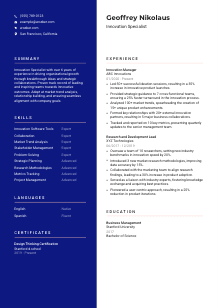
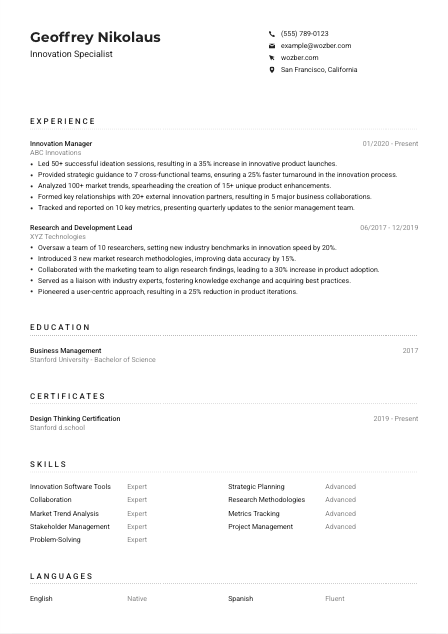
Place "Innovation Specialist" directly under your name if that is the role you are pursuing. Matching the posted title helps recruiters and ATS systems sort your profile correctly, especially when your prior titles may be broader, such as Innovation Manager or R&D Lead.
If the employer asks for local availability, include your city and state exactly. In this example, listing San Francisco, California directly answers a stated requirement and removes any doubt about whether you can work from the needed location.
If you have a LinkedIn profile, personal site, or project portfolio, include it only if it supports your innovation work. Useful additions might show workshop facilitation, product concept development, research-led initiatives, speaking engagements, or collaboration with startups and external partners.
Skip details such as age, marital status, or other non-job-related information. For innovation roles, the focus belongs on strategic thinking, research, facilitation, and execution, not on personal background that has no bearing on performance.
This section should confirm that you are reachable, professionally presented, and aligned with any practical requirement in the posting. Keep it tight and accurate so the reader can move straight to your innovation track record.




Innovation experience needs to do more than show creativity. It should show how you identify opportunities, guide teams through ambiguity, connect ideas to company goals, and report outcomes in terms leadership can act on.
Read the posting for the actual work patterns behind the title. For Innovation Specialist roles, that often includes leading ideation sessions, guiding cross-functional teams, researching market shifts, building external partnerships, and tracking initiative performance. Use those priorities to choose which achievements deserve space and which can be cut.
List your most recent and relevant work first, with job title, company, and dates easy to scan. That format helps hiring teams quickly understand your progression from adjacent work into innovation leadership. In the example, moving from Research and Development Lead to Innovation Manager makes the career path easy to follow and supports the target title naturally.
Bullet points should show what changed because of your work. For this profession, strong outcomes include faster innovation cycles, more successful launches, stronger partner ecosystems, better market insight, or product improvements tied to research. The sample resume does this well by linking ideation sessions to a 35% increase in product launches and cross-functional guidance to a 25% faster process turnaround.
Quantify where the numbers reflect real scope or business value. Useful measures include number of workshops led, number of trends analyzed, speed to prototype or launch, collaboration count, adoption lift, reduction in iteration cycles, or quarterly KPI reporting. Metrics give substance to innovation work that can otherwise sound vague.
Keep the emphasis on work that matches the employer's innovation model. If a posting leans heavily toward strategy and facilitation, lead with workshop leadership, market research, and stakeholder guidance. If it leans toward external ecosystems, bring forward startup partnerships, industry collaboration, and scouting work. Relevance is more persuasive than a longer list of loosely related wins.
By the end of the experience section, the employer should understand how you move ideas from exploration to action. Focus on business outcomes, cross-functional execution, and innovation metrics that show real ownership.
For Innovation Specialist roles, education usually serves as a foundation rather than the main selling point. What matters is how clearly your degree supports strategic thinking, research, and business decision-making in innovation settings.
If the job asks for a bachelor's degree in Business, Management, or a related field, make sure that information is easy to find and written clearly. This is one of the quickest screening checks in many innovation postings, so do not bury it.
List degree, field of study, school, and graduation details if relevant. Avoid overloading the section unless you are early in your career. In the example, "Bachelor of Science in Business Management, Stanford University" gives the hiring team exactly what they need without extra clutter.
When your degree aligns directly with the posting, such as Business Management for a role that values strategic and organizational thinking, keep that field visible. If your degree is in a related discipline, present it clearly and let your experience carry the rest of the case.
Coursework can help if you are early-career, changing direction, or your degree title does not obviously connect to innovation work. Prioritize subjects tied to product development, market research, design thinking, business strategy, entrepreneurship, or organizational change.
Honors, research projects, incubator programs, or capstone work can strengthen this section when they connect directly to innovation practice. If they do not relate to strategy, experimentation, customer insight, or product development, leave them out and keep attention on stronger sections.
Your education section should confirm that you meet the academic baseline and, where useful, reinforce the business or research lens behind your innovation work. Clear presentation is enough here.
Certifications matter most when they sharpen your credibility in a specific innovation method or working style. They are especially useful when the employer mentions structured frameworks such as Design Thinking, innovation methodology, or facilitation practice.
Start with the certifications the employer actually mentions or strongly implies. Here, Design Thinking is preferred, so a credential in that area directly supports the role's emphasis on ideation, structured problem-solving, and team facilitation.
Lead with certificates tied to design thinking, innovation management, research methods, product discovery, agile experimentation, or workshop facilitation. These credentials add more value than generic training because they connect to the day-to-day mechanics of innovation programs.
Add the date earned, and include renewal information if the credential requires it. Recency matters most when the certificate reflects an active methodology or current practice. In the example, a Design Thinking Certification from Stanford d.school supports the posting well because it closely matches the preferred qualification.
Innovation roles change with new frameworks, tooling, and market research practices. Updated certifications can show that you continue to refine how you facilitate teams, test ideas, and evaluate opportunities, especially if your day-to-day work spans strategy and execution.
A well-chosen certification tells the employer that your innovation work is backed by a repeatable approach. Keep the section focused on credentials that deepen your case for leading workshops, guiding teams, and shaping opportunity pipelines.
The skills section should map directly to how innovation gets done inside organizations. Hiring teams want a quick read on whether you can facilitate, analyze, collaborate, and translate ideas into initiatives with measurable follow-through.
Use the posting to identify both technical and interpersonal skills worth listing. For an Innovation Specialist, that usually includes innovation software tools, market research, trend analysis, strategic planning, stakeholder management, workshop facilitation, and cross-functional collaboration.
List skills you can support elsewhere in the resume with achievements, tools, or project scope. If you claim market trend analysis, your experience should show research activity or opportunity identification. If you list collaboration, your bullets should show how you guided teams, partners, or senior stakeholders through the innovation process.
Keep the list focused and easy to read, whether you group skills by category or proficiency. The example works because it combines role-specific capabilities such as Innovation Software Tools, Market Trend Analysis, Stakeholder Management, and Metrics Tracking with supporting strengths like Strategic Planning and Project Management.
A hiring manager should be able to glance at this section and understand how you operate in innovation environments. Prioritize skills tied to facilitation, analysis, strategic alignment, and measurable execution.
Innovation Specialists often work across departments, external partners, and leadership groups, so language ability matters most where it supports communication and relationship-building. This section should stay practical and tied to business use.
If the posting specifies English communication ability, list English clearly and indicate your level. That requirement is especially important in roles involving workshop facilitation, strategic recommendations, and presentations to senior management.
Lead with the language the employer needs for meetings, written reports, and partner communication. In this case, English belongs at the top because it is explicitly required for the role.
Additional languages can strengthen your profile when the work touches diverse user groups, global markets, or international startup ecosystems. They are supportive rather than essential unless the posting says otherwise.
Choose standard terms such as Native, Fluent, Conversational, or Basic. Avoid vague wording. The sample's use of "English - Native" and "Spanish - Fluent" works because it gives a quick, practical sense of communication range.
When innovation work includes external experts, startups, or multi-market research, language skills can support relationship-building and discovery. Mention extra languages when they add real context to the kind of collaboration the role involves.
This section works best when it quickly confirms that you can communicate where the role demands it. For innovation work, that means clear writing, confident facilitation, and smooth stakeholder interaction.
The summary should quickly establish the kind of innovation professional you are. It needs to signal your level, your operating strengths, and the business outcomes you are used to influencing without slipping into broad claims about creativity or vision.
Before writing, note the few themes the employer keeps returning to. In this case, the recurring priorities are ideation leadership, strategic guidance, market research, cross-functional collaboration, and metric tracking. Those should shape the summary more than generic innovation language.
Start with your title, years of experience, and the kind of innovation work you handle. A concise opening such as experience in innovation, R&D, or strategic product improvement gives the reader an immediate frame for the rest of the resume.
Use one or two concrete strengths that match the target role closely, such as leading ideation sessions, turning market analysis into product opportunities, or guiding cross-functional teams through innovation initiatives. The sample summary works best where it mentions market trend analysis, strategic collaboration, and alignment with company goals.
Aim for a short paragraph that sounds grounded in actual work. Three to five lines is usually enough. Focus on scope, methods, and outcomes instead of personality traits, and avoid repeating points that already appear in the skills section.
When this section is written well, the employer knows within a few lines whether your background fits their innovation agenda. Keep it specific enough to establish credibility and broad enough to support the rest of your experience.
You now have a framework for presenting innovation experience in a way that hiring teams can read quickly and trust. Use Wozber's free resume builder to organize your content in an ATS-friendly resume format that keeps strategic work, research impact, and collaboration history easy to scan.
Refine the language around ideation, market analysis, stakeholder guidance, and reporting, then check alignment with an ATS resume scanner so the resume reflects the posting without sounding forced. The finished document should make it easy to judge how you lead innovation efforts and what results tend to follow.




