



Use Wozber and land your dream job
Create Resume
No registration required
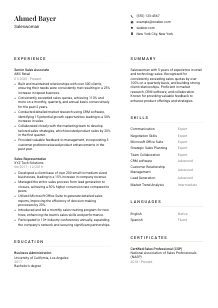
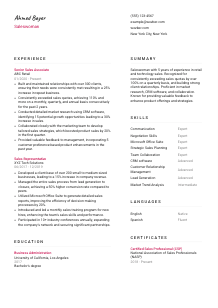
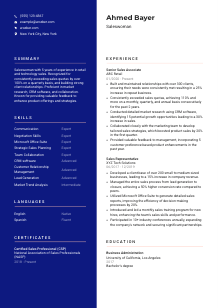
Sealing deals, but your resume isn't closing any chapters? Check out this Saleswoman resume example, created with Wozber free resume builder. Learn how to pitch your sales prowess and customer connection to match job needs, ensuring your career journey is as successful as your closing statements!
Sales hiring moves quickly, and resumes get attention when they show commercial results early. For a Saleswoman role, that usually means a clear record of client relationship building, quota performance, and practical sales execution across a store, territory, or account base. If those results are buried under generic duties, hiring teams cannot tell whether you can bring in revenue, retain customers, or spot growth opportunities.
A tailored resume changes the first read from "sales background" to "relevant revenue contributor." When your wording reflects the posting's priorities, such as CRM use, market analysis, and cross-functional work with marketing, Wozber's free resume builder helps you shape that experience into an ATS-compliant resume that surfaces the right terms and achievements fast. The result is a document that makes your sales track record easier to recognize.
This section is simple, but in sales even the basics reflect professionalism. Clean contact details, a role-aligned title, and location when relevant remove friction and let the reader move straight to your sales performance and customer-facing experience.
Place your full name at the top in a larger, readable font. Sales resumes benefit from immediate clarity. You want the hiring manager to remember your name alongside the quota numbers and client results that appear later on the page.
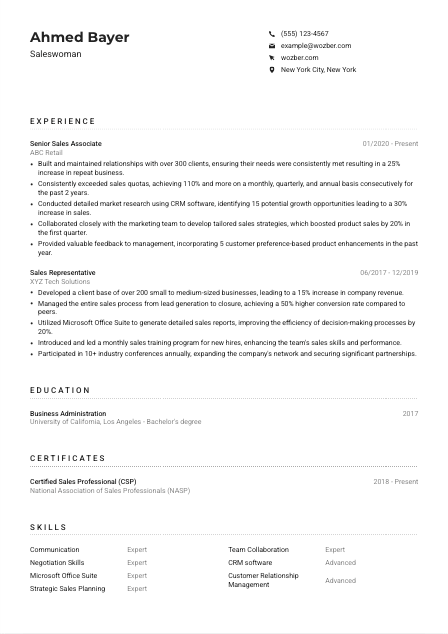
Add "Saleswoman" under your name if that matches the role you are pursuing. This keeps your positioning consistent from the first line. In the example resume, that direct title immediately connects prior sales experience to the opening instead of leaving the reader to interpret a broader label.
Include a reliable phone number and a professional email address. If a sales manager wants to move quickly after seeing strong conversion numbers or client growth, outdated contact information can cost you an interview. Double-check every character before sending.
Some sales roles are tied to a store, territory, or local client base. Here, the employer specifically asks for someone located in New York City, New York, so listing that location helps confirm you meet a stated requirement without forcing the reviewer to guess.
A polished LinkedIn profile can reinforce your resume, especially if it supports your sales history with consistent job titles, achievements, or recommendations. Include a website or portfolio only if it adds something useful, such as product knowledge, industry presence, or public sales achievements.
Your personal details should confirm that you are reachable, professionally presented, and logistically aligned with the role. Then the rest of the resume can focus on what matters most in sales hiring: revenue contribution, customer relationships, and consistency against target.




For a Saleswoman resume, the experience section carries the most weight. Hiring teams want to see how you handled customers, whether you hit target, how you grew business, and what commercial outcomes followed from your work.
Start by identifying the experience most relevant to the target role. Prioritize positions where you managed customer relationships, drove revenue, handled lead generation, or contributed to sales strategy. In the example, roles in retail and sales representation line up well because they show client management, quota ownership, and measurable growth.
For every entry, include your job title, employer, and dates of employment. Then follow with bullet points that show what you delivered. In sales, a clean structure matters because it helps the reader quickly scan for territory scope, account volume, sales performance, and progression from one role to the next.
Do not stop at duties like "maintained client relationships" or "worked with marketing." Show what those actions produced. The example does this well by tying relationship management to a 25% increase in repeat business and market research to 15 growth opportunities that lifted sales. That is the level of detail hiring managers remember.
Use metrics that belong naturally in sales work: quota attainment, repeat business, conversion rate, revenue growth, account growth, upsell performance, pipeline expansion, or partnership wins. Statements like achieving 110% of quota or increasing revenue by 15% give immediate context that generic phrases never will.
Every bullet should help explain why you can perform in the target environment. If you have broad experience, keep the details that support customer engagement, negotiation, reporting, CRM use, and collaboration with marketing or management. Less relevant tasks can be shortened or removed so the strongest sales evidence stays visible.
A persuasive sales experience section shows more than isolated wins. It should reveal a consistent pattern of building relationships, moving deals forward, and delivering against target. When that pattern is clear, your resume starts reading like someone who can contribute quickly.
Education usually will not outweigh sales performance, but it still matters when a posting asks for a specific academic background. Present it clearly and make sure the degree supports the business, marketing, or commercial foundation the employer requested.
Read the posting closely and match the education details to it. Here, the employer asks for a Bachelor's degree in Business, Marketing, or a related field, so your degree title and field of study should be easy to find.
Include your degree, field of study, school, and graduation year or date. Keep the structure clean and easy to scan. This section should confirm qualifications quickly, not make the reader search for basic information.
If your degree directly relates to the role, show that clearly. In the example, "Bachelor's degree" in "Business Administration" aligns well with a sales opening because it supports commercial judgment, customer-facing work, and basic market understanding.
If you are earlier in your career or your degree title is broad, include selected coursework in areas like sales, marketing, consumer behavior, or business analytics. For experienced sales professionals, this is optional and should only stay if it strengthens the story without crowding stronger results.
Honors, student business organizations, case competitions, or projects tied to marketing, customer research, or commercial strategy can add value, especially when professional experience is lighter. Keep them relevant and concise.
This section should quickly show that you meet the academic requirement and have a business-related foundation. Once that is clear, the resume can return attention to the numbers, customer outcomes, and sales execution that drive hiring decisions.
Certifications are not mandatory in every sales role, but the right one can strengthen your profile. They work best when they support how you sell, manage accounts, or develop professionally in a target market or industry.
Start with credentials that support sales performance, customer management, negotiation, account development, or industry knowledge. The posting mentions relevant sales certifications if common for the role, so this section is worth using when you have recognized training to show.
One respected certificate is more useful than several unrelated ones. In the example, the Certified Sales Professional credential works because it directly supports the candidate's commercial background and ongoing development in sales.
Include the completion date or validity period so the employer can see whether the credential is current. For sales roles, this matters most when the certificate reflects current methods, customer engagement practices, or structured sales training.
Sales tools, customer expectations, and go-to-market approaches evolve. If you pursue new training in CRM platforms, consultative selling, retail strategy, or account management, update your resume so your development stays visible and relevant.
A well-chosen certificate adds weight when it supports the kind of sales work you want to do. Keep this section selective, current, and clearly connected to customer-facing performance or commercial growth.
The skills section should reflect how you actually sell. For a Saleswoman role, that means balancing customer-facing strengths with practical tools and commercial judgment, then aligning the wording with the language used in the posting.
Start with the skills named or strongly implied in the posting. Here, that includes interpersonal communication, negotiation, CRM software, Microsoft Office Suite, market research, and collaboration with marketing. Those should shape the section before you add anything else.
Sales hiring is rarely based on soft skills alone. Pair strengths like communication and negotiation with practical capabilities such as CRM use, reporting, lead generation, sales planning, and market analysis. The example resume does this well by combining relationship-driven skills with tools and planning skills that support execution.
Order matters. Place the most relevant skills first so the reader sees immediately that you can handle customer interaction, track activity, support strategy, and work toward quota. Keep the list focused rather than trying to capture every skill you have ever used.
A useful sales skills section reads like a summary of how you win business and support revenue. When the list mirrors the role's workflow and terminology, it strengthens both human review and ATS optimization without sounding forced.
Language ability matters in sales when it affects customer communication, local market coverage, or relationship building. Present languages clearly, especially when the employer explicitly asks for professional fluency in one of them.
If the posting names a language, list it first with an accurate proficiency level. In this case, professional English is essential, so English should appear prominently and be described in a way that matches your real working ability.
Additional languages can be valuable in retail, account management, and diverse urban markets. In the example, Spanish adds practical value because it can support client communication and relationship building beyond the required English proficiency.
Choose straightforward levels such as Native, Fluent, Intermediate, or Basic. Hiring teams need an honest sense of how well you can hold a customer conversation, explain a product, or manage follow-up communication.
Some sales roles serve a local neighborhood, some cover regional accounts, and others involve broader market outreach. If your language skills help you connect with the audience that role serves, they deserve space on the resume.
Only include languages you can genuinely use. In sales, even conversational ability can matter when it supports rapport, service, or smoother interactions, but it should always be presented accurately and in the right proportion to the rest of your profile.
This section is most effective when it shows how you communicate with customers, not just what languages you have studied. Keep it honest, relevant, and tied to the kind of client interaction the role involves.
Your summary sits at the top of the resume, so it should quickly frame your sales background in terms that matter to the role. A Saleswoman summary works best when it combines years of experience, sales context, and two or three concrete strengths or results.
Lead with a concise description of who you are professionally. Mention your title or closest equivalent, your years of experience, and the sales environment you know best, such as retail, B2B, consumer products, or technology sales.
Choose a few highlights that match the opening. If the employer emphasizes quotas, client relationships, and growth opportunities, your summary should mention those directly. The example does this by referencing quota overperformance, strong client relationships, and market research capability.
Aim for a few lines, not a paragraph packed with every skill you have. Use precise wording and concrete outcomes where possible. Sales summaries are strongest when they sound commercial and grounded rather than broad or self-promotional.
Reflect the terms that matter in the posting, such as CRM software, collaboration with marketing, or customer feedback that influences product decisions. This helps position you for both ATS review and human readers while keeping the summary tailored to the opportunity.
Your summary should quickly tell the reader what kind of sales professional you are and what business outcomes tend to follow your work. When that message is clear, the rest of the resume has a stronger frame from the start.
A Saleswoman resume earns attention when it shows the business side of your work clearly: the customers you managed, the targets you hit, the growth you created, and the tools you used to keep performance moving. Keep each section tied to those outcomes, and use the job description to decide what deserves the most space.
Wozber's free resume builder can help you organize that experience into an ATS-friendly resume template, refine role-specific wording with AI support, and check alignment with an ATS resume scanner before you apply. That makes it easier to submit a resume that shows exactly what a sales hiring team wants to confirm first: can you build relationships and deliver results?




