



Use Wozber and land your dream job
Create Resume
No registration required
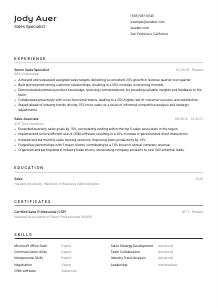
Closing deals, but your resume isn't sealing the deal? Check out this Sales Specialist resume example, created with Wozber free resume builder. Learn how to position your persuasive prowess to match job specifics, pitching your profile as convincingly as your top products!
Sales Specialist resumes are strongest when they show two things fast: consistent revenue performance and the ability to keep customers engaged after the first deal. Hiring teams want to see how you moved pipeline, hit quota, handled objections, and turned product knowledge into repeat business, not just that you "worked in sales." Your resume should make that commercial impact easy to follow.
Small wording changes can shift how your background is read in both ATS screening and human review. When your resume reflects the language of the role, such as sales targets, CRM use, customer retention, and cross-functional collaboration, Wozber's free resume builder helps you shape an ATS-compliant resume that surfaces the right experience early. That makes it easier to recognize whether you can drive revenue and manage customer relationships in the way the role requires.
Sales work starts with trust and responsiveness, and your contact section should reflect both. Keep it clean, professional, and aligned with any practical requirements in the job post so there is no friction before the first conversation.
Use your full name in a larger font than the rest of the header. For a Sales Specialist, that top line should feel polished and straightforward, much like a strong client introduction. Avoid clutter, nicknames, or decorative formatting that distracts from the role you are targeting.
Place "Sales Specialist" under your name if that is the position you are pursuing. This immediately frames your background around sales execution, account development, and customer-facing performance instead of leaving the reader to infer your target role.
Recruiters and sales leaders often move quickly when they see relevant quota-carrying experience, so your contact information needs to be accurate and current.
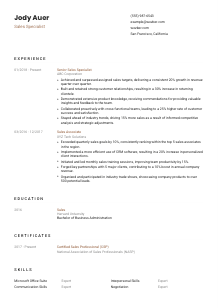
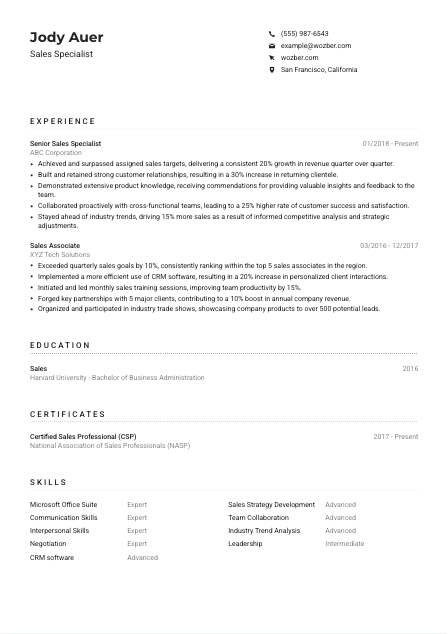
If the employer specifies a location, include your city and state in this section. Here, being based in San Francisco, California directly addresses a stated requirement. That does not apply to every Sales Specialist job, but when location is part of the screen, make it visible immediately.
Include LinkedIn or another professional profile if it supports your sales story. Make sure the roles, dates, headline, and performance highlights match your resume. For sales candidates especially, inconsistency between platforms can raise unnecessary questions about territory scope, tenure, or results.
This section should confirm that you are easy to contact, aligned with the target role, and available where needed. It is a small section, but it removes early objections before your sales results even come into view.




For Sales Specialist roles, the Experience section carries most of the decision weight. Hiring teams look for quota attainment, customer retention, pipeline contribution, CRM discipline, and the kind of product or market exposure that suggests you can ramp up quickly.
Start by pulling out the recurring themes in the posting, then reflect them in your bullets. In this case, the priorities include hitting sales targets, maintaining customer relationships, using CRM tools, collaborating across teams, and staying current on market trends. Those should show up in your experience through actions and outcomes, not as copied phrases.
List your positions in reverse chronological order with job title, employer, and dates. Sales hiring teams pay attention to progression, whether that means moving from Sales Associate to Senior Sales Specialist, taking on larger accounts, or handling more complex products. Clear structure helps them track that growth quickly.
Your strongest bullets should show what you sold, improved, or grew. The sample resume does this well with results like 20% quarter-over-quarter revenue growth and a 30% increase in returning clientele. Metrics like quota attainment, renewal rate, average deal size, conversion rate, and ranked performance carry real weight in sales hiring.
Do not stop at percentages alone. Show what changed because of your work, whether that was stronger client retention, more personalized outreach through CRM usage, better customer satisfaction, or increased annual revenue from key accounts. Sales leaders want to see performance connected to customer and business results.
Prioritize accomplishments that mirror the role you want. Ranking in the top 5 sales associates, winning major clients, or improving CRM-driven engagement all translate well because they point to prospecting skill, relationship management, and disciplined follow-through. If you have industry-specific sales experience, move that closer to the top of the section.
A Sales Specialist resume should leave little doubt about how you contribute to revenue. When your bullets connect targets, customer relationships, tools, and market awareness, your experience reads like a record of repeatable performance rather than a list of duties.
Education matters most here as a qualification check and as context for your commercial foundation. It will not outweigh sales results, but it should still confirm that you meet the academic requirement and can speak the language of business, customers, and market performance.
If the posting asks for a bachelor's degree in Business, Sales, or a related field, make that information easy to spot. A degree such as a Bachelor of Business Administration aligns well with this kind of opening because it connects naturally to sales operations, customer strategy, and commercial decision-making.
List the school, degree, field of study, and graduation year or date. This section is usually scanned quickly, so clarity matters more than extra description. Clean formatting also helps ATS parsing pick up the credential correctly.
If your degree is directly tied to business, sales, marketing, or another commercial discipline, include the field clearly. That gives useful context, especially when the employer has stated a preference for a related academic background.
Most experienced Sales Specialists do not need to list courses. It can help earlier-career candidates, especially if coursework covered consumer behavior, negotiation, business communication, or market analysis. Include it only if it adds context that your work history does not yet provide.
If you have additional training that supports your sales work, such as workshops in consultative selling or account management, consider where it fits best. Formal certifications usually belong in the Certifications section, but recent professional development can reinforce your commitment to the field.
This section should quickly confirm that you satisfy the educational baseline for the role. Once that is clear, your sales record can stay at the center of the resume, where most hiring decisions for this role are made.
Sales certifications can strengthen your resume when they support the kind of selling the role involves. They are especially useful when the posting lists certification as a plus, or when you want to show formal training in prospecting, negotiation, account management, or consultative selling.
Focus on credentials that connect clearly to revenue generation, customer management, or sales process discipline. A certification such as Certified Sales Professional works because it reinforces your commitment to the craft and your familiarity with structured selling practices.
A short, targeted list has more value than a crowded section full of loosely related courses. For Sales Specialist roles, one respected certification tied to selling methodology or client development often says more than several generic badges.
Certification dates help hiring teams see whether your training is current. In sales, where tools, buyer behavior, and market dynamics shift regularly, recent credentials can support your claim that you stay sharp and keep refining your approach.
Remove outdated or low-value certifications that no longer reflect your level of work. Instead, keep the credentials that support your present target, whether that is enterprise sales, channel development, customer retention, or industry-specific selling.
Certifications can strengthen your profile, especially when a posting mentions them directly. They work best when they complement a record of hitting targets, managing customer relationships, and contributing to revenue growth.
A Sales Specialist skills section should show how you operate, not just which buzzwords you know. The strongest lists combine selling skills, customer-facing communication, and the tools you use to manage pipeline, reporting, and follow-up.
Start with the terms the employer uses for the role. Here that includes CRM software, Microsoft Office Suite, interpersonal communication, written and verbal communication, and sales experience tied to performance. If those genuinely match your background, use that wording so both ATS systems and hiring teams can connect your profile to the job quickly.
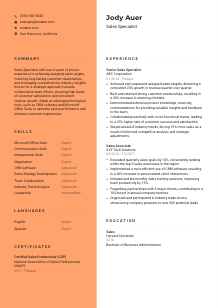
Do not list everything you have ever touched. Focus on the tools and abilities you use to prospect, track customer activity, report progress, analyze opportunities, and close business. In the sample resume, CRM software, negotiation, sales strategy development, and industry trend analysis work well because they map directly to day-to-day sales execution.
Put the most role-critical skills first, usually core sales competencies and tools before broader traits. A clean list might begin with CRM software, negotiation, customer relationship management, communication skills, Microsoft Office Suite, and competitive analysis. That ordering tells the reader how you actually get results.
Every skill listed here should support a real part of the job, whether that is managing a pipeline, building trust with customers, or sharing market feedback with internal teams. If a skill does not help explain how you sell, it probably does not need space on the page.
Language proficiency matters in sales when it affects client communication, territory coverage, or customer experience. Even when only one language is required, listing your proficiency clearly helps remove doubt about your ability to present, negotiate, and follow up effectively.
If the posting states that English is essential, list it clearly and near the top of the section. That directly answers a stated requirement and supports the communication-heavy nature of sales work, from discovery calls to proposal follow-up.
Lead with the language the job requires and use a truthful proficiency level such as Native or Fluent. This is especially important in roles where written outreach, client presentations, and internal coordination all depend on strong communication.
Additional languages can be useful when they open access to broader customer groups or support work in diverse markets. Spanish, for example, may not be required in every Sales Specialist role, but it can be a practical advantage in customer-facing sales environments.
Be accurate about your speaking and writing ability. In sales, overrating language skills can create problems quickly if the role includes live customer conversations, demos, or negotiation in that language.
If the role involves regional diversity, international accounts, or multilingual customer bases, language capability becomes more than a bonus. It can support rapport building, clearer discovery, and stronger long-term account relationships.
This section does not need to be long. It simply needs to show that you can communicate at the level the role requires and, if applicable, that you can build relationships across a wider customer base.
The summary sits at the top of the resume, so it should quickly define the kind of Sales Specialist you are. Focus on years of experience, core sales strengths, and a few performance themes that match the role, such as quota attainment, customer retention, CRM fluency, or market insight.
Read the job posting closely and pull out the few priorities that appear most often. In this case, those include proven sales experience, customer relationship building, CRM proficiency, communication, and awareness of industry trends. Your summary should reflect that mix in plain, direct language.
Start with a concise line that identifies you as a Sales Specialist and states your experience clearly, such as 3+ years or 6+ years depending on your background. That gives immediate context before the reader moves into your achievements.
Use one or two phrases that point to measurable sales performance and customer results. The example summary works because it references target achievement, long-term customer relationships, and revenue growth rather than leaning on generic adjectives.
Aim for three to five lines. That is enough space to cover your commercial focus, key strengths, and relevant tools without turning the summary into a paragraph of broad claims. Every sentence should earn its place by telling the reader how you sell and what results tend to follow.
A well-written summary helps the reader understand your sales profile before they reach the detailed bullets below. When it highlights targets, customer relationships, and the tools you use to manage performance, it sets up the rest of the resume to land clearly.
A Sales Specialist resume works best when it shows a clear pattern of revenue contribution, customer relationship strength, and practical tool use. If each section points back to those themes, the hiring team can quickly understand how you would perform in the role.
Use Wozber's free resume builder to organize your content in an ATS-friendly resume format, strengthen wording with role-specific language, and check alignment with an ATS resume scanner. The final result should make your sales results, customer impact, and readiness for the position easy to judge.