



Use Wozber and land your dream job
Create Resume
No registration required
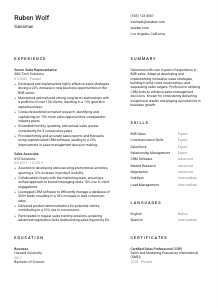
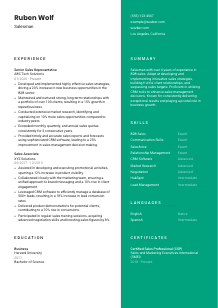
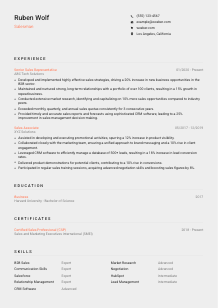
Closing deals, but your resume keeps getting rejected at the checkout? Check out this Salesman resume example, made with Wozber free resume builder. Learn how to show off your persuasion power and relationship-building skills right next to the job's purchase button, setting your career up for a sales surge!
Sales resumes get attention when they make commercial performance easy to see. Hiring teams want more than generic claims about communication or drive. They look for proof that you can open new business, manage a pipeline, keep client relationships productive, and hit quota over time. Your resume should quickly show how you sell, what markets you know, and what results followed.
A tailored resume also helps separate broad sales experience from the kind that matches the opening, especially when B2B selling, CRM usage, and forecasting are part of the day-to-day work. Wozber's free resume builder helps you align that language into an ATS-compliant resume, so terms like quota attainment, client retention, lead management, and sales reporting are easy to parse and easy for the hiring team to connect to revenue responsibility.
Sales work starts with credibility, and that begins before anyone reads your first achievement bullet. Your header should confirm who you are, what role you are targeting, and whether basic requirements like location and contact accessibility are already covered. Keep this section clean, accurate, and aligned with the role.
Use your full name as the clearest visual anchor on the page. It should be easy to scan and slightly more prominent than the rest of the header, much like a professional signature on client-facing materials. Skip nicknames unless that is how you are known professionally.
Place the role title directly under your name and match the posting when it makes sense. If the opening says "Salesman," use that title instead of a broader alternative. This helps position you as a direct applicant for the role, especially when ATS filters and recruiters are sorting across similar titles such as Sales Representative, Account Executive, or Business Development Representative.
List a reliable phone number and a professional email address, then verify both. In sales, missed contact attempts can cost interviews the same way missed follow-ups cost deals. A simple format such as firstname.lastname@email.com keeps the focus on your professionalism.
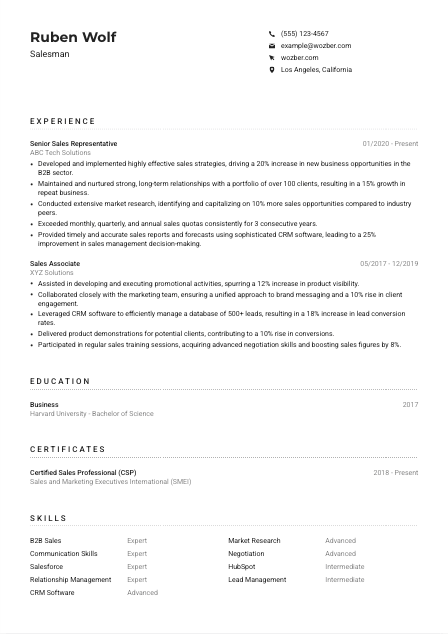
If the employer specifies a city or state, show that information clearly in your personal details. In the example, listing Los Angeles, California directly addresses the stated location requirement and removes uncertainty about availability. When a job does not require a specific location, city and state are usually enough.
If you include LinkedIn or a personal website, make sure it supports your sales story. A strong profile can reinforce account growth, industry focus, recommendations, and consistency of titles and dates. For sales professionals, that extra context can help validate relationship-building credibility and career progression.
This section should answer the basic screening questions immediately: who you are, what role you want, how to reach you, and whether you meet any location requirement. When those details are clear, the reader can move straight to your sales results.




For sales hiring, the experience section carries the most weight. This is where employers look for quota performance, business development wins, client retention, market coverage, and the tools you used to manage the sales cycle. The best bullets show commercial outcomes, not just activity.
Read the posting closely and mark the responsibilities that define success in the role. Here, that includes developing sales strategies, building long-term client relationships, researching market opportunities, meeting quotas, and reporting through CRM systems. Those priorities should shape which achievements you lead with and how you phrase them.
Start with your current or most recent sales role and work backward. That structure helps recruiters quickly understand your latest market exposure, account responsibility, and sales maturity. Include company name, title, and dates consistently so progression from associate-level selling to a more strategic sales role is easy to follow.
Write bullets that answer the job posting with specifics from your own history. The sample resume does this well with lines such as "Developed and implemented highly effective sales strategies" and "Maintained and nurtured strong, long-term relationships" because they mirror the role while still describing real work. Use that approach across your own experience, especially for prospecting, client management, pipeline growth, and forecasting.
Sales is measured in numbers, so your resume should be too. Include metrics such as quota attainment, percentage growth in new business, repeat business, lead conversion, portfolio size, win rate, or forecast accuracy whenever you can support them. Results like a 20% increase in new business opportunities or consistent quota achievement over three years give hiring managers a much stronger read than broad claims about being high-performing.
Prioritize achievements that show how you generate revenue and manage customer relationships. Product demos, CRM reporting, market research, territory growth, cross-functional work with marketing, and repeat account expansion all belong if they tie back to sales outcomes. Trim bullets that do not strengthen your case for B2B selling, quota ownership, or client growth.
A sales experience section should leave no doubt about what you sold, how you managed the process, and what commercial results followed. If each role shows strategy, relationship management, and measurable performance, your resume will read like a candidate ready to carry a book of business.
Education rarely outweighs sales performance, but it still matters when a posting asks for a business-related degree. Present it clearly, keep it relevant, and use it to confirm the foundation behind your market understanding, communication, and commercial judgment.
When the job requests a bachelor's degree in Business, Marketing, or a related field, make that information easy to find. If your degree is directly aligned, as in the example's Bachelor of Science in Business, list it clearly so recruiters can confirm the requirement in seconds.
Most sales resumes need only the school name, degree, field of study, and graduation year or date. A concise format works best because hiring teams are usually scanning this section to confirm qualifications, not to read a detailed academic history.
Spell out the degree and field correctly. Details such as "Bachelor of Science, Business" or "Bachelor of Arts, Marketing" carry more weight than vague labels because they align more naturally with the posting's educational requirement and present a more polished record.
If you have limited sales experience, coursework can help bridge the gap. Classes in marketing, consumer behavior, negotiation, data analysis, business communication, or sales management can support your case, especially when your professional track record is still developing.
Honors, scholarships, or competition results are worth adding if they reinforce business acumen, discipline, or communication ability. For experienced sales candidates, keep this brief. Once your resume includes quota history and client results, academic detail should stay in the background.
This section should quickly show that you meet the academic requirement and have relevant business grounding. Then let your sales achievements do the heavier lifting.
Sales certifications are usually secondary to performance, but they can still help when they support your selling method, product knowledge, or commitment to professional development. Choose certificates that reinforce how you operate in client-facing, target-driven roles.
List credentials that support core sales work, such as negotiation, account management, consultative selling, or professional sales standards. A certificate like Certified Sales Professional can add useful credibility because it speaks directly to structured sales practice, even when the job posting does not require it.
Use only certifications that strengthen your case for the role. A short, relevant list is more persuasive than a long one filled with unrelated training. For a B2B sales opening, prioritize credentials tied to sales execution, client development, CRM-driven process, or industry knowledge.
If a certificate is current, renewed, or active, include that information. Dates help the reader understand whether the training reflects your current skill set and whether you maintain your credentials over time.
Sales teams adapt to new buying behavior, software workflows, and reporting expectations. Recent certification activity can show that you stay current with modern sales process, prospecting methods, and customer engagement tools rather than relying only on older experience.
Certifications will not replace quota performance, but they can strengthen the picture of a disciplined sales professional who keeps improving. Keep them relevant, current, and clearly presented.
A sales skills section should reflect how you actually win and manage business. Hiring teams want to see the combination of systems knowledge, client-facing ability, and commercial judgment that supports prospecting, conversion, retention, and forecasting.
Start with the skills the role explicitly names, then add closely related strengths you can back up elsewhere in the resume. In this case, CRM proficiency, written and verbal communication, relationship management, market research, and quota-driven sales work all deserve attention. If the posting names Salesforce or HubSpot, include them when you have real experience with those tools.
Order the section around the capabilities that matter most in sales execution. B2B sales, pipeline management, negotiation, lead qualification, account growth, forecasting, CRM reporting, and client relationship management usually carry more weight than broad traits. The sample resume handles this well by placing B2B Sales, Salesforce, and Relationship Management near the top.
Avoid turning the section into a keyword dump. Choose skills that connect to your experience bullets and summary, and use precise labels rather than vague phrases. "Salesforce," "HubSpot," "Lead Management," and "Market Research" tell a clearer story than general claims about being organized or motivated.
Your skills section should reflect the real mechanics of the role: managing prospects, moving deals through a CRM, communicating clearly, and closing business. When those skills line up with your experience, the resume feels consistent and credible.
Language ability matters in sales when it affects client communication, territory coverage, or day-to-day collaboration. Present languages clearly and honestly, especially when the employer specifically asks for strong English skills.
If the posting states that strong English is necessary, make your level easy to see. Use a clear label such as Native, Fluent, or Professional depending on your real ability. For a sales role that involves presentations, follow-ups, proposals, and reporting, language level directly affects credibility.
Additional languages can strengthen your value when they help with client conversations, regional accounts, or multicultural customer bases. In some sales environments, Spanish, French, or other languages can support stronger rapport and broader coverage, but list them only when they are genuine working skills.
Use realistic proficiency levels instead of overstating fluency. Hiring teams may expect you to handle calls, demos, emails, or negotiations in the languages you list, so accuracy matters. Honest labeling also prevents awkward mismatches later in the interview process.
If a second language has helped you work with a specific client segment, region, or type of account, that can be worth reinforcing elsewhere in the resume. The language section itself should stay concise, but it can support a broader story about territory reach and relationship building.
For sales candidates, a language is most useful when it improves communication with buyers, speeds up trust-building, or expands account access. Keep that practical lens in mind and avoid listing beginner-level knowledge that would not hold up in real client interaction.
Clear language information helps employers judge whether you can handle the communication demands of the role. For client-facing sales work, that clarity matters.
Your summary should quickly position you as a sales professional with relevant market experience, measurable results, and the right operating style for the role. Think of it as the short version of your commercial case, built from proof rather than personality claims.
Start with your years of experience and the environment you know best, such as B2B sales, account growth, or new business development. That gives immediate context for the rest of the resume. The sample summary does this effectively by leading with more than 4 years of B2B sales experience.
Include one or two outcomes that show how you perform. Consistent quota attainment, business growth, client retention, or conversion improvement are all strong options because they map directly to how sales roles are evaluated.
Bring in the capabilities that make your performance believable, such as CRM proficiency, sales strategy, relationship management, forecasting, or market research. Keep the wording tied to actual work you have done. If the job emphasizes Salesforce, HubSpot, or reporting accuracy, mention those only when they are part of your background.
Aim for a compact paragraph that reads quickly and points the reader toward the evidence in your experience section. Avoid soft claims like being passionate or people-oriented unless they are backed by client outcomes, pipeline growth, or repeat business metrics. A concise summary with concrete sales language will do more work for you than a long personal statement.
A well-written summary should make the next question obvious: how did this candidate deliver those results? When your opening lines highlight relevant sales scope, performance, and tools, the rest of the resume has a clear story to support.
A Salesman resume works best when every section supports the same commercial message: you know how to generate demand, manage relationships, use CRM systems well, and deliver against targets. Tailor the language to the opening, keep the numbers specific, and make it easy to connect your past work to the employer's sales process.
Wozber's free resume builder can help you structure that story in an ATS-friendly resume template, while its ATS resume scanner helps you spot missing requirements, align keywords naturally, and improve section-level match before you apply. The finished resume should make one thing clear fast: you can step into the role and contribute to revenue.