



Use Wozber and land your dream job
Create Resume
No registration required
Closing deals, but your resume isn't sealing the right job? Check out this Sales Professional resume example, optimized with Wozber free resume builder. Learn how to position your selling savvy to align with job calls, and watch your career chalk up more victories than discounts!
Sales hiring moves quickly when a resume makes one thing obvious: you know how to win business and keep accounts growing. For a Sales Professional, that usually means showing pipeline ownership, client retention, quota performance, and the ability to turn conversations into revenue. If those details stay vague, even solid candidates start to blend together.
A tailored resume changes how your background is read, especially when hiring teams sort B2B sales applicants through ATS filters before anyone looks at your numbers. Wozber's free resume builder helps you align your wording with the job description, keep an ATS-friendly resume format, and surface the mix of sales results, CRM use, and customer-facing experience that makes your track record easy to recognize.
In sales, small details carry weight. Your contact section should make you look easy to reach, professionally presented, and already aligned with any practical requirement the employer has set for the role.
Put your name at the top in a clean, readable format, then pair it with the exact role title you are pursuing. Using "Sales Professional" immediately tells the reader where your background is headed and helps reinforce keyword alignment for ATS screening. Keep it simple and credible, the same way you would open a client conversation with clarity rather than noise.
List a current phone number and a professional email address that would not look out of place in a client-facing role. Sales work depends on responsiveness, so this section should feel dependable at a glance. Check every character carefully. A typo in your contact details undercuts the polished, detail-aware impression expected from someone who manages prospects, follow-ups, and customer relationships.
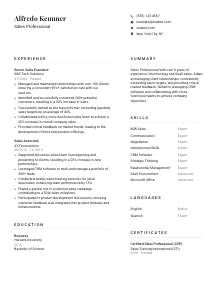
If a posting names a location requirement, show that match clearly in your header. Here, New York City, NY is specifically requested, so listing it removes an avoidable question. This is a tailoring move, not a rule for every sales resume. Include location when it matters to territory coverage, in-person meetings, or employer logistics.
A LinkedIn profile can reinforce your sales story when it reflects the same titles, dates, and measurable results shown on the resume. For sales candidates, it can also support credibility through recommendations, industry presence, or a fuller account of territory scope and client segments. Only include it if it is current and consistent.
You do not need to include age, marital status, or other personal details unrelated to selling performance. Sales employers want to understand whether you can prospect, present, negotiate, manage accounts, and hit targets. Keep this section focused on the information that helps them contact you and place you correctly in the hiring process.
This section should confirm that you are a reachable, professional candidate who already matches the basics of the opening. In sales, clean presentation matters because it sets the tone for everything that follows.




For Sales Professionals, the experience section carries most of the decision-making weight. Hiring teams look here for deal volume, quota attainment, client growth, retention, prospecting activity, and the tools or environments you worked in, especially when the role involves B2B or SaaS sales.
Before you rewrite any bullets, identify what the employer is emphasizing. In this posting, the pattern is clear: B2B sales experience, client relationship management, prospecting, target attainment, CRM familiarity, and collaboration with the broader sales team. Those priorities should shape which achievements you feature first and which terms you mirror naturally in your wording.
Start with your most recent sales role and work backward, showing company name, job title, and dates in a format that is easy to scan. This structure helps hiring managers quickly trace your progression from supporting sales activity to owning larger accounts, bigger quotas, or more strategic territory responsibilities. For experienced candidates, recent revenue-facing work should stay front and center.
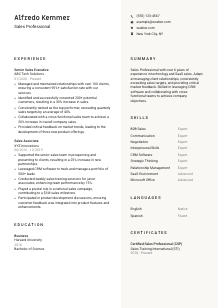
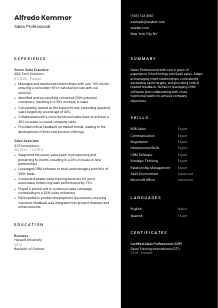
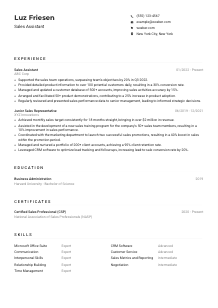
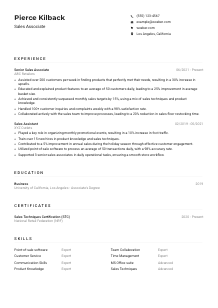
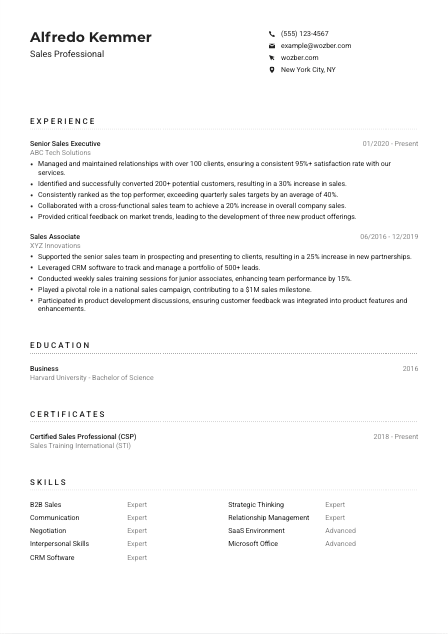
Sales resumes get stronger when they quantify commercial impact. Include numbers tied to quota performance, revenue growth, lead conversion, account volume, win rate, retention, or portfolio size. The example does this well with details like managing 100+ clients, converting 200+ potential customers, and exceeding quarterly targets by 40%. Those are the kinds of metrics that show performance without forcing the reader to guess.
Choose bullets that line up with the actual responsibilities of the target role. If the job calls for maintaining client satisfaction, researching prospects, presenting solutions, and contributing market feedback, your experience should reflect those same motions. A bullet about improving customer satisfaction or feeding customer insight into product decisions will usually do more for a sales application than a generic statement about being results-driven.
Every bullet should support your case for this specific kind of sales job. Leave out accomplishments that are interesting but unrelated to pipeline generation, relationship management, territory growth, product presentation, CRM discipline, or team selling. A focused experience section makes it easier to see your fit for B2B sales work and the level of responsibility you can handle from day one.
A strong sales experience section does more than list employers. It shows how you build relationships, move opportunities forward, and deliver against quota. When those results are clear, the resume starts reading like a producer's track record.
Education rarely carries a sales resume on its own, but it still matters when a posting asks for a specific degree background. Present it clearly, meet the requirement, and let your selling results remain the main story.
When a role asks for a bachelor's degree in Business, Sales, or a related field, make that information easy to find. In the example, a Bachelor of Science in Business maps directly to the requirement. If your degree is in a related discipline such as marketing, communications, or economics, list it clearly and let your experience handle the rest of the proof.
Include the school name, degree, field of study, and graduation year or date. This section does not need creative formatting. In sales hiring, clarity wins. The reader should be able to confirm your education in a few seconds and move back to the revenue-producing parts of your resume.
If your degree is closely tied to sales, business development, or commercial strategy, make sure that relevance is visible. A business degree supports the commercial side of the role, especially for positions involving account planning, market research, pricing conversations, or SaaS sales cycles. This matters most for earlier-career candidates or jobs with explicit degree filters.
Most mid-career sales candidates do not need to list coursework, but it can help if you are early in your career or moving into a more specialized market. Include classes or projects related to sales strategy, buyer behavior, CRM use, negotiation, or business communication only when they add something your work history does not already show.
Honors, leadership roles, or relevant student organizations can stay if they support your commercial profile and do not crowd out stronger work experience. For example, participation in business competitions, sales clubs, or case presentations may be worth keeping for recent graduates. For seasoned sellers, keep this brief unless it is especially relevant.
Your education section should confirm that you satisfy the stated degree expectation without pulling attention away from quota results, customer growth, and sales execution.
Certifications can strengthen a sales resume when they sharpen your relevance, especially in structured B2B environments where methodology, CRM fluency, or product-led selling matter. The key is choosing credentials that support how you actually sell.
List certifications that connect to prospecting, account management, negotiation, CRM use, or the industry you sell into. A credential such as Certified Sales Professional fits naturally because it supports the commercial focus of the role. Skip unrelated certificates that do not add value to your sales story.
When a posting mentions tools or ways of working, a relevant certification can strengthen your alignment. For example, if CRM software is named in the job description, training or certification in a platform like Salesforce or HubSpot can be a useful addition. Treat that as role-specific tailoring, not a universal requirement for every sales opening.
Hiring teams want to see whether a credential is current, recently completed, or still active. That matters most for certifications tied to software, sales methodology, or regulated products. A current certificate suggests that your approach has kept pace with how modern teams manage pipeline, reporting, and customer engagement.
Sales employers often value candidates who respond well to feedback, training, and coaching. A concise certification section can support that impression, especially if the role mentions continuous improvement. Include the strongest few credentials and keep the section easy to scan so it complements your experience rather than competing with it.
The right credential can strengthen your case for a B2B sales role, particularly when it reinforces CRM fluency, selling discipline, or industry knowledge. Keep the focus on relevance and currency.
A sales skills section should read like the operating toolkit behind your results. Employers are looking for a practical mix of client-facing strengths, commercial judgment, and the systems knowledge needed to manage pipeline and follow-through.
Start with the language in the job description, then read between the lines. Here, the obvious requirements include communication, negotiation, interpersonal skills, CRM software, Microsoft Office, and B2B sales. The responsibilities also imply prospect research, relationship management, product presentation, and teamwork around quotas and market feedback. Those are the skills worth prioritizing.
Put the most important sales skills first, especially the ones that map directly to the job. For this kind of opening, B2B sales, relationship management, negotiation, CRM use, and communication should appear before broader traits. The example resume also benefits from including SaaS environment experience, which is especially relevant when the company sells technology solutions.
Avoid turning this section into a long inventory of every platform or trait you have ever used. A tighter list creates a cleaner match between your skills and your track record. Include capabilities you can support elsewhere on the resume, such as managing accounts, using CRM data, presenting solutions, collaborating with sales teams, and working toward measurable targets.
When the right skills are listed in the right order, this section reinforces the commercial story told in your experience. It should feel connected to how you prospect, manage clients, and close business.
Language ability matters in sales when it affects client communication, territory coverage, or relationship building. Present it clearly, especially when the job description calls out a required language for presentations, outreach, or account management.
If the role specifically requires English, list your English proficiency clearly. In this posting, effective communication in English is mandatory, so that should be easy to find. For sales roles, language ability is not just a nice extra. It affects discovery calls, demos, negotiation, follow-up emails, and account conversations.
Place the most relevant language first, followed by any others that could help with customer relationships or market coverage. If you speak an additional language used by a meaningful part of the customer base, it can strengthen your profile, particularly in city-based or regional sales environments with diverse clients.
Use clear levels such as Native, Fluent, Professional, or Conversational so employers know what to expect. In sales, overstating language ability can create problems quickly, especially if the role involves live calls, negotiation, or product presentations. Accuracy matters more than ambition here.
Additional languages can be useful when selling across regions, supporting multilingual accounts, or building rapport with varied customer groups. They are especially worth keeping when they help with outreach, relationship-building, or customer retention. If the job has no multilingual angle, keep the section brief and factual.
Only claim a proficiency level you can use in a real client setting. Could you run a discovery call, answer objections, or explain pricing in that language with confidence? That is the practical standard sales hiring teams care about. Honest language ratings build credibility and avoid awkward surprises later in the process.
For a sales resume, language proficiency matters when it supports communication with prospects and clients. Keep the section accurate, relevant, and tied to the markets you can serve effectively.
Your summary should give a fast, accurate picture of the kind of seller you are. In a few lines, it needs to establish your experience level, the sales environment you know, and the results or strengths that make your background worth closer review.
Start with your title, years of experience, and the environment you sell in. A line such as "Sales Professional with 6+ years in technology and SaaS sales" works because it immediately covers seniority and industry context. For this role, that matters because the employer is asking for B2B sales experience, preferably in a technology or SaaS setting.
Follow with the commercial strengths most relevant to the opening, such as exceeding targets, managing client relationships, converting prospects, or using CRM tools effectively. The sample summary handles this well by pairing target attainment with relationship management and market feedback. Keep the points specific enough to sound real, but compact enough to scan quickly.
Aim for a short paragraph that a recruiter or sales leader can absorb in seconds. Three to five lines is usually enough. Do not repeat every skill or every responsibility. Use the space to frame your strongest positioning for the role, then let the experience section carry the detailed proof.
A well-written summary gives hiring teams an immediate read on your market, your sales strengths, and the kind of results you are used to delivering. When it is tailored well, the rest of the resume lands faster.
A Sales Professional resume works when it shows more than enthusiasm for selling. It should make your quota performance, client management, prospecting skill, and commercial judgment easy to see in a few quick scans.
Use Wozber's free resume builder to shape that story in an ATS-friendly resume template, align your wording with the job description, and check your targeting with the ATS resume scanner. The finished resume should leave no doubt about your ability to build relationships, move deals forward, and deliver revenue in the kind of sales environment you are pursuing.