




Use Wozber and land your dream job
Create Resume
No registration required
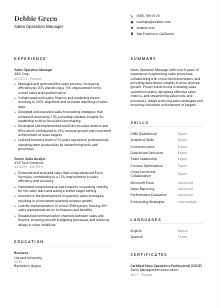
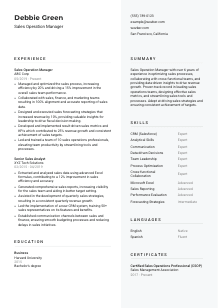
Driving sales strategies, but your resume isn't closing the deal? Check out this Sales Operation Manager resume example, created with Wozber free resume builder. Learn how to present your managerial strengths and operational savvy in a way that matches job specifics, ensuring your career trajectory is as lucrative as your top-performing accounts!
Sales operations sits where process discipline meets revenue pressure. Hiring teams look for people who can clean up pipeline management, tighten forecasting, improve reporting accuracy, and give sales leadership numbers they can trust. Your resume needs to show that you do more than support the commercial engine. It needs to show how you improve it through systems, analysis, and cross-functional execution.
A generic operations resume can blur together with analytics, enablement, or general business support profiles. Using Wozber's free resume builder to tailor your wording and structure into an ATS-compliant resume helps surface the right signals early, especially your CRM ownership, KPI design, forecast work, and partnership with sales, finance, and marketing. That makes it easier for a hiring team to see you as someone who can run the sales operating rhythm, not just report on it.
For a Sales Operation Manager, the top of the resume should read like a clean business record. This role depends on accuracy, timely communication, and operational discipline, so your contact details should be complete, current, and easy to scan in seconds. Keep this section simple and exact.
Place your full name at the top in a larger font than the rest of the header. Sales operations leaders work with dashboards, forecasts, and executive updates where clarity matters, and your resume should reflect that same habit of organized presentation.
Add "Sales Operation Manager" beneath your name if that matches the role you are pursuing. This helps connect your background to the opening immediately, especially when recruiters are screening candidates across sales operations, revenue operations, and analyst tracks.
List a reliable phone number and a professional email address, then double-check both. If a hiring manager wants to discuss your experience with CRM administration, sales forecasting, or KPI reporting, you do not want a typo getting in the way.
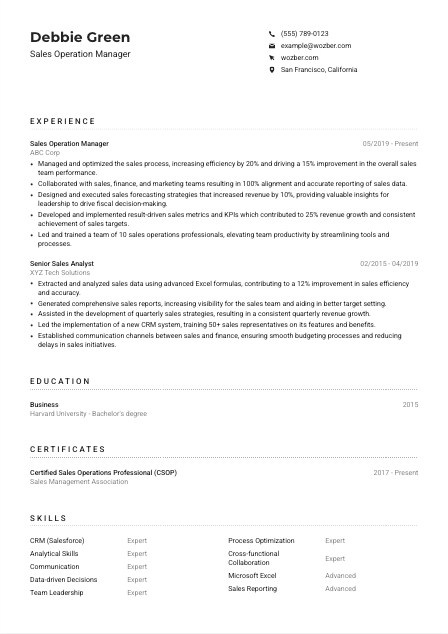
If a role has a location requirement, show it clearly in your header. In the example, "San Francisco, California" belongs here because the job specifically asks for candidates based there. Treat that as targeted tailoring, not a rule for every sales operations application.
Include LinkedIn or another professional profile only if it is current and aligned with the resume. For this field, that profile should reinforce your experience with sales systems, reporting cadence, cross-functional planning, and team leadership rather than act as a generic online presence.
Your header should communicate the same discipline the job requires in forecasts, CRM data, and reporting. When the basics are accurate and targeted, the rest of the resume lands more credibly.




This section carries the most weight for a Sales Operation Manager. Employers want to see how you improved the sales process, what systems you managed, how you influenced revenue planning, and whether your reporting actually changed decisions. Focus less on task lists and more on outcomes tied to efficiency, forecast quality, pipeline visibility, and team performance.
Before rewriting experience, mark the responsibilities that define the role. For this opening, that includes optimizing sales processes, working across sales, finance, and marketing, owning forecasting and pipeline analysis, building KPIs, and leading the sales operations team. Your bullets should echo those business priorities using language that matches your real work.
List your most recent role first, then move backward with job title, company, and dates clearly shown. That format helps hiring teams quickly trace your progression from analytical or support-heavy work into broader ownership of systems, reporting, and operational leadership.
Every bullet should answer, "What changed because you did this?" In sales operations, that often means faster processes, cleaner reporting, better forecast accuracy, stronger quota planning, higher team productivity, or revenue growth. The example does this well with metrics such as a 20% efficiency gain, 15% improvement in team performance, and 25% revenue growth.
Use numbers tied to the commercial engine rather than generic productivity claims. Good evidence includes pipeline coverage, reporting accuracy, CRM adoption, forecast variance, cycle-time reductions, territory performance, quota attainment, and revenue lift. If you trained a team or rolled out a system, include scale as well, such as team size or number of users affected.
Prioritize achievements that show system ownership, analytical decision support, process improvement, and cross-functional coordination. A bullet about implementing a CRM, refining Excel-based reporting, or aligning finance and sales on budgeting will help far more than unrelated accomplishments. Shape each role so it supports the case that you can run the operating layer behind a sales organization.
A hiring manager should come away knowing how you improved the sales engine, not just that you worked near it. When your experience shows cleaner processes, better reporting, sharper forecasting, and stronger revenue support, your value is clear.
Education usually plays a supporting role at this level, but it still needs to be aligned and easy to verify. For Sales Operation Manager roles, the degree matters most when it satisfies a posted requirement and reinforces your grounding in business, sales, analytics, or a related field.
If the posting asks for a bachelor's degree in Business, Sales, or a related area, present that information in direct terms. In the example, a Bachelor's degree in Business aligns neatly with the requirement and should be stated exactly that way for both ATS matching and human review.
Keep the format straightforward: degree, field of study, school, and graduation year. This is especially useful when your resume already carries complex information about forecasting, CRM tools, and cross-functional reporting. The education section should not create extra work for the reader.
Write the official degree and field instead of shortening them too much. Precision matters in a role built on clean data and reliable reporting, and it also helps when employers are screening for a business-oriented academic background.
If you are earlier in your career or moving into sales operations from adjacent work, relevant coursework in business analytics, sales management, finance, or statistics can help. For candidates with 5+ years in the field, experience and performance metrics will usually matter more than classroom detail.
Honors, academic leadership, or relevant student organizations can stay if they add something credible to your story, especially for more recent graduates. For experienced candidates, keep only what supports your business, analytical, or leadership profile without crowding out stronger professional evidence.
Education does not need to do the heavy lifting for a Sales Operation Manager, but it should satisfy the requirement cleanly and support the business foundation behind your operational work.
Certifications are optional in many sales operations searches, but the right one can strengthen your positioning. They work best when they reinforce practical strengths such as process design, sales systems knowledge, reporting discipline, or operational leadership.
Start with the posting. If no certification is required, use this section to add relevant depth rather than filler. A credential such as Certified Sales Operations Professional supports a profile centered on process optimization, forecasting, and sales performance management.
Choose certifications that connect to sales operations practice, CRM administration, analytics, revenue processes, or leadership. The point is not to collect badges. It is to show added competence in the systems and operating frameworks that support a sales team.
If a certification is active, recently earned, or renewed, include the date. That helps show your methods are current, which matters in a field shaped by changing CRM workflows, reporting expectations, and commercial tooling.
Sales operations changes as forecasting models, CRM workflows, and revenue reporting mature. Relevant certifications can show that you continue building your judgment in areas that affect planning quality, tool adoption, and team execution.
A certification will not outweigh proven results, but it can reinforce that you understand the systems and disciplines behind strong sales execution. Include the ones that sharpen your case, not just lengthen the page.
The skills section should read like the operating toolkit behind your results. For this role, that means a mix of systems fluency, analytical strength, and cross-functional execution. Choose skills that connect directly to how sales performance is measured and improved.
Start with the tools and capabilities named in the posting, then add closely related strengths you actually use. Here, CRM software such as Salesforce, Microsoft Excel, analytical decision-making, communication, and cross-functional collaboration all belong because they map directly to the work.
Lead with the skills most central to sales operations performance. CRM administration, forecasting, pipeline analysis, KPI design, reporting, process optimization, and Excel often carry more weight than broad soft-skill labels because they point to the mechanics of the role.
Present skills in a format that can be reviewed quickly by both recruiters and ATS tools. Grouping related abilities or using sensible proficiency levels can work well, as long as the list stays honest and tied to experience shown elsewhere on the resume.
A useful skills section should support the story already proven in your experience. If your bullets show forecasting, reporting, CRM ownership, and revenue support, the skills section should reinforce that operating profile at a glance.
Sales Operation Managers spend a large part of the job translating data into decisions across teams. That makes communication ability relevant, and language skills can help if the business supports regional or global sales groups. Keep this section accurate and practical.
If the posting states strong English proficiency, list English clearly with an honest proficiency level. Since this role involves reporting, leadership communication, and cross-functional coordination, that requirement connects directly to the work rather than serving as a formality.
Order them from strongest to weakest and use recognizable labels such as Native, Fluent, or Intermediate. Hiring teams should be able to understand your communication range quickly, especially if the role includes coordination across regions or distributed teams.
Extra languages are worth showing when they could support sales teams, customer-facing functions, or global reporting environments. In the example, Spanish adds useful range, but it should remain secondary to the core operational qualifications unless multilingual communication is a clear part of the role.
Do not overstate fluency. If you may be asked to join leadership calls, support training, or handle written communication in that language, your stated proficiency needs to hold up in real business settings.
For most sales operations jobs, languages are a supporting detail, not a primary hiring factor. Include them to round out your profile, but keep the main focus on forecasting, systems, analytics, and collaboration unless the employer clearly operates in multiple markets.
Language skills can strengthen your profile when they support collaboration across teams or regions. Just keep them honest and in the right proportion to the operational strengths the role is really hiring for.
Your summary should quickly position you as someone who improves sales performance through process, systems, and analysis. Avoid generic leadership claims. Use this space to link your years of experience to the parts of sales operations that matter most in the target role.
Read the posting closely, then identify the few themes that define the role. For this one, those include optimizing the sales process, managing tools and reporting, forecasting pipeline performance, building KPIs, and leading a sales operations team. Those themes should shape the summary language.
Open with your title, years of experience, and the kind of outcomes you influence. A summary that mentions process optimization, revenue support, forecasting, and cross-functional alignment immediately tells the reader you understand the operating demands behind sales performance.
Pull in the qualifications that matter most for the target role, such as CRM expertise, Excel strength, data-driven decision-making, and collaboration with sales, finance, and marketing. The example summary works because it stays close to those priorities instead of drifting into broad management language.
Aim for a short paragraph that sounds grounded in real work. Two to four sentences are usually enough. If every line points to forecasting, process improvement, KPI ownership, team leadership, or revenue growth, the summary will do its job without repeating the whole resume.
Your summary should make it obvious that you know how sales performance is managed behind the scenes. When that message is clear from the first lines, the rest of the resume has a stronger frame.
A well-tailored Sales Operation Manager resume should show how you improve forecasting, reporting, CRM use, and day-to-day sales execution. Those are the details that separate an operations leader from a candidate with only adjacent analytics or support experience.
Wozber helps you turn that experience into a focused, ATS-friendly resume format with practical tailoring support, from role-specific phrasing to ATS optimization and section-by-section alignment. The result should make your operational impact, analytical judgment, and revenue support easy to recognize.




