




Use Wozber and land your dream job
Create Resume
No registration required
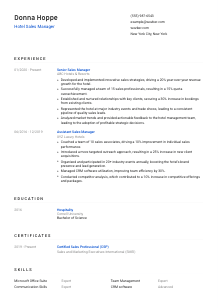
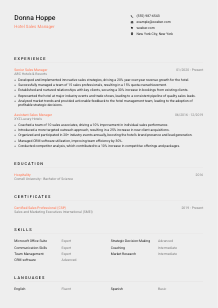
Fueling occupancy, but your resume isn't checking in with hiring managers? Check out this Hotel Sales Manager resume example, created with Wozber free resume builder. Learn how to present your sales acumen and hospitality touch in a way that matches job demands, leading your career to the penthouse suite of success!
Hotel sales leadership sits at the point where occupancy goals, client relationships, and market positioning meet. A Hotel Sales Manager resume needs to show commercial judgment, not just activity. Hiring teams want to see how you grew revenue, strengthened account retention, led a sales team, and turned market insight into bookings the property could actually count on.
When that story is tailored well, the first scan becomes much clearer. Wozber's free resume builder helps you shape an ATS-compliant resume around the language of the posting, so revenue growth, CRM use, team leadership, and client development are easy to pick up in both ATS screening and human review. That matters when employers are sorting hospitality sales candidates who may all have client-facing experience, but not the same record of driving hotel business.
For a Hotel Sales Manager, the header needs to do more than identify you. It should confirm that you are reachable, professionally presented, and aligned with practical requirements the employer may screen for early, especially title match and location. Keep this section clean and useful.
Use your full name as the most prominent text in the header. Keep the formatting simple and polished so it reads like a professional introduction, not a design exercise. In hospitality sales, where relationship-building matters, clarity and professionalism start here.
Place "Hotel Sales Manager" under your name when that is the role you are pursuing. This immediately connects your resume to the position and helps reinforce relevance in ATS screening. If your current title is slightly different, such as "Senior Sales Manager," you can still target the role as long as the experience below supports hotel sales leadership responsibilities.
Include a reliable phone number and a professional email address. Double-check both. A missed digit or an outdated email can cost you an interview, especially in sales hiring where responsiveness is part of the job. If you include a website or LinkedIn profile, make sure it reflects your hospitality sales background, account growth, and leadership experience.
If the employer requires someone based in New York City or willing to relocate there, state that clearly in your location line. For this opening, that detail removes a likely screening question right away. Only include location when it is relevant to the role or requested in the posting.
A strong LinkedIn profile or personal website can reinforce your resume if it shows consistent career progression, hotel or hospitality industry experience, and measurable sales results. Think of it as supporting material, not filler. If the content is thin or outdated, leave it off until it is worth reviewing.
This section should confirm the basics fast: who you are, what role you are targeting, how to reach you, and whether any stated location requirement is covered. That keeps attention on your sales results instead of avoidable questions.




This is the section that carries the most weight for a Hotel Sales Manager. Employers need to see what kind of business you have won, how you managed accounts or teams, and whether your work moved revenue, bookings, and client retention. Generic sales bullets will not do much here. Property-level impact and measurable outcomes will.
Read the job description closely and note the recurring priorities. In this case, those include revenue growth, sales strategy, team leadership, client retention, event participation, market analysis, and CRM proficiency. Then shape your experience bullets around matching responsibilities and outcomes instead of listing every task you handled in past roles.
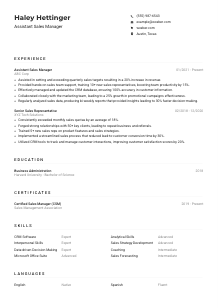
List your positions in reverse chronological order, with title, company, and dates. Put hotel, resort, or closely related hospitality sales experience front and center when you have it. For example, a progression from Assistant Sales Manager to Senior Sales Manager clearly supports a move into a Hotel Sales Manager role because it shows both continuity in the field and growth in scope.
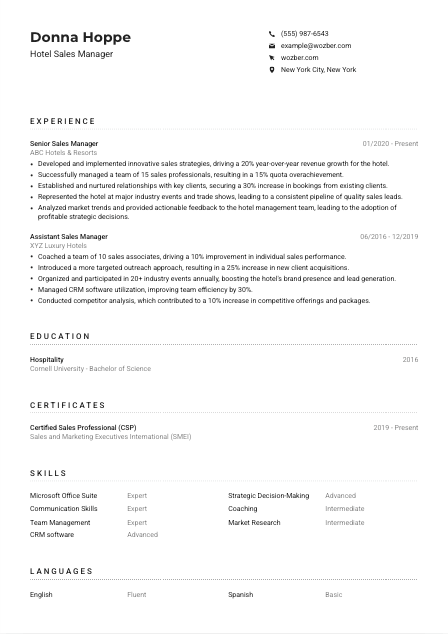
Each bullet should show what you did and what changed because of it. "Developed and implemented innovative sales strategies" becomes much stronger when paired with a result such as year-over-year revenue growth. The sample resume does this well by linking strategy work to a 20% revenue increase and client relationship management to a 30% lift in bookings from existing accounts.
Revenue growth, quota attainment, booking increases, team size, retention gains, event volume, and lead pipeline results all help employers understand your commercial impact. These are the metrics that make hospitality sales experience credible. If you managed a team of 15 or improved CRM adoption enough to raise efficiency by 30%, include it.
Prioritize experience that speaks to selling rooms, group business, corporate accounts, events, partnerships, market positioning, or team management. Older or less relevant work can stay brief. The goal is to make the reader quickly understand that you can generate bookings, coach sales staff, and contribute to property revenue strategy.
By the end of this section, the employer should be able to see the scale of business you handled, the teams you led, and the revenue outcomes you influenced. That is what separates a hospitality sales leader from someone who simply held a sales title.
Education usually will not outrank sales performance for this position, but it still matters when the posting asks for a specific degree background. In hotel sales hiring, your degree helps establish industry grounding and business fluency, especially when paired with relevant commercial experience.
If the employer asks for a bachelor's degree in Business, Hospitality, or a related field, state your degree, school, and field clearly. A Bachelor of Science in Hospitality, like the one in the sample resume, directly supports the role and should not be buried.
List the institution, degree, field of study, and graduation year or date range. That is usually enough for an experienced Hotel Sales Manager. Recruiters and hiring managers want to confirm the credential quickly without digging through extra text.
If your studies were in hospitality, business, marketing, or another closely related discipline, make sure that connection is obvious. It reinforces your understanding of hotel operations, revenue thinking, and customer-facing business strategy.
Relevant coursework, honors, or projects can help if you are earlier in your career or if they directly connect to sales, hospitality management, event business, or market analysis. For a seasoned candidate, these details are optional unless they add something meaningful.
Student leadership, hospitality associations, or business clubs can be worth noting if they support your sales or leadership profile. Keep them brief. For experienced candidates, professional results should remain the focus.
Your education section should confirm that you meet the stated degree requirement and, where relevant, reinforce your grounding in hospitality or business. Once that is established, let your sales record do the heavier lifting.
Certifications are not always required for Hotel Sales Manager roles, but the right one can sharpen your profile. They are most useful when they support sales leadership, account development, hospitality knowledge, or ongoing professional growth.
When a job posting does not require a certification, use this section to strengthen your positioning rather than to fill space. Sales credentials, hospitality certifications, or leadership training can help reinforce expertise, especially when your experience already shows strong results.
Choose certifications that reflect skills the role actually uses, such as consultative selling, revenue growth, client relationship management, or hospitality operations. In the sample resume, the Certified Sales Professional credential works because it complements a track record in hotel sales performance.
Show when the certification was earned and whether it is current. This helps employers see that the credential is recent or maintained, which is more useful than listing a title alone.
Hotel sales shifts with market demand, corporate travel patterns, event business, and digital sales tools. Continuing education in sales management, revenue strategy, or hospitality leadership can keep your resume current and show that you stay engaged with the commercial side of the industry.
A well-chosen certificate can support the story your experience already tells. Keep the focus on credentials that make sense for hospitality sales leadership, not on collecting unrelated badges.
The skills section should reflect how hotel sales actually operates. Employers are looking for a mix of client-facing ability, commercial planning, team leadership, and practical tool use. A short list of well-chosen skills does more than a long list of generic strengths.
Start with the language used in the posting. Here, that includes interpersonal communication, written communication, CRM software, Microsoft Office Suite, sales strategy, team management, client relationship building, and market analysis. These are not filler keywords. They map directly to how the job is performed and how ATS systems may categorize your resume.
Feature skills tied to winning and retaining business, such as account management, lead generation, negotiation, coaching, strategic planning, and competitor analysis. For a Hotel Sales Manager, these are more useful than broad labels that could apply to almost any office role.
Aim for a concise set of skills you can back up in your experience section. The sample resume works because skills like CRM software, team management, market research, and strategic decision-making are all reflected in the job history. That consistency matters.
Every skill here should connect to actual work you have done, whether that is growing bookings, coaching a sales team, analyzing local competition, or managing outreach through a CRM. Relevance beats volume.
Hotel sales often involves relationship building across corporate accounts, event planners, travel partners, and international guests. Language skills can add value, but they need to be presented accurately and in the right order, starting with what the employer requires.
If fluent English is listed as a requirement, make sure English appears first with the correct proficiency level. For this job, that is a baseline qualification because written proposals, client meetings, and internal reporting all depend on it.
Extra languages can strengthen your profile when they are relevant to the hotel's client base, travel segments, or local market. Spanish, for example, may be useful in many hospitality settings, but it should be listed as an added capability rather than a substitute for required English fluency.
Use clear labels such as Fluent, Native, Professional Working, or Basic. Avoid overstating ability. In a sales role, language claims are easy to test during interviews and client-facing scenarios.
If a hotel serves international travelers, global corporate accounts, or multilingual event business, relevant language skills can support relationship-building and service coordination. Mention them when they genuinely reflect your background and the market you know how to work in.
Additional languages can help with rapport, account development, and guest confidence, especially in diverse hospitality environments. They are most persuasive when they complement a solid sales record rather than try to replace it.
For this kind of role, fluent English should be immediately visible. Any additional language should strengthen your commercial profile by showing broader client reach or market versatility.
A Hotel Sales Manager summary should quickly establish the scale and kind of sales leadership you bring. This is where you frame your value in terms the employer cares about most: revenue growth, team leadership, account development, and hospitality-specific commercial experience.
Before writing, identify the few priorities that matter most in the role. In this case, that means direct sales experience, goal attainment, client retention, strategy development, team leadership, and market insight. Those themes should shape the summary, not a generic career statement.
Start with a direct line that names your role and level of experience. For example, "Hotel Sales Manager with 6+ years of hospitality sales experience" gives immediate context and helps position you correctly for the opening.
Mention strengths that connect tightly to the job, such as growing hotel revenue, leading sales teams, improving bookings from existing clients, or representing properties at industry events. The sample summary is effective because it combines revenue results, team leadership, and strategic decision support in a compact way.
Aim for a short paragraph that reads with confidence and specificity. Avoid vague phrases about being passionate or results-driven unless they are followed by concrete proof. This section should make the employer expect strong numbers in the experience section that follows.
Your summary should position you as someone who can drive hotel business, manage relationships, and lead a sales function with measurable impact. If those points are clear in a few lines, the rest of the resume has a strong opening.
A Hotel Sales Manager resume works when every section supports the same commercial story: you know how to win business, grow existing accounts, guide a sales team, and respond to market conditions in a way that lifts hotel revenue.
Use Wozber's free resume builder to organize that story in an ATS-friendly resume format, refine role-specific wording with AI support, and check alignment with an ATS resume scanner before you apply. The final read should make it easy to judge your ability to deliver bookings, client loyalty, and sales leadership in a hotel setting.




