



Use Wozber and land your dream job
Create Resume
No registration required
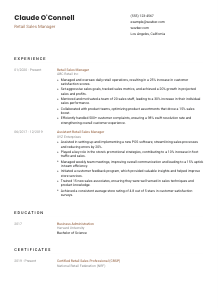
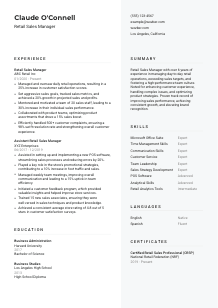
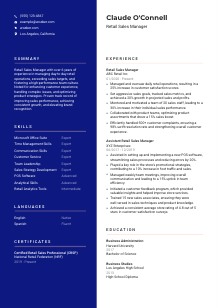
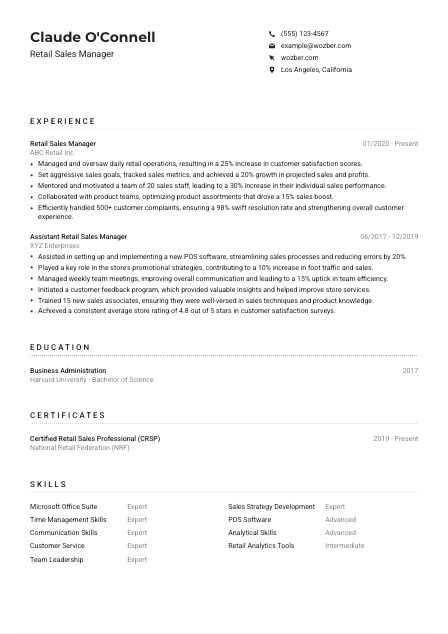
Leading sales teams, but your resume isn't checking out? Check out this Retail Sales Manager resume example, made with Wozber free resume builder. Learn how to present your leadership acumen to match job needs, guiding your retail career to keep ringing up successes!
Retail Sales Managers are hired to keep a store moving on every front at once. Sales targets, staffing, customer experience, product mix, and day-to-day floor execution all land on the same desk. A resume for this role needs to show that you can run operations, coach a team, and improve commercial results in a live retail environment where decisions affect revenue and customer loyalty fast.
The first screening pass often looks for proof that your management scope matches the store's needs. That means clear titles, measurable sales outcomes, team leadership, and tools such as POS systems or reporting workflows need to appear in the right places. Wozber's free resume builder helps shape that information into an ATS-compliant resume, so hiring teams can quickly see whether you've led retail performance, not just worked in retail.
Retail hiring starts with practical signals. Can this candidate be reached quickly, are they presenting themselves at a management level, and do their basics align with the role's logistics. Keep this section clean, professional, and tied to how store leadership roles are actually reviewed.
Use your full name in a clear, readable format so it stands out immediately at the top of the page. For management hiring, that first line should feel polished and straightforward, closer to a store leader's nameplate than a styled headline.
Place "Retail Sales Manager" beneath your name when that is the role you are pursuing. Matching the posted title helps frame the rest of the resume around store operations, team supervision, sales growth, and customer service accountability from the first glance.
Include a reliable phone number and a professional email address. If you add a website or LinkedIn profile, make sure the information supports the same leadership story shown in your resume, such as store results, team size, or operational accomplishments, rather than generic retail duties.
Some retail management roles need someone already based in the market, especially when stores need quick onboarding or local oversight. Here, listing "Los Angeles, California" directly addresses the posting's location requirement and removes a common point of uncertainty early.
Age, marital status, and similar details do not strengthen a retail leadership application. Use the space for information that supports store readiness instead, such as your title, contact details, and location when relevant to the posting.
This section should tell an employer, in seconds, that you are a serious candidate for store leadership and easy to place in the hiring process.




For a Retail Sales Manager, experience is where hiring teams look for real proof. They want to see whether you have led staff, improved sales performance, handled customer issues, and managed the daily pressure of store operations, not just supported those activities from the sidelines.
Read the job description for the recurring priorities and build your bullets around them. In this case, the role centers on daily operations, customer satisfaction, sales targets, staff development, promotional coordination, and issue resolution. Those themes should show up in your work history using the same language you can honestly support.
List positions in reverse chronological order and make the progression easy to follow. Retail employers want to see whether you moved from assisting store execution to owning team performance, forecasting, and floor leadership. A path from Assistant Retail Sales Manager to Retail Sales Manager, like the example, makes that progression immediately legible.
Each bullet should show what you owned and what changed because of your work. Strong retail bullets mention results tied to sales, customer experience, staff performance, promotions, or operational efficiency. "Managed daily retail operations" becomes much stronger when paired with an outcome such as higher customer satisfaction or improved store performance.
Numbers carry real weight in retail management. Use metrics that match how stores are evaluated, such as sales growth, profit improvement, customer satisfaction scores, complaint resolution rates, foot traffic, conversion improvements, or team productivity. The sample resume does this well with figures like 20% growth in projected sales and profits, a 30% lift in individual sales performance, and a 98% complaint resolution rate.
If you have a long retail background, give the most space to work that shows supervision, target setting, coaching, reporting, inventory or assortment input, and customer issue ownership. Earlier individual contributor roles can stay, but they should support the story of your development into someone trusted to run store performance.
After this section, a hiring manager should be able to picture the size of the team you led, the targets you managed, and the business results you improved.
Retail Sales Manager roles are usually won on experience first, but education still matters when the employer has set a degree requirement or wants stronger business grounding. Present it clearly, especially when the role calls for business, sales, marketing, or a related field.
If the posting asks for a bachelor's degree, make sure that credential is easy to find and accurately named. When your degree is in Business, Marketing, Sales, or a related discipline, the connection is obvious. In the example, a Bachelor of Science in Business Administration aligns well with the employer's stated requirement.
List the degree, field of study, school name, and graduation year. That is usually enough for an experienced retail manager. Keep the formatting consistent so the section is easy to scan during a quick review or ATS pass.
You do not need to overexplain your education, but the right field can strengthen your profile. Business Administration, Marketing, or related study areas can support the analytical and commercial side of the role, especially when the job includes forecasting sales, tracking profit, or planning promotions.
If you are earlier in your career, relevant coursework or projects in sales analysis, consumer behavior, merchandising, or management can help. For a candidate with several years of store leadership experience, those details are usually optional unless they add something the experience section does not cover.
Formal education and professional learning work well together in retail leadership resumes. If you also hold relevant certifications or recent training in sales, customer experience, or retail operations, that combination shows both foundational knowledge and current professional engagement.
For this role, education should confirm that you meet the stated requirement and support the business side of your retail leadership background.
Certifications are not always required for Retail Sales Manager roles, but the right one can sharpen your credibility. They are most useful when they reinforce areas employers already care about, such as sales practice, customer experience, retail operations, or leadership development.
Prioritize credentials that connect to retail selling, sales leadership, customer service, merchandising, or operational management. A certification such as Certified Retail Sales Professional fits naturally because it supports the same customer-facing and sales-driven responsibilities found in many store leadership roles.
A short, relevant certification section is stronger than a long list of unrelated courses. Keep the focus on credentials that help explain why you can lead staff, improve sales execution, or manage the customer experience more effectively.
Add the issue date or active period when available. In retail, current knowledge matters, especially when practices around customer engagement, sales processes, and store systems evolve over time. Dates also help employers understand whether the certification is active and recent.
If you are targeting higher-level store leadership roles, ongoing learning can support your resume over time. Look for training tied to retail analytics, staff coaching, visual merchandising, loss prevention, POS systems, or promotional planning, depending on the direction of your career.
A well-chosen certification should strengthen the same capabilities your experience already demonstrates, especially in sales leadership and customer-facing retail operations.
A Retail Sales Manager's skills section should read like the operating toolkit behind store performance. Hiring teams look for a mix of commercial awareness, staff leadership, customer handling, and comfort with the systems used to track sales and run the floor.
Use the posting to identify the skills the employer is likely filtering for. Here, that includes POS software, Microsoft Office Suite, analytical ability, organization, time management, communication, and English proficiency. Mirroring that language helps both ATS matching and human review when those skills reflect your real background.
Do not make the section too soft or too technical. Retail management usually sits between team leadership and commercial execution, so include skills such as team leadership, customer service, sales strategy development, forecasting, complaint resolution, POS systems, and reporting tools when they apply to your experience.
Focus on the skills most likely to matter in store leadership decisions. A compact list with relevant strengths is more useful than a long inventory of generic abilities. The sample resume handles this well by combining management skills like team leadership and customer service with systems and analysis skills such as POS software, Microsoft Office Suite, and retail analytics tools.
Your skills should quickly confirm that you can lead people, read store performance, and work with the systems that support daily retail operations.
Language skills can matter more in retail than candidates sometimes realize. Clear communication affects coaching on the sales floor, conflict handling, customer service recovery, and day-to-day team coordination, especially in stores serving diverse communities.
When the job description asks for strong English, list English at the top with an accurate proficiency level. That directly addresses a stated requirement and supports core responsibilities such as staff communication, complaint handling, reporting, and customer interaction.
Additional languages can be a real advantage in customer-facing retail, particularly in multilingual regions or stores with diverse teams. They are not always required, but they can strengthen your ability to support service quality and smoother in-store communication.
Use clear labels such as Native, Fluent, Intermediate, or Basic. In a management role, inflated language claims can create problems quickly if the job involves conflict resolution, coaching, or customer escalations in that language.
Language relevance depends on context. In some retail environments it may not change the hiring decision, while in others it can make you more effective on the floor, especially when leading a diverse team or serving high-volume walk-in traffic.
When listed honestly, language skills can support better service, smoother staff communication, and stronger customer relationships. The example's English and Spanish combination is a useful illustration of how multilingual ability can complement a retail management profile without replacing the need for sales and leadership results.
For retail management, languages matter most when they help you communicate clearly with customers, staff, and escalated service situations.
The summary needs to establish your management level fast. In a few lines, it should tell the employer how long you have worked in retail, what kind of leadership scope you bring, and which business outcomes you tend to improve.
Build the summary around the employer's core needs rather than around generic ambition. For this kind of opening, that usually means daily operations, sales growth, staff leadership, customer satisfaction, and commercial judgment. These points give the summary immediate relevance.
Lead with a direct professional identity statement such as Retail Sales Manager with 6+ years of experience in store operations and sales leadership. That quickly tells the reader whether your background is aligned with the level of the role before they move into the rest of the resume.
Choose strengths that connect closely to the posting and support them with outcomes or scope. You might mention exceeding sales targets, coaching teams to stronger performance, improving customer satisfaction, or collaborating on assortments and promotions. The sample summary works because it pairs leadership themes with concrete results-oriented language.
Stay concise. A summary of three to five lines is usually enough if each sentence earns its place. Avoid soft descriptors unless they are tied to store results, team performance, or customer outcomes the employer can expect you to influence.
A hiring manager should finish the summary already knowing your retail level, your leadership scope, and the kind of sales and customer results you are used to delivering.
A Retail Sales Manager resume works when each section points to the same conclusion: you can lead a team, run daily operations, and improve sales performance in a real store setting. Wozber's free resume builder, ATS-friendly resume template, and ATS optimization tools help you align that story to the job description without losing the specifics that make your track record believable.
Keep refining the resume as your store scope grows, your metrics improve, and your leadership responsibilities expand. The finished document should make it easy to judge whether you can step into the floor, guide the team, and deliver results.




