



Use Wozber and land your dream job
Create Resume
No registration required
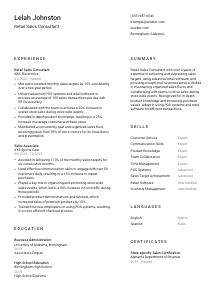
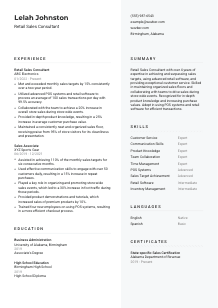
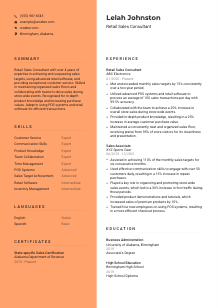
Guiding customers through racks, but your resume feels tucked away? Explore this Retail Sales Consultant resume example, created with Wozber free resume builder. Learn how to spotlight your sales savvy to match the job criteria, ensuring your career is always on the best-dressed display!
Retail Sales Consultant hiring moves quickly, and resumes often miss the details that matter most on the sales floor. Store managers want to see how you help customers choose the right product, keep the floor ready for business, and contribute to revenue day after day. Your resume should make that retail rhythm visible, from customer conversations to checkout accuracy to results during promotions.
When your resume mirrors the language of the posting, it becomes much easier to surface in ATS screening and stand out for the right reasons. Wozber's free resume builder helps organize those details into an ATS-compliant resume that clearly connects your sales numbers, POS experience, and customer-facing strengths to the role. That gives the hiring team a faster read on whether you can perform well in a live retail environment.
In retail hiring, the top of the resume gets scanned in seconds. Managers look for a clear role match, reliable contact details, and any practical requirement that affects scheduling or availability. Your personal details should answer those questions cleanly and without distraction.
Place your full name at the top in a clear, readable size. Retail hiring often involves reviewing many applications in a short window, so your header should be easy to identify at a glance.
Add "Retail Sales Consultant" directly under your name when that is the role you are pursuing. Matching the title helps frame your background immediately, especially if your recent work also includes titles like Sales Associate or Customer Service Associate.
Include a working phone number and a professional email address you check regularly. For store-based roles, interview requests can move fast, so accuracy matters. If you include a website or LinkedIn profile, make sure it reflects the same work history, sales background, and customer-facing presentation shown on your resume.
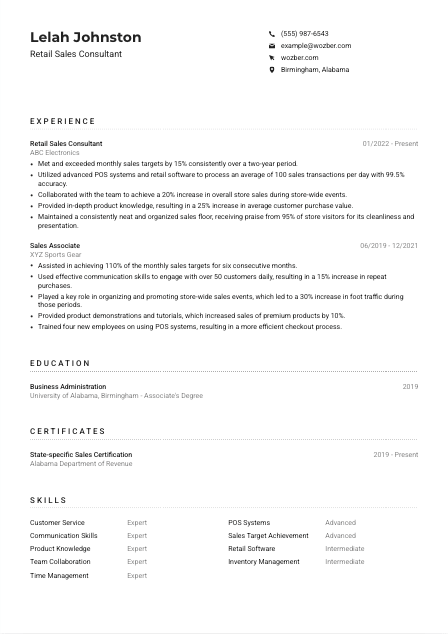
If the employer requires you to be based in a specific area or open to relocation, show that clearly in your location line. In the example, listing Birmingham, Alabama directly supports a stated requirement without taking up extra space elsewhere on the resume.
A LinkedIn profile can support your application if it reinforces your retail history, product categories, promotions work, or customer service background. Skip links that are outdated or unrelated to sales performance, store operations, or customer engagement.
Your header should quickly show that you are reachable, professionally presented, and logistically aligned with the opening. For a Retail Sales Consultant role, that early clarity removes friction before the hiring manager even reaches your experience section.




Retail experience is judged by what happened on the floor. Hiring teams want to see sales performance, customer interaction, transaction accuracy, and the kind of day-to-day ownership that keeps a store running smoothly. Your experience section should show what you handled and what improved because of your work.
Read the job description with a highlighter. For this kind of role, the essentials are usually retail sales or customer service experience, target attainment, product knowledge, POS proficiency, and teamwork during promotions. Build your bullets around those points so your background answers the posting directly instead of listing generic duties.
List recent positions in reverse chronological order and give each entry the basics first: job title, employer, and dates. Put your strongest customer-facing and sales-driven roles up front. A current Retail Sales Consultant role or a closely related Sales Associate position will carry more weight here than unrelated experience.
Retail resumes improve immediately when bullets show what changed because of your work. Instead of saying you assisted customers, show the result of that service. The example does this well with points like increasing average purchase value through in-depth product knowledge and helping drive store sales during events.
Retail managers trust metrics they recognize. Include monthly target attainment, average daily transactions, checkout accuracy, repeat purchases, event sales lifts, foot traffic gains, upsell performance, or customer satisfaction results when you have them. Figures like 15% above target, 100 transactions per day, or 99.5% POS accuracy make your impact concrete.
Prioritize experience that reflects customer guidance, merchandising upkeep, returns processing, account handling, team selling, and product updates. If a bullet does not help prove you can sell, serve, or support store operations, trim it. Relevance matters more than volume in this section.
By the end of your experience section, the reader should be able to picture you working the floor, handling transactions accurately, and contributing to store targets. That is the standard to write toward.
Education is rarely the main deciding factor in retail sales hiring, but it still adds useful context. It can show business fundamentals, communication training, or early exposure to customer-facing work. Present it simply, then let it support the stronger proof in your experience section.
Some Retail Sales Consultant openings ask for a diploma, some prefer college coursework, and others focus almost entirely on sales history. If there is no strict degree requirement, include your highest completed education and keep the emphasis proportional to the role.
List the school, degree, field of study, and graduation year. A straightforward format helps the hiring manager scan quickly. In the example, an Associate's Degree in Business Administration adds relevant business context without taking attention away from stronger sales achievements.
If you are early in your career or your work history is still developing, a few related courses can help. Subjects like retail operations, business communication, marketing, or customer relationship management can support your positioning for a customer-facing sales role.
Student leadership, part-time retail work during school, sales competitions, or projects tied to merchandising or customer behavior can be worth adding. Keep the link to store work clear. General academic honors matter less than activities that show initiative, service, or commercial awareness.
If you hold a required sales license or state-specific certification, list it in the certificates section rather than folding it into education. That keeps formal schooling distinct from job-specific credentials and makes required qualifications easier to find.
Use education to add context, not clutter. For retail sales roles, it should support your customer service and commercial background without competing with the sales results that matter most.
Certifications matter most when they answer a stated requirement or strengthen trust in regulated sales environments. If a posting asks for a state-specific sales certification or license, make it easy to find and easy to verify. This section should be brief, direct, and current.
Lead with any certificate or license named in the job posting. In this case, a state-specific sales certification belongs at the top because it directly addresses a stated requirement. When a credential is mandatory, do not bury it below optional training.
Focus on credentials tied to sales, customer service, product categories, compliance, or store operations. A short list of relevant items is more effective than a long list of unrelated training that does not strengthen your case for a customer-facing sales role.
Add the name of the issuer and the relevant date or validity period. That helps a hiring manager confirm whether the credential is current. The example's "2019 - Present" format works well for an active certification.
Retail changes with new products, promotions, systems, and compliance expectations. If you complete vendor product training, customer service coursework, or updated sales certification, add it when it supports the kind of store work you want next.
Your certificates section should quickly show whether you meet any formal requirement and whether you stay current in areas that affect selling, service, or store compliance.
Retail sales skills need to read like tools you actually use on shift. Hiring managers scan for the abilities that affect customer experience, conversion, checkout flow, and team execution. Build this section from the language of the job posting and the work you can back up in your experience bullets.
Start with the capabilities the employer names explicitly. For this role, that includes customer service, communication, POS systems, retail software, product knowledge, and sales target achievement. If those skills are real strengths, use the same wording so both ATS screening and human reviewers can connect your resume to the posting quickly.
Put customer-facing and sales-driving strengths near the top. Product knowledge, upselling, customer communication, transaction handling, and team collaboration usually matter more than broad soft skills with no retail context. The sample skill list works because it centers on store-relevant abilities rather than generic traits.
Use a concise skills section that matches what your experience proves. If you rate yourself highly in POS systems or sales target achievement, your work history should show transaction volume, accuracy, or target results to support it. A short, credible list is more persuasive than an oversized inventory of every skill you have touched.
This section should reinforce the retail capabilities already visible in your experience, especially the ones tied to customer interaction, sales performance, and store systems.
Language skills can matter in retail because every shift depends on clear communication with customers and coworkers. The priority is simple: show required fluency first, then add any additional languages that could help you serve a broader customer base.
If the posting asks for strong English fluency, list English clearly and use an honest proficiency level such as Native or Fluent. That immediately addresses a basic operating requirement for customer conversations, product explanations, and transaction handling.
Additional languages can be valuable in stores with diverse customer traffic. Even basic conversational ability may help with greetings, simple product guidance, or building rapport. In the example, Spanish adds a useful secondary skill without overstating proficiency.
Stick with standard terms such as Native, Fluent, Intermediate, or Basic. Retail roles involve direct interaction, so accuracy matters. If a manager switches to that language during an interview or on the job, your listed level should hold up.
Some stores benefit more from multilingual ability than others. A location with high tourist traffic or a broad neighborhood customer base may value extra language skills more strongly. Include them when they add practical service value, not just because you have studied them briefly.
The value of a second language in retail is usually practical. It can make product explanations smoother, reduce friction during returns or account questions, and help customers feel comfortable asking for assistance. Present languages in that spirit.
List the languages you can genuinely use in customer interactions and make required fluency impossible to miss. For retail sales, that is what gives this section real hiring value.
The summary sits at the top of the resume, so it needs to establish your retail profile fast. A hiring manager should learn your level of experience, the kind of sales environment you know, and the business results you tend to produce. Keep it short, but make every sentence carry specific weight.
Before writing, identify the few priorities the employer keeps returning to. For a Retail Sales Consultant role, that often means direct retail experience, sales results, customer guidance, POS fluency, and product knowledge. Those should shape the summary more than broad adjectives ever will.
Start with a direct line that positions you clearly, such as your title and years of experience in retail sales or customer service. The example summary does this effectively by leading with more than 4 years in the field, which immediately places the candidate above the minimum experience requirement.
Choose strengths that connect to how stores actually operate. Mention sales target achievement, customer service, product expertise, transaction efficiency, or success during promotions. Keep them close to the employer's wording so your summary feels aligned without reading like a copy of the job ad.
Aim for a compact paragraph of a few lines. Skip vague claims about being passionate or hardworking unless they are backed by specifics. A summary that mentions sales growth, POS competence, and customer purchase value will do more work than one filled with general enthusiasm.
Your summary should quickly position you as a retail professional who can sell, support customers, and contribute to store performance. If the reader reaches your experience section already expecting solid sales execution, the summary has done its job.
A Retail Sales Consultant resume works best when it shows the realities of the job clearly: customer guidance, product knowledge, transaction accuracy, team selling, and measurable sales results. Keep each section aligned with the posting so the hiring manager can quickly connect your background to store needs.
Use Wozber to build and refine an ATS-friendly resume format, check alignment with an ATS resume scanner, and tighten your wording around the requirements that matter most. The finished resume should make one thing easy to judge: whether you can step onto the sales floor and contribute from the start.