



Use Wozber and land your dream job
Create Resume
No registration required
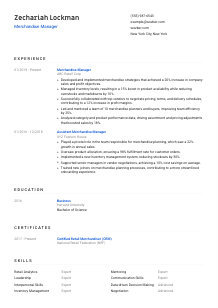
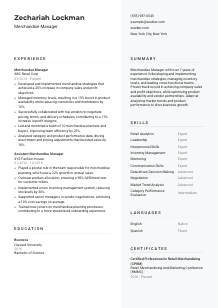
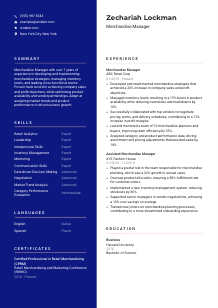
Designing store displays, but your resume seems out of stock? Check out this Merchandise Manager resume example, created with Wozber free resume builder. It shows how to strategically arrange your retail experience to match job specs, making your career trajectory as appealing as your most eye-catching merch!
Merchandise managers are hired to make commercial decisions that hold up in the numbers. Sales growth, margin protection, inventory flow, markdown control, and assortment performance all sit inside the role, so your resume needs to show that you can connect planning decisions to retail results, not just that you have worked around product.
A tailored resume changes how quickly that commercial judgment comes through. When your language matches the posting's priorities, such as merchandise strategy, retail analytics, vendor negotiation, and team leadership, Wozber's free resume builder helps you shape that experience into an ATS-compliant resume that is easy to parse and easy to read as profitable retail leadership.
Retail hiring moves faster when the basics are clear. For a Merchandise Manager role, this section should immediately confirm who you are, what role you do, and whether practical requirements like location and contactability are already covered.
Make your name the most visible text in the header so hiring teams can identify and remember you quickly. Use a clean font and enough spacing to keep the top of the resume sharp and professional, especially for a role that depends on organization and commercial discipline.
Place "Merchandise Manager" under your name if that is the role you are targeting. This creates immediate alignment with the posting and helps frame the rest of the resume around planning, buying, allocation, and category performance rather than a more generic retail background.
Include a reliable phone number and a professional email address in a straightforward format. Check every character. A typo in your email or phone number can block follow-up after a strong first screen, which is an avoidable miss at this stage.
If the employer specifies a city, include it in your header when it applies. Here, listing New York City, New York works well because the job calls for candidates based there. Treat that as tailoring to this opening, not a rule for every merchandise management resume.
If you include LinkedIn or a personal site, make sure it supports your resume with consistent titles, dates, and retail achievements. For this profession, a strong profile often reinforces category scope, brand exposure, vendor work, and measurable wins such as sell-through improvement or margin gains.
This section should remove basic questions before the hiring team reaches your experience. Clear identity, role alignment, and any stated location requirement help keep the focus on your merchandise results.




This is the section where Merchandise Manager candidates separate themselves. Hiring teams look for proof that you have influenced sales, managed inventory intelligently, worked across buying and planning decisions, and led teams or vendor relationships with clear business outcomes.
Read the job description for the operating themes behind the title. In this case, the core areas are merchandise strategy, inventory control, vendor collaboration, retail analytics, and team leadership. Those themes should shape which bullets you keep, rewrite, or move higher so your experience reflects how the role is actually measured.
List jobs in reverse chronological order and include title, company, and dates in a consistent format. For merchandise roles, that structure matters because progression from allocator, planner, buyer, or assistant manager into broader category ownership tells a clear story of increasing responsibility.
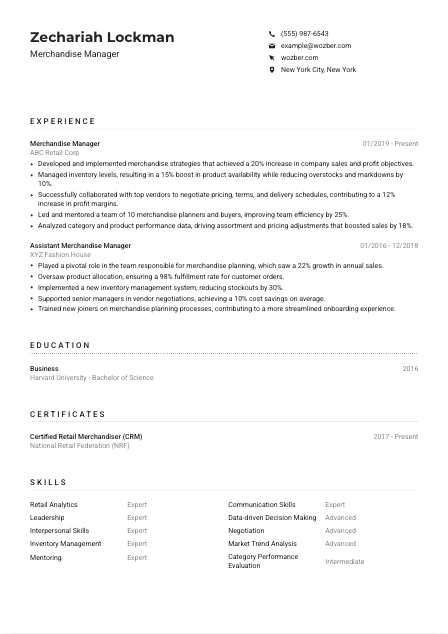
Focus each bullet on what you owned and what changed because of your work. Strong examples in this field include improving product availability, reducing overstocks, lifting gross margin, sharpening assortments, or negotiating better vendor terms. The sample resume handles this well by tying strategy work to a 20% increase in sales and profit objectives instead of stopping at a task description.
Numbers matter in merchandising because the work is judged through performance. Include percentages, margin gains, stockout reduction, fill rate, markdown improvement, or team productivity when you can support them. Metrics like a 15% boost in product availability or a 12% increase in profit margins immediately tell a hiring manager how your decisions landed in the business.
Keep the section centered on assortment planning, inventory decisions, pricing input, vendor negotiation, analytics, and leadership. General retail duties, unrelated customer service detail, or broad management claims dilute the message if they do not support the level of a Merchandise Manager. Every line should help the reader picture you running a category, portfolio, or planning function.
Your experience section should read like a record of commercial judgment. When hiring teams can see how you grew sales, protected margin, improved inventory health, and led people around those outcomes, the resume starts working at the right level.
Education usually sits behind experience for a Merchandise Manager, but it still matters when the posting names a degree requirement. Keep it direct and relevant so recruiters can confirm the credential quickly and move on to your planning and trading results.
If you have a bachelor's degree in Business, Merchandising, or a related field, list it clearly. That is especially important here because the posting asks for it directly. A Bachelor of Science in Business, as shown in the example, checks the box cleanly without extra explanation.
Present degree, field of study, school, and graduation year in a consistent order. Clean formatting helps recruiters verify requirements fast, especially when they are screening multiple retail candidates with similar years of experience.
Do not make the reader guess. If your degree is directly related to merchandising, retail, business, supply chain, or a similar discipline, use the formal wording from your transcript. Clear degree wording supports ATS matching and avoids unnecessary ambiguity.
Most experienced candidates can skip coursework, but it can help if your degree title is broad or your early experience is lighter. Courses in retail analytics, consumer behavior, inventory management, pricing, or merchandising strategy can add context when they strengthen your story.
Honors, retail-focused projects, case competitions, or merchandising internships are worth noting if they connect to commercial planning or category work. Keep them brief. Once you have substantial experience, these details should support the section, not dominate it.
Education does not need much space here. It needs to confirm that you meet the stated academic requirement and support the retail and analytical background already shown elsewhere on the page.
Certifications are not always mandatory in merchandise management, but they can strengthen your profile when the employer mentions them or when you want to show deeper commitment to the retail side of the profession. Use this section selectively and keep it closely tied to merchandising practice.
When a job description mentions credentials such as CRM or CPRM, place those first if you hold them. That kind of direct alignment helps the recruiter confirm a preferred qualification immediately and shows that your development tracks with the language of the role.
Do not crowd the section with unrelated coursework badges or general management certificates. Prioritize credentials that support merchandising, retail operations, assortment planning, buying, analytics, or inventory decision-making. Relevance carries more weight than volume.
Certification dates help the reader understand whether the credential is current or recently earned. That is helpful in retail functions where tools, planning methods, and market practices keep evolving. The example resume includes active date ranges, which makes the credentials easier to interpret.
A certification section works best when it suggests that you stay current on retail practices, not that you collected titles once and stopped. If you are actively maintaining certifications or adding new training in analytics, planning systems, or merchandising methods, let the timeline reflect that ongoing growth.
Relevant certifications can strengthen your retail profile, especially when they back up real experience in merchandise planning, category analysis, and buying leadership. Keep the section focused and directly connected to the work.
A Merchandise Manager skills section should read like the toolkit behind your decisions. Employers want to see whether you can analyze performance, manage inventory, influence vendors, and lead teams, not just whether you can list broad business strengths.
Pull both explicit and implied skills from the posting. Here that means retail analytics, data-driven decision making, leadership, collaboration, inventory management, negotiation, and category performance analysis. Those are the capabilities that support the responsibilities, so they deserve space before more generic business skills.
Merchandise Managers sit between numbers and people. Your list should reflect both sides of the job, such as assortment analysis, pricing decisions, forecasting, inventory control, vendor management, mentoring, and cross-functional communication. The sample resume does this well by pairing retail analytics and inventory management with leadership and interpersonal strength.
Use a focused list rather than trying to capture every system, trait, and tool you have touched. Prioritize the skills that most directly support sales planning, margin performance, stock health, and team execution. A compact, relevant list is more convincing than a long inventory of loosely related abilities.
This section should reinforce the way you work as a merchandise leader. When the listed skills connect clearly to planning decisions, commercial analysis, vendor work, and team management, the rest of the resume reads with more credibility.
Language skills are usually secondary for Merchandise Manager roles, but they can still add value. Retail organizations often work across vendors, internal teams, and customer markets, so clear communication matters, especially when the posting names English proficiency outright.
If the role requires English, list it first with an accurate proficiency level such as Native or Fluent. That answers the stated requirement immediately and keeps the recruiter from having to infer communication ability from the rest of the resume.
Place the most job-relevant language at the top, then add any others that may support supplier communication, regional market work, or broader team collaboration. This simple ordering makes the section easier to read and more useful.
Extra languages can be a plus when the business works with international vendors, diverse store markets, or cross-border sourcing teams. Spanish, for example, may be worth listing if it is real and usable, as shown in the sample resume. Just do not oversell it as essential unless the job says so.
Choose labels you can defend in a real conversation. Native, Fluent, Intermediate, and Basic are usually enough. Honest proficiency matters more than ambitious wording, especially if the role includes vendor calls, presentations, or team coaching.
List languages because they improve how you work, not because they fill space. For merchandising roles, that might mean clearer collaboration with vendors, smoother communication across retail teams, or stronger market understanding. If a language does not add practical context, it is optional.
For this role, language skills should support communication and market reach. Cover the required English proficiency clearly, then add other languages only when they strengthen your retail profile.
Your summary should sound like someone who has run commercial decisions, not someone introducing themselves in broad terms. In a few lines, show your level, your merchandising scope, and the kind of results you influence across sales, margin, inventory, and team performance.
Start with your current professional identity, years of experience, and core area of strength. For this role, that may mean merchandise planning, buying, allocation, category management, or broader retail strategy. The reader should understand your lane within the first line.
Use one or two measurable outcomes that reflect the employer's priorities. Results such as increasing sales, improving product availability, reducing markdowns, or strengthening vendor margins work well because they speak directly to the commercial side of merchandising. The sample summary succeeds by combining strategy, inventory management, and business growth in a compact way.
Aim for a short paragraph that can be read in seconds. Skip vague adjectives and avoid repeating everything that appears later in the resume. Use the space for high-value information that tells the employer what kind of merchandise decisions you have led and what outcomes usually follow.
Adjust the summary each time you apply so it mirrors the level and focus of the opening. If a posting leans heavily on retail analytics, team leadership, or vendor negotiation, bring those themes into the summary in natural language. This is also a place where Wozber's AI resume builder can help tighten phrasing around the exact requirements without losing your real voice.
A strong summary gives the hiring team a fast read on your merchandising scope and business impact. By the time they reach your first role, they should already understand that you can steer assortment decisions, inventory health, and profit-focused execution.
A Merchandise Manager resume should make commercial judgment visible from top to bottom. When your experience, skills, and summary all point to sales growth, margin management, inventory control, vendor partnership, and team leadership, the document starts to reflect the level of the job.
Use Wozber to turn that experience into an ATS-friendly resume format with stronger ATS optimization, clearer role alignment, and sharper wording around the priorities in each posting. The result should make it easy for a hiring team to see how you would run the business behind the assortment.




