



Use Wozber and land your dream job
Create Resume
No registration required
Mastering leads, but your resume isn't closing deals? Check out this Sales Lead resume example, created with Wozber free resume builder. Learn how to pitch your lead-generating prowess to match job criteria, paving your career path with sales victories!
Sales Lead hiring turns quickly on one question: can you turn a sales plan into repeatable revenue through people, process, and customer relationships? A generic sales resume often leans too heavily on personality traits or individual wins. For this level, hiring teams want to see team leadership, target attainment, account growth, and the ability to adjust strategy when pipeline data says the current approach is not working.
A tailored resume changes how that story lands in both ATS screening and human review. When your language reflects the employer's terms for CRM use, sales strategy, cross-functional work, and quota performance, Wozber's free resume builder helps you shape an ATS-compliant resume that surfaces the right priorities early. That makes it easier to see whether you can lead reps, grow key accounts, and steer sales results in the direction the business needs.
Sales roles start with accessibility and credibility. Your contact section should make it easy to reach you and, when relevant to the posting, quickly confirm practical requirements such as location. Keep it clean, accurate, and aligned with the level of responsibility expected from a Sales Lead.
Your name should be the most visible text on the page, set in a clear professional font. Sales leadership is a client-facing function, so the top of the resume should feel polished and easy to scan, much like a well-structured pitch deck or account summary.
Place "Sales Lead" directly under your name when that is the role you are pursuing. Matching the posted title helps frame your resume immediately, especially when your background includes titles such as Senior Sales Representative, Account Executive, or Sales Manager that may otherwise be interpreted differently.
List a current phone number and a professional email address, then check both for errors. In sales hiring, missed calls and bounced emails create the wrong impression fast. A simple format such as firstname.lastname@email.com keeps the focus on your experience, not your inbox name.
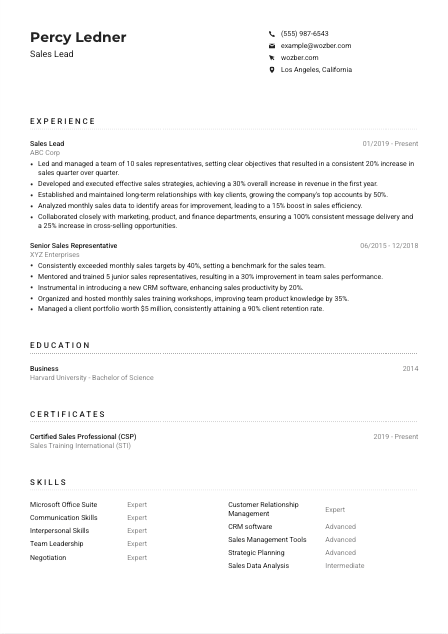
If the employer requires a local candidate, show your city and state in the header. In the example, "Los Angeles, California" answers a stated requirement right away. That kind of detail belongs here, where it resolves a practical screening question without taking space from your achievements.
Include LinkedIn or a personal site only if it supports your candidacy with consistent information, sales awards, speaking engagements, or industry credibility. For sales leaders, an updated profile can reinforce team leadership, account growth, and market experience, but only if it matches the resume closely.
This section should confirm who you are, how to reach you, and whether you meet any immediate practical requirements. For a Sales Lead resume, that means a professional header that removes friction and lets the reader move straight to your revenue and leadership record.




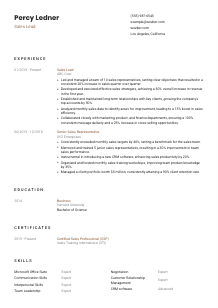
This is the section that carries the most weight for a Sales Lead. Hiring teams want more than a list of duties. They look for proof that you led reps, hit targets, grew accounts, improved sales efficiency, and worked across departments to move revenue forward.
Before editing your work history, identify the few responsibilities that define the role. Here, the posting emphasizes leading sales representatives, building strategy, growing key client relationships, analyzing sales data, and partnering with marketing, product, and finance. Those themes should shape which achievements you highlight first and how you phrase them.
List your most recent sales roles first with job title, employer, and dates clearly shown. For Sales Lead positions, recent experience usually carries the strongest signal because it reflects current quota ownership, team size, CRM usage, and management scope. A clean timeline also helps readers track progression from individual contributor to leadership.
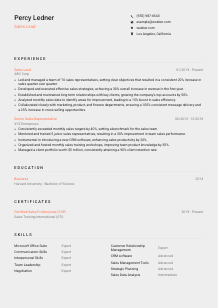
Each bullet should show what you owned and what changed because of your work. Strong examples include team performance, revenue lift, retention, expansion, forecast accuracy, or process gains. In the sample resume, "Led and managed a team of 10 sales representatives" works because it is tied to a 20% quarter-over-quarter sales increase, not left as a management duty alone.
Sales resumes benefit from metrics more than most. Include quota attainment, revenue growth, average deal size, account expansion, renewal rate, cross-sell performance, pipeline conversion, or team productivity where you can support them. The example uses figures such as 30% revenue growth, 50% top-account growth, and 90% client retention, which give hiring managers a concrete sense of scale and consistency.
Prioritize experience that supports sales leadership, strategic planning, customer growth, and team management. Earlier roles that do not connect to selling, coaching, or commercial results can be shortened or removed. If your background includes strong individual sales experience before management, keep the bullets that show target overperformance, mentoring, or CRM adoption because they explain how you grew into a lead role.
Your experience section should leave no doubt about the scope you handled and the results you produced. When the bullets show team leadership, measurable sales outcomes, and smart use of data, the reader can quickly picture you leading a revenue function rather than simply participating in one.
For most Sales Lead roles, education supports your candidacy rather than driving it. Still, when a posting specifies a bachelor's degree in Business, Marketing, or a related field, your resume should make that qualification easy to find and easy to confirm.
If the role asks for a bachelor's degree, list it in a straightforward format with no unnecessary wording. A degree in Business, Marketing, or a related discipline lines up naturally with sales planning, customer strategy, and commercial analysis. In the example, a Bachelor of Science in Business directly satisfies that requirement.
Include your degree, field of study, school, and graduation year or date. Recruiters do not need a paragraph here. They need a fast, reliable read on whether you meet the academic baseline while they focus on your sales results and leadership history.
When your degree maps closely to the posting, do not hide it behind abbreviations or clutter. If you studied Business, Marketing, Communications, or another relevant field, show that clearly. Straightforward alignment helps both ATS matching and manual screening.
Relevant coursework can help if you are early in your career or if the role has a specialized commercial focus such as analytics, channel sales, or product-heavy selling. For an experienced Sales Lead, this is usually optional. Once you have several years of quota-carrying or management experience, revenue outcomes matter more than classroom detail.
Honors, leadership activities, or major projects are worth mentioning only if they add something useful, such as leadership, presentation skill, or business development exposure. Keep the emphasis where sales hiring places it most heavily, on performance in the field.
Education should confirm that you meet the stated baseline and then get out of the way. For a Sales Lead, it supports the picture. Your leadership record, customer growth, and target attainment still do the heavier lifting.
Certifications are rarely the deciding factor for Sales Lead hiring, but they can strengthen your profile when they reflect practical sales capability, leadership development, or knowledge of a relevant selling framework. Used well, this section shows that you keep sharpening your commercial toolkit.
Start with the job ad. If it names a required or preferred certification, mirror that wording accurately. If it does not, use the section to highlight training that reinforces your sales leadership value rather than filling space with unrelated credentials.
Prioritize certifications tied to sales performance, account management, negotiation, leadership, CRM platforms, or industry-specific selling. The sample's Certified Sales Professional credential works because it speaks directly to sales discipline and professional development.
Include the completion date and, when relevant, whether the credential is active. This matters most for certifications tied to current methods, tools, or platform expertise. A recent certification can also show that your approach to pipeline management or customer engagement is current.
Ongoing learning carries more weight when it connects to real sales outcomes. Training in forecasting, sales coaching, enterprise selling, pricing strategy, or CRM workflow design can all support a Sales Lead profile because they influence execution, rep performance, and customer growth.
A well-chosen certification section strengthens your commercial profile by showing relevant development and current knowledge. Keep it focused on sales, leadership, and tools that matter to the role, and let it reinforce the results shown in your experience section.
A Sales Lead skills section should read like the operating toolkit behind your results. That means balancing leadership and communication strengths with practical commercial tools such as CRM platforms, forecasting, reporting, negotiation, and sales analysis.
Read the posting closely and note both stated and implied skills. Here, CRM proficiency, Microsoft Office, sales management tools, communication, and interpersonal strength are explicitly named, while strategy development, data analysis, coaching, and cross-functional collaboration are clearly part of the work as well.
Lead with skills that directly support Sales Lead responsibilities, such as team leadership, client relationship management, negotiation, CRM software, sales strategy, and performance analysis. In the example, the strongest entries are the ones connected to management scope and commercial execution, not generic software familiarity on its own.
Avoid turning this section into a dump of every capability you have picked up. Focus on the tools and strengths that help a sales team hit numbers, manage pipeline, retain customers, and coordinate with other departments. A shorter, sharper list usually reads better in both ATS systems and recruiter review.
Your skills section should support what your experience already proves. When the listed skills match the way you actually lead teams, manage accounts, use CRM data, and collaborate across the business, the resume feels coherent and credible.
Language ability matters in sales because trust, clarity, and persuasion all depend on communication. For many Sales Lead roles, English fluency is the baseline. Additional languages can be valuable when they support client coverage, regional growth, or multicultural teams.
If the posting specifies a language, list it first with an accurate proficiency level. In this case, English competency is required, so English should appear prominently in the section and match the communication standard expected for client conversations, team leadership, and internal collaboration.
Use plain labels such as Native, Fluent, Intermediate, or Basic. Sales roles rely on clear communication in presentations, negotiations, and account management, so vague phrasing is less useful than a direct indication of how comfortably you operate in the language.
Additional languages can strengthen your resume if they help with customer relationships or market reach. In a city like Los Angeles, Spanish may be a practical asset for some teams or territories, but treat extra languages as added value rather than a universal requirement.
Do not overstate what you can do. If you can manage client discussions, present solutions, or negotiate in a second language, say so with the right proficiency level. If not, keep the rating honest. Sales hiring often surfaces language ability quickly in interviews and live conversations.
If a language has helped you manage accounts, support cross-border deals, or work with diverse customer segments, that impact can also appear elsewhere in your resume. The language section itself should stay concise, but it can point to broader market versatility.
List the languages you can actually use in business settings and be clear about your level. For a Sales Lead, accurate language information helps the employer understand how you might handle customer communication, internal leadership, and market reach.
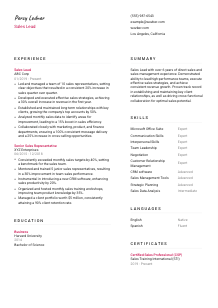
The summary is your opening case for why your background belongs in a Sales Lead conversation. It should quickly connect your experience level, leadership scope, and sales results to the kind of commercial responsibility the employer needs covered.
Review the posting and identify the recurring priorities before you write. For this role, those priorities include sales leadership, strategy execution, target achievement, client relationship management, CRM use, and cross-functional coordination. Your summary should bring the strongest of these together in a few lines.
Start with your current professional identity and years of relevant experience. A line such as "Sales Lead with 6+ years in direct sales and sales management" works because it immediately places you in the right lane and answers a core requirement from the posting.
Use the summary to reference outcomes you are known for, such as revenue growth, high-performing teams, account expansion, or consistent quota attainment. The sample summary works best where it points to team leadership and revenue growth, because those are the outcomes the role is hired to deliver.
Aim for 3 to 5 lines with direct language and no filler. This section should read like the top of a business case, not a career objective. If it includes the right keywords naturally, it will also support ATS alignment while giving the reader a quick picture of your sales leadership value.
A focused summary helps the reader understand your level, your results, and the kind of sales team or revenue target you can lead. When it is tailored well, the rest of the resume feels like proof of that opening claim.
A Sales Lead resume should make three things easy to judge within seconds: the size of the revenue challenge you have handled, the teams or accounts you have led, and the results you produced. When each section supports that story with clear metrics, relevant tools, and direct language, your application reads with far more authority.
Use Wozber to tighten that alignment from top to bottom. With Wozber's AI resume builder, ATS-friendly resume format, and ATS resume scanner, you can match your wording to the role, surface missing requirements, and organize your experience around the commercial outcomes that matter most. The finished resume should make it easy to see that you can lead pipeline, people, and growth with confidence.




