



Use Wozber and land your dream job
Create Resume
No registration required
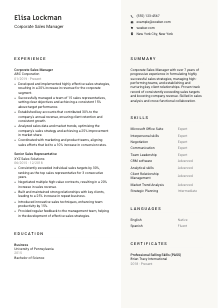
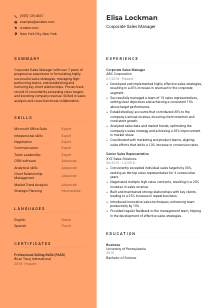
Masterminding profits, but your resume seems understocked? Check out this Corporate Sales Manager resume example, created with Wozber free resume builder. Learn how to showcase your strategic sales acumen in step with corporate ambitions, positioning your career at the front of the sales pack!
Corporate Sales Manager hiring usually turns on one question fast: can you turn a sales plan into repeatable revenue through team execution and account growth? Resumes for this role need to make that visible. Hiring teams look for proof that you can set direction, coach performance, retain major clients, and adjust strategy when pipeline, conversion, or market conditions shift.
When those results are tailored to the target role, the resume is easier to rank in an ATS and easier for decision-makers to read as commercial leadership rather than individual selling alone. Wozber's free resume builder helps organize that alignment in an ATS-friendly resume format, so your revenue growth, team management, and key account wins show up clearly from the first scan.
This section is short, but it still does useful work in a Corporate Sales Manager resume. It should confirm who you are, how to reach you, and whether you already meet basic logistics for the role without distracting from the commercial story in the rest of the document.
Use your full name as the most visible line on the resume. Keep it clean, readable, and slightly larger than the body text so the page opens with a clear executive presence rather than a cluttered header.
Place "Corporate Sales Manager" directly under your name when that is the role you are targeting. This creates an immediate match between your profile and the position, especially when hiring teams are reviewing resumes across sales leadership, account management, and business development backgrounds.
List a reliable phone number and a professional email address, ideally in a simple format such as firstname.lastname. In sales leadership roles, details matter. A typo here suggests the same lack of care could show up in proposals, account communication, or reporting.
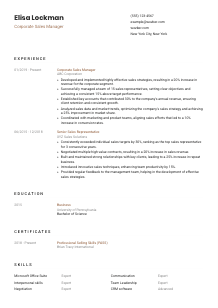
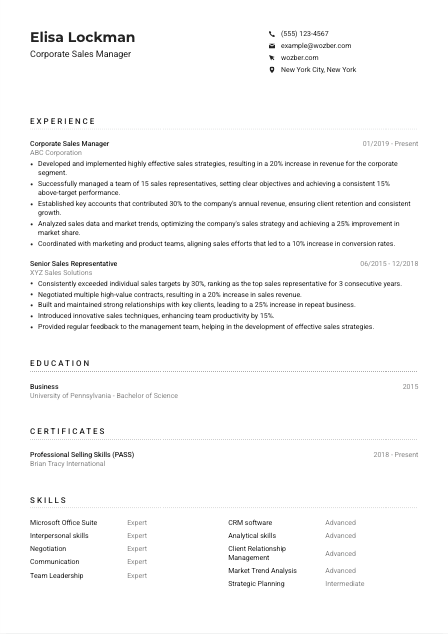
If the opening specifies a location, show it clearly. In the example, "New York City, New York" directly addresses a stated requirement and removes an early question about availability. For other roles, city and state are usually enough unless the employer asks for more.
A LinkedIn profile or professional site can strengthen your application when it reflects the same sales leadership story as the resume. Make sure titles, dates, revenue results, and team scope match. For a Corporate Sales Manager, consistency across platforms matters because employers often compare account growth claims and leadership history before moving forward.
This section does not need personality flourishes. It needs accuracy, professionalism, and any practical detail that helps the employer move straight to your sales track record.




For a Corporate Sales Manager, experience is the section that carries the application. Employers want to see how you built revenue, managed a team, grew accounts, and responded to market data, not just that you held a sales title.
Start by identifying the operating priorities in the job description. Here, the role centers on sales strategy, team performance, key account retention, market analysis, and cross-functional coordination. Use those themes to choose which parts of your background deserve the most space and strongest wording.
List positions in reverse chronological order with job title, company name, and dates. That structure lets hiring teams quickly track progression from individual contributor work into management, enterprise sales ownership, or broader commercial leadership.
Each bullet should show what changed because of your work. For this profession, that usually means revenue growth, target attainment, retention, market share, conversion rates, contract value, or team performance. The example resume does this well with bullets such as a 20% revenue increase, a 25% market share improvement, and managing a sales team that performed 15% above target.
Numbers make sales performance credible. Include percentages, quota attainment, account contribution, team size, pipeline growth, renewal rates, or contract values where possible. Metrics like "contributed 30% of annual revenue through key accounts" tell a hiring manager far more than "managed important clients."
Prioritize experience that supports the target role's level and responsibilities. If you have older or adjacent work in general sales, business development, or account management, keep only the parts that show negotiation skill, client growth, forecasting, or leadership progression. The goal is a clear picture of someone who can run a corporate segment, not a mixed history of unrelated wins.
By the end of this section, an employer should be able to see your market impact, leadership scope, and ability to turn strategy into revenue. That is the standard this role is hired on.
Education matters here as a qualification check, especially when the employer asks for a bachelor's degree in Business, Marketing, or a related field. Keep it straightforward and make the match easy to spot.
If you hold the requested degree or a close equivalent, state it plainly. A "Bachelor of Science in Business" aligns directly with this posting and immediately covers the academic baseline for a Corporate Sales Manager role.
List degree, field of study, school, and graduation year. Clean formatting helps recruiters and ATS systems read this section quickly without hunting for the essentials.
When your education is directly tied to sales leadership, marketing, business operations, or a related commercial field, make that visible. In the example, the University of Pennsylvania business degree reinforces readiness for strategic planning, market analysis, and commercial decision-making.
Most mid-career Corporate Sales Managers do not need to list classes. Include coursework only if it is especially relevant, such as B2B marketing, sales management, market analytics, or negotiation, and only when your work history is still developing.
Honors, projects, and student leadership can help early-career candidates show initiative, presentation skills, or commercial thinking. Once you have several years of quota-carrying or team leadership experience, those details should stay brief so your resume remains focused on business results.
This section needs to establish the required academic background quickly and then step aside for the revenue and leadership proof in your experience section.
Certifications are especially useful in sales leadership when they reinforce methodology, negotiation ability, or a commitment to sharpening commercial skills. They matter most when the employer calls one out directly, as this posting does with PASS.
If the job description mentions a preferred credential, include it prominently when you have it. Here, "Professional Selling Skills (PASS)" is a direct example. Listing it makes the employer's preferred qualification easy to confirm.
Choose certifications tied to professional selling, sales leadership, account management, negotiation, CRM use, or revenue operations. Skip certificates that do not strengthen your case for leading a corporate sales function.
Certification dates show recency and ongoing relevance. That is helpful for credentials tied to current selling frameworks, renewal periods, or continued professional development. In the example, the PASS certification date gives useful context without taking over the section.
Corporate sales environments change with buying behavior, competitive pressure, and sales tooling. Ongoing training in consultative selling, forecasting, or team coaching tells employers you are still refining how you lead revenue, not relying on an old playbook.
Used well, this section strengthens your sales leadership profile with targeted proof of continued development and role-relevant methodology.
A Corporate Sales Manager skills section should read like the toolkit behind your results. That means a mix of sales systems, analytical ability, client-facing strengths, and leadership capabilities that match the way the role actually operates.
Read the posting for both direct and implied skill needs. This one explicitly asks for CRM proficiency, Microsoft Office Suite, analytical strength, negotiation, communication, and interpersonal ability. It also implies team leadership, account management, and strategy execution through the responsibilities.
Include skills that support pipeline management, forecasting, reporting, client retention, and sales team direction. The example skill list works because it combines systems and business skills, such as CRM software and market trend analysis, with leadership and relationship skills such as negotiation, communication, and team leadership.
Avoid filling this section with broad soft skills or low-value tools. Pick the capabilities that support how you win and grow business. A shorter list of relevant strengths is more convincing than a long list that mixes strategic sales leadership with generic office abilities.
When this section is aligned well, it reinforces the methods behind your revenue numbers, account growth, and team performance instead of repeating generic strengths.
Language skills can matter in corporate sales when they support client communication, regional coverage, or relationship building across diverse accounts. They are usually a supporting detail, but for some markets they can widen your commercial reach.
If the posting names a required language, list it first with an honest proficiency level. This role asks for a solid grasp of English, so English should appear clearly and prominently.
Put the most useful language for the role at the top, then any additional languages that could support account growth or cross-market communication. For some Corporate Sales Manager roles, a second language can help with regional clients or multinational stakeholders.
Choose standard terms such as native, fluent, advanced, or conversational. That gives employers a practical sense of whether you can present, negotiate, or manage client relationships in each language.
Even when only one language is required, others can still be worth listing if they are usable in business settings. In the example, Spanish adds potential value for broader client communication, but it supports the profile rather than defining it.
For domestic corporate sales roles, language skills may play a smaller part than quota history or team leadership. For multi-region or international portfolios, they can become a stronger differentiator. Give this section space based on the kind of accounts you are targeting.
List them when they expand your ability to build relationships, cover accounts, or communicate with clients. If they do not materially affect the role, keep the section brief and accurate.
The summary is your opening commercial snapshot. For a Corporate Sales Manager, it should quickly establish leadership level, sales scope, and the kind of results you are known for delivering.
Before writing, identify the few requirements that define the opening. In this case, strategy development, target-beating performance, team management, client retention, and analytical decision-making are central. Your summary should reflect that mix instead of giving a generic sales introduction.
Start with your title or functional identity, then mention your years of experience and area of specialization. A line such as "Corporate Sales Manager with 7+ years of experience leading B2B sales growth and team performance" is direct, specific, and easy to place.
Choose highlights that map closely to the opening, such as exceeding sales targets, increasing revenue, managing a sales team, improving retention, or expanding key accounts. The example summary works because it ties together strategy, leadership, and measurable business growth in a compact space.
Aim for a short paragraph that can be read in seconds. Skip broad traits and save detail for the experience section. The summary should position you as someone who can lead a corporate segment and deliver predictable sales performance.
A sharp summary helps the reader understand your level before they reach the first job entry. It should frame you as someone who can lead revenue, manage people, and grow strategic accounts with confidence.
Your resume should now show the three things employers care about most in this role: revenue growth, leadership of sales performance, and the ability to retain and expand key accounts. If those are visible in your summary, experience, and skills, the document is doing its job.
Use Wozber's free resume builder to tighten that alignment further with ATS optimization, an ATS resume scanner, and an ATS-friendly resume template that keeps your sales metrics, CRM experience, and leadership scope easy to read. The final result should make one point clear fast: you can lead a corporate sales function and deliver results.