



Use Wozber and land your dream job
Create Resume
No registration required
Juggling store dynamics but feel your resume is stuck in the stockroom? With this Assistant Store Manager resume example, created with Wozber free resume builder, learn how to align your leadership strengths with job standards. Shape your career narrative so it shines as brightly as the store's display, setting you up for prime management opportunities!
Assistant Store Managers work where daily execution meets people management. Hiring teams look for candidates who can keep the floor running smoothly, coach staff through sales goals, handle customer issues without losing momentum, and stay on top of inventory and reporting in a fast-moving store environment. Your resume needs to make that operational range visible quickly.
A tailored resume helps separate retail candidates who simply supported store activity from those who actually helped drive performance. Using Wozber's free resume builder to shape an ATS-compliant resume makes it easier to align your wording with the posting, surface retail-specific terms like POS systems, inventory management, and staff training, and show that you can contribute to sales, service, and day-to-day store control.
Store leadership hiring moves fast, and the contact section needs to remove friction immediately. For an Assistant Store Manager, that means clear identification, a role-aligned title, and any location detail that answers a stated requirement without forcing the employer to search for it.
Use your full name in a clean, readable format so it stands out right away. Retail hiring often involves quick review between interviews, floor coverage, and reporting tasks, so clarity matters. Keep styling simple and professional rather than decorative.
Place "Assistant Store Manager" below your name if that is the role you are targeting. This immediately connects your resume to the position and helps frame the rest of your experience around store operations, team supervision, customer service, and sales support.
Include a current phone number and a professional email address. If you add a website or LinkedIn profile, make sure it supports your retail management background with consistent job titles, dates, and achievements such as team size, sales performance, or training results.
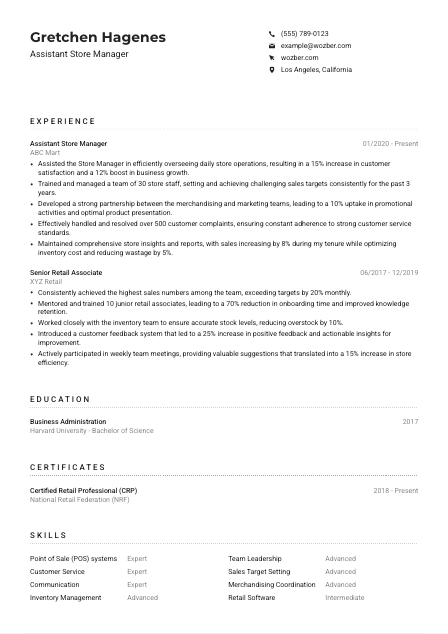
If a role requires local availability, include your city and state. In the example here, Los Angeles, California appears in the personal details because the posting explicitly asks for candidates based there. That kind of detail can remove an early screening question before the employer even reaches your experience section.
Do not use this section for birth date, marital status, photo, or other nonessential details unless a local market specifically requires them. Store leadership resumes benefit more from clean presentation and quick access to relevant information than from extra personal background.
This section should make you easy to contact and easy to place in the hiring pipeline. When your title, contact details, and any required location are handled cleanly, the employer can move straight to the part that matters most: how you run a store floor and support results.




For an Assistant Store Manager, experience is where hiring teams look for proof of real floor leadership. They want to see how you supported daily operations, improved customer experience, coached staff, hit sales targets, and kept inventory and reporting under control when the pace picked up.
Prioritize roles that show direct overlap with store leadership. Assistant manager, shift lead, senior retail associate, customer service supervisor, or department lead positions all help when they include responsibility for staff direction, sales execution, merchandising support, or issue resolution. Put the most relevant retail management experience closest to the top.
For every position, list job title, employer, and dates in a format that is easy to scan. Reverse chronological order is usually best because it shows your most recent store responsibilities first. If your progression moved from associate-level work into team supervision, that upward path is useful context for this role.
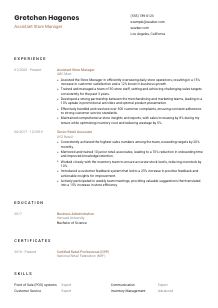
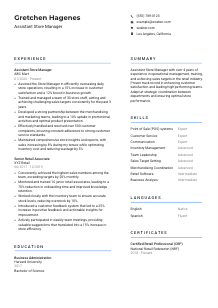
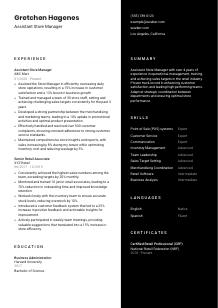
Retail employers respond to numbers they recognize: sales growth, customer satisfaction, shrink or waste reduction, staff headcount, onboarding speed, complaint resolution volume, or inventory accuracy. The sample resume does this well by tying store support to a 15% rise in customer satisfaction, 12% business growth, management of 30 staff, and a 5% reduction in wastage. Those metrics tell a much fuller story than "helped with daily operations."
Use phrases that match the employer's wording when they reflect your actual work. If the job ad emphasizes "overseeing daily store operations," "training store staff," "sales targets," or "store insights and reports," build those terms into your bullet points where they are true. This strengthens ATS optimization and makes your background read as directly relevant rather than adjacent.
Cut accomplishments that do not support the retail leadership story. Focus on what changed because of your work on the floor or behind the scenes: stronger promotional execution, faster staff ramp-up, cleaner customer issue handling, better stock control, or more reliable reporting. Even earlier roles should point toward management potential, as the example does with mentoring junior associates and improving store efficiency.
Your experience section should leave no doubt that you can help run a retail operation, support the Store Manager, and improve what customers and staff experience each day. When the bullets show scope, outcomes, and retail language clearly, your value is easy to see.
Education is usually a supporting section for Assistant Store Manager roles, but it still matters when the posting asks for a specific degree. Keep it straightforward and make the match clear, especially when your academic background connects directly to business, retail operations, or management.
If the employer asks for a bachelor's degree in Business Administration, Retail Management, or a related field, list that qualification clearly. In the example, the Bachelor of Science in Business Administration directly matches the requirement, so it deserves an uncomplicated presentation that is easy to confirm.
Include degree, field of study, school, and graduation year or date. That is usually enough for this level of retail role. Hiring teams do not need a dense academic profile when they are mainly checking that you meet the stated education requirement.
When your degree closely matches the posting, do not bury the field of study after less relevant details. "Business Administration" or "Retail Management" should be visible because those subjects connect naturally to sales analysis, team supervision, operations, and business growth.
Relevant coursework can help if you are early in your career or if your degree title is broad. Classes in retail operations, consumer behavior, supply chain, merchandising, or business analytics can reinforce your understanding of how stores perform beyond the sales floor. If your experience is already strong, you can keep this section minimal.
Academic honors, leadership activities, or business-related clubs are worth mentioning only when they add useful context. For example, a student leadership role, retail case competition, or business society involvement can support a management profile. Skip anything that does not contribute to your retail or leadership narrative.
This section does not need to do heavy lifting, but it should confirm that you meet the educational baseline for the role. A clean degree entry with the right field can quietly strengthen the rest of your retail management profile.
Certifications are not always required for Assistant Store Manager positions, yet they can strengthen your profile when they reinforce store operations, team leadership, customer service, or retail best practices. Used well, they show continued development in a field where process and performance matter every day.
Start with the job description. If a certification is required or preferred, match that wording exactly. If none is listed, choose credentials that still support the role. The example includes Certified Retail Professional, which fits naturally because it reinforces retail knowledge without overstating its importance.
List certifications that connect to the work of running a successful retail operation. Good examples include retail management, customer service, sales leadership, loss prevention, inventory control, or merchandising programs. Prioritize certificates that strengthen the same responsibilities you want employers to notice in your experience section.
Include the issuing organization and date earned, and note ongoing validity when relevant. Current information matters because retail tools, compliance practices, and service standards change. A clearly listed active certification reads as maintained professional development, not a forgotten line item.
Retail environments change with new systems, fulfillment models, promotional strategies, and customer expectations. Continuing education in POS platforms, inventory practices, coaching, or analytics can support your candidacy, especially if you are moving into a larger store, higher-volume location, or more structured brand environment.
A certification will not replace hands-on store leadership, but it can sharpen your profile when it supports the same strengths your resume already shows. Keep the focus on retail execution, team management, and customer-facing results.
Assistant Store Managers need a mix of floor-level judgment and practical systems knowledge. Your skills section should reflect how the job is actually done: using POS and retail software, guiding staff, handling customer issues, supporting merchandising, and keeping inventory and sales activity on track.
Read the job ad closely and capture the exact skills that match your background. In this example, that includes POS systems, retail software, interpersonal communication, inventory management, and team leadership. Using the employer's language helps your resume perform better in ATS optimization and makes your qualifications easier to connect to the role.
Retail management is both system-driven and people-driven, so your list should reflect both sides of the work. Pair technical abilities such as POS systems, stock management, reporting, and retail software with team coaching, customer service, conflict resolution, and communication. That balance shows you can support the floor, the staff, and the numbers.
Avoid long skill sections packed with generic terms. Choose the capabilities most relevant to assistant store leadership and back them up elsewhere in the resume. If you list inventory management, your experience should show reduced overstock, lower waste, or stronger stock accuracy. If you list sales target setting, include results that show targets were met or exceeded.
Every skill on the page should connect to real store work, whether that means handling a busy register environment, coaching associates, reviewing sales data, or coordinating promotions. The best skills section feels consistent with the results shown in your experience.
Language ability matters in retail because communication happens constantly, with customers, associates, and managers across the day. If the posting names a required language, treat it as a clear hiring criterion. Additional languages can also strengthen your value in stores serving diverse communities.
If the role requires English, include it with an accurate proficiency level. The example does this by listing English as native, which immediately satisfies a stated requirement and supports the communication demands of customer service, coaching staff, and reporting to management.
Additional languages are especially useful in retail settings with multilingual shoppers and teams. Spanish, for example, can be highly relevant in many markets because it improves customer interactions, staff communication, and service recovery in real time. Include extra languages when they would genuinely help you perform the job.
Use honest labels such as native, fluent, proficient, or conversational. In customer-facing work, language claims are easy to test during an interview or on the floor. Accurate proficiency levels protect your credibility and help employers place you appropriately.
Think about the location, customer mix, and daily communication demands of the role. Some stores rely heavily on multilingual interaction during sales conversations, returns, complaint handling, or team coaching. When language ability supports those realities, it becomes a practical business asset, not just a bonus detail.
List the languages you can actually use in customer and team interactions. When a required language is clearly covered and any additional language supports the store's audience, this section adds practical value to your application.
The summary needs to establish, in a few lines, that you can step into a busy retail environment and support store performance from day one. Focus on management scope, customer service strength, sales contribution, and the operational habits that matter in an Assistant Store Manager role.
Start with a direct description of who you are professionally. Include your target title, years of relevant experience, and the area of retail work you handle well, such as store operations, team supervision, customer service, or sales execution. The example summary does this by anchoring the profile in assistant store management and operational leadership.
Use the summary to mention outcomes that fit the role you want. Metrics like customer satisfaction gains, sales growth, team size managed, inventory savings, or training impact work especially well because they reflect the way store performance is measured. The sample resume's customer satisfaction increase and team leadership scope are the kind of details that strengthen a short opening paragraph.
Aim for a short paragraph, not a mini cover letter. Avoid broad claims like "results-driven professional" unless they are immediately supported by something concrete. A concise summary built around retail operations, staff leadership, and measurable business improvement gives the reader a fast, accurate picture of your value.
When the summary is specific, employers can quickly place you in the level of store leadership they need. Use it to show that you understand the retail floor, can support the Store Manager effectively, and have already contributed to sales, service, and team performance.
A well-tailored Assistant Store Manager resume should show more than familiarity with retail. It should connect your leadership, customer service, sales support, POS proficiency, inventory awareness, and reporting discipline into one clear management profile.
Use Wozber's free resume builder to organize that story in an ATS-friendly resume format, refine role-specific phrasing with its AI resume builder features, and check alignment with an ATS resume scanner. The finished resume should make it easy for a hiring team to see that you can step in, support the Store Manager, and keep store performance moving.




