



Use Wozber and land your dream job
Create Resume
No registration required
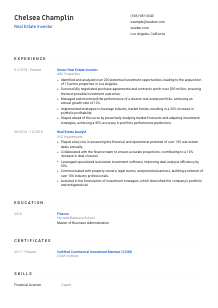
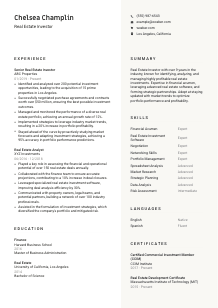
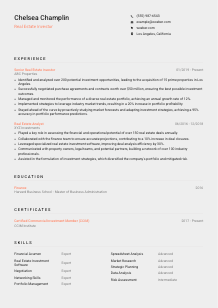
Flipping properties, but your resume feels like a fixer-upper? Check out this Real Estate Investor resume example, created with Wozber free resume builder. Learn how to present your property prowess in line with job criteria, setting your career on a growth trajectory as impressive as your portfolios!
Real estate investment resumes are strongest when they show how you make money decisions under uncertainty. Hiring teams want to see more than interest in property. They look for a track record in sourcing opportunities, underwriting deals, negotiating terms, and improving portfolio performance after acquisition. Your resume should make that operating range visible quickly.
A tailored resume also helps separate investment candidates from adjacent profiles such as brokers, analysts, or property managers whose experience may overlap but stop short of ownership-level decision making. Using Wozber's free resume builder to shape an ATS-compliant resume around deal analysis, acquisitions, and asset performance makes it easier for hiring teams to see where you have actually driven investment outcomes.
This section is brief, but it still affects how smoothly your application moves forward. For real estate investment roles, clear contact details, a location match when requested, and a professional online presence remove practical questions before anyone gets to your deal history.
Place your full name at the top in a clean, readable format. Keep it more prominent than the rest of the contact details so the document feels polished and easy to reference during interview scheduling or internal review.
Use the job title directly under your name when it reflects the role you want. For this opening, "Real Estate Investor" is the right choice because it aligns with the employer's language and immediately positions your background around acquisitions, analysis, and portfolio growth rather than a broader real estate label.
Add a reliable phone number and a professional email address. Investor hiring often moves through calls with principals, partners, or recruiters, so use contact information you check regularly and avoid casual email formats that can undercut an otherwise serious financial profile.
If a role has a location requirement, list your city and state clearly. Here, Los Angeles, California matters because the employer specifically asks for it, and local market familiarity can be relevant in sourcing deals, evaluating neighborhoods, and maintaining partner relationships.
Include a website, LinkedIn profile, or portfolio link if it shows relevant transactions, market commentary, development projects, or investment work. For a real estate investor, that kind of link should extend your resume with credible deal context, not just repeat basic bio information.
Your personal details should answer logistics in seconds and reinforce that you are ready to operate in the market named in the posting. Then the hiring team can focus on your underwriting judgment, negotiation history, and portfolio results.




For a Real Estate Investor, experience is where the resume earns credibility. Hiring teams look for transaction volume, deal size, financial analysis, negotiation responsibility, and signs that you improved asset performance after closing. The closer your bullets get to real investment outcomes, the more convincing this section becomes.
Read the posting and mark the responsibilities that define the role. In this case, that includes identifying opportunities, conducting due diligence, negotiating contracts and financing terms, monitoring portfolio performance, and staying current on market and legislative changes. Those themes should appear throughout your experience section in language that reflects work you have actually done.
List positions in reverse chronological order with job title, company name, and dates. For investment roles, this structure helps employers quickly see progression from analytical support work into higher-stakes responsibility such as acquisitions, negotiations, partnerships, or portfolio management.
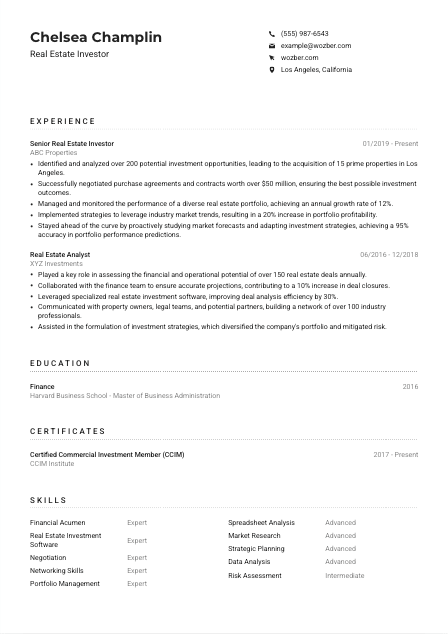
Each bullet should show what you analyzed, negotiated, closed, or improved. Strong investor bullets usually combine an action with business context and a result. The sample resume does this well with lines such as analyzing more than 200 opportunities, acquiring 15 properties, and managing a portfolio that grew 12% annually.
Quantify with metrics that matter in real estate. That can include number of deals reviewed, acquisition count, transaction value, annual portfolio growth, profitability gains, forecast accuracy, or efficiency improvements in underwriting. The example's "$50 million" in negotiated contracts and "20% increase in portfolio profitability" work because they show both scale and operating impact.
Prioritize experience tied to acquisitions, underwriting, partnerships, financing, asset management, or market analysis. If you include related work from property management or analyst roles, frame it through investment relevance, such as improving deal evaluation speed, supporting projections, reducing risk, or building a partner network.
By the end of this section, a hiring manager should be able to tell what markets you evaluated, what deal responsibility you carried, and what financial outcomes followed. That is what turns experience from a job history into a credible investment track record.
Education matters here because the role sits at the intersection of finance, property, and business judgment. You do not need an academic essay, but you do need to show that your training supports work like valuation, investment analysis, market assessment, and strategic decision making.
Check the education line before you format this section. This employer asks for a bachelor's degree in Real Estate, Finance, Business, or a related field, so your listed degree should make that connection obvious if you meet it.
List degree, field of study, school, and graduation year. Keep the structure consistent across entries. That helps both ATS parsing and human review, especially when employers are quickly confirming that your academic background aligns with investment work.
If your degree directly matches the role, make sure it is easy to spot. In the example, a Bachelor of Science in Real Estate aligns neatly with the requirement, while the MBA in Finance adds weight for advanced financial analysis and investment decision making.
Relevant courses, executive programs, or specialized study can help if they connect to underwriting, real estate finance, development, portfolio strategy, or market analysis. This matters most for earlier-career candidates or for professionals whose degree title does not fully show their investment training.
Honors, research, or leadership activities are worth mentioning when they reinforce your direction in finance or real estate. Keep them if they add substance, such as work on valuation, urban development, or investment analysis. Leave them out if your professional deal history already carries the section.
Your education section should confirm that you have the academic grounding for real estate investing without taking attention away from transactions and portfolio results. Once that match is clear, the rest of the resume can do the heavier lifting.
Certifications are not always required for real estate investor roles, but the right ones can sharpen your profile. They are especially useful when they signal stronger expertise in investment analysis, commercial property, development, or market strategy.
Start with the posting. This one does not require a certification, so the section should support your candidacy rather than dominate it. That means listing credentials that are genuinely relevant to investment work instead of every course or license you have collected.
Choose certifications that strengthen your authority in underwriting, commercial investment, development, or financial evaluation. In the example, the CCIM designation is a strong fit because it is widely recognized in commercial real estate and speaks directly to investment competence.
Show the year earned and, if relevant, the active period. This helps employers understand whether the certification reflects recent, maintained knowledge or an older qualification that no longer shapes your day-to-day investment work.
If your target niche involves commercial assets, multifamily, development, syndication, or complex financing structures, pursue certificates that support that direction. The best additions are the ones that deepen your positioning in the asset classes or deal types you want to handle next.
A good certificate section adds professional depth, but it will not replace proof of closed deals, sound analysis, or profitable asset management. Keep it relevant, current, and clearly connected to the kind of investment work you want to do.
The skills section should read like the toolkit behind your deal decisions. For this profession, that usually means a mix of financial analysis, market judgment, negotiation, relationship management, and the software fluency needed to evaluate opportunities quickly and accurately.
Read beyond the skill list and look at the work itself. This description points to financial acumen, spreadsheets, real estate investment software, negotiation, interpersonal skill, networking, due diligence, and portfolio monitoring. Those are better anchors than generic traits because they map directly to how the role operates.
List the capabilities you use in sourcing, analyzing, closing, and managing investments. Good examples include spreadsheet analysis, portfolio management, market research, risk assessment, negotiation, and real estate investment software. The sample resume's mix works because it covers both technical evaluation and deal-facing relationship work.
Place the most job-relevant skills first so the section reinforces the priorities already seen in the job description. For this role, financial and investment analysis should usually appear before broader business skills, unless the position is especially relationship-driven or partner-facing. Keep the list focused enough that each item supports the investor story.
When this section is tailored well, it reinforces the mechanics of how you operate as an investor. Anyone reading it should see the tools and judgment areas behind your acquisitions, due diligence, negotiations, and portfolio performance.
Language skills can matter more in real estate than candidates sometimes expect. Investor roles rely on negotiation, relationship building, and communication with owners, partners, lenders, legal counsel, and tenants. If a posting names a required language, make that clear immediately.
Look for required or preferred language skills before you write this section. Here, English proficiency is explicitly required, so your English level should appear first and be stated clearly.
List English first with an accurate level such as "Native" or "Fluent." That removes a basic screening question and keeps attention on your investment background instead of on whether you meet a core communication requirement.
Extra language ability can strengthen your profile when it helps with relationship building, community knowledge, or cross-border investment activity. In a market as diverse as Los Angeles, Spanish or another widely used language may support owner outreach, partner conversations, or local network development.
Choose straightforward levels such as "Native," "Fluent," "Intermediate," or "Basic." Clear labeling is more useful than inflated claims, especially in roles where negotiation and stakeholder communication are central.
If another language has helped you build networks, work with diverse communities, or navigate international investment conversations, it is worth keeping on the resume. That is especially true when your investment strategy or market coverage depends on trust and communication across different groups.
For a Real Estate Investor, language skills are valuable when they help you build relationships and move deals forward. Keep the section accurate and relevant to the markets and stakeholders you work with.
The summary is where you establish your investment identity before the reader gets into the details. In a few lines, you should show seniority, investment focus, and the kind of results or capabilities that define your work, whether that is acquisitions, financial analysis, partnership development, or portfolio growth.
Use the job description to decide what your summary should emphasize. This one leans on experience, deal analysis, closing capability, financial acumen, software proficiency, negotiation, and market awareness. Your summary should foreground the mix that best matches your background.
Start with a direct line that names who you are and how long you have worked in the field. The example, "Real Estate Investor with over 9 years in the industry," works because it quickly establishes level and specialization.
Follow with the capabilities most relevant to the position you want. For this role, that could include underwriting and closing deals, using spreadsheets and investment software, building strategic partnerships, or improving portfolio profitability. Keep it specific enough to sound like investor work, not a general real estate profile.
Aim for 3 to 5 lines that create interest without repeating your entire experience section. A strong summary hints at deal judgment and business results, then lets the bullets below provide the proof. If you use Wozber's AI resume builder, you can refine the wording so the summary mirrors the employer's terminology while staying natural and aligned with the rest of your resume.
A well-written summary should make the reader expect solid deal experience, disciplined analysis, and measurable portfolio impact before they even reach your work history. That is the right setup for a Real Estate Investor application.
Your resume should now show the parts of real estate investing that employers actually hire for: opportunity analysis, due diligence, negotiation range, financial judgment, and portfolio performance. Those are the details that make an investor resume credible.
Use Wozber's free resume builder to organize that experience into an ATS-friendly resume template, strengthen ATS optimization with role-specific phrasing, and review alignment through an ATS resume scanner. The final document should make it easy to judge whether you can find good deals, close them well, and grow value after the acquisition.




