




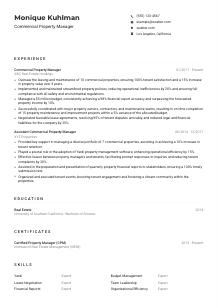
Use Wozber and land your dream job
Create Resume
No registration required
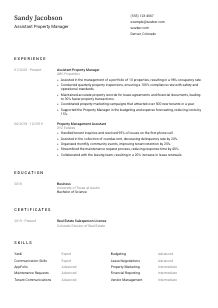
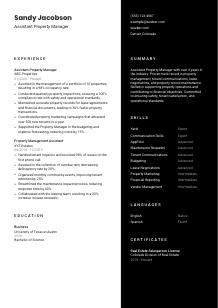
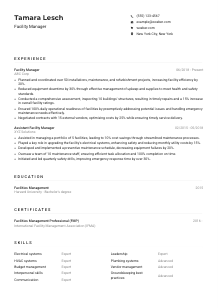
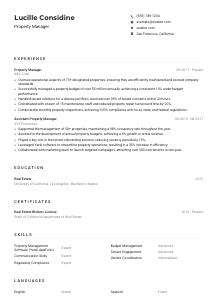
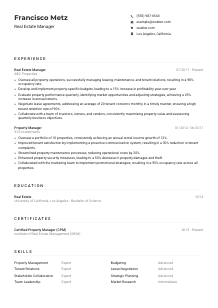
Helping manage properties, but your resume feels vacant? Check out this Assistant Property Manager resume example, created with Wozber free resume builder. It shows how to present your real estate endeavors to match job demands, making your career trajectory as prosperous as the buildings you oversee!
Assistant Property Managers sit close to the day-to-day pressure points of a property. Maintenance coordination, tenant communication, inspections, lease paperwork, and budget support all land in the same workflow, often on the same day. Your resume needs to show that you can keep operations moving, records accurate, and residents informed without letting service standards slip.
Hiring teams often sort these resumes by one early question: can this person step into active property operations with minimal ramp-up. That is where tailored language matters. Wozber's free resume builder helps you line up your experience with the posting in an ATS-friendly resume format, so software, leasing, inspection, and reporting work are easy to recognize in both ATS screening and human review.
Property management work depends on quick contact, clear accountability, and local availability. Your Personal Details section should make those basics obvious right away, especially when a posting includes location or communication requirements.
Place your name at the top in a clean, readable style. For a role that handles tenant issues, vendor follow-up, and lease documentation, a cluttered header sends the wrong message. Keep it straightforward and professional.
Add "Assistant Property Manager" directly under your name if that is the role you are pursuing. Matching the posted title helps recruiters and ATS tools connect your resume to the opening quickly, especially when they are screening for property operations support rather than broader real estate experience.
Include a phone number you answer and a professional email address. This role involves constant coordination with tenants, owners, maintenance teams, and vendors, so your resume should reflect reliability from the first line. Double-check every character before you send it.
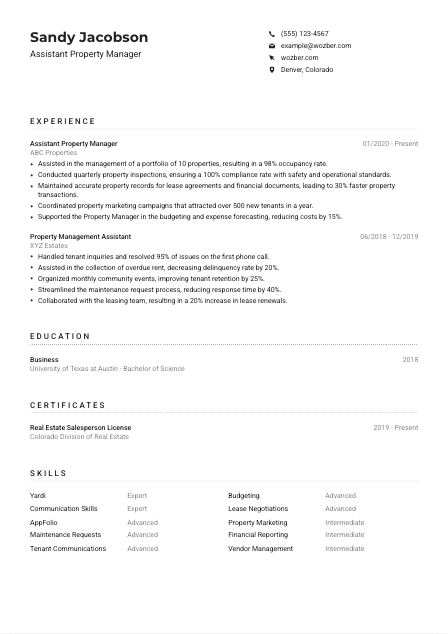
If the employer wants someone based in a specific market, state your city and state. Here, listing Denver, Colorado directly supports the posting's location requirement. If you are relocating, indicate that plainly rather than leaving the employer to guess.
A LinkedIn profile or professional website can help if it reinforces your property management background, portfolio size, software exposure, or certifications. Keep it current and aligned with your resume. Broken links or outdated job titles create unnecessary doubts.
This section should answer simple operational questions fast: who you are, what role you want, how to reach you, and whether you can work in the required market. That clarity helps the rest of your resume do its job.




Experience matters most when it shows what kind of portfolio, tenant activity, and operational load you have actually handled. Assistant Property Manager hiring is usually grounded in execution, so your bullets should sound like property work, not generic office support.
Start with the responsibilities named in the job description, then map your experience to them. For this opening, that means daily operations, maintenance requests, lease negotiations, inspections, tenant communication, recordkeeping, marketing support, and budgeting assistance. Your strongest bullets should mirror those functions using language you can back up.
Use reverse chronological order and include job title, company, and dates for each role. Make the progression easy to follow, especially if you have moved from assistant or coordinator work into more direct property oversight. Hiring managers want to see continuity in operations exposure.
Replace generic statements with outcomes tied to occupancy, compliance, response time, collections, renewals, or cost control. The sample resume does this well with details such as managing a 10-property portfolio, reaching a 98% occupancy rate, and reducing costs by 15%. Metrics like these tell a property team what scale and impact you have handled.
Choose examples that show how you handled the actual friction points of the job. Strong bullets might cover resolving tenant issues on first contact, speeding up maintenance workflows, improving lease renewals, or keeping inspection standards at 100% compliance. These are the kinds of details that separate property experience from general administrative support.
If you have used Yardi, AppFolio, or another property management platform, connect it to the tasks you performed. Mentioning that you tracked lease records, logged maintenance requests, supported reporting, or maintained financial documents in those systems is more useful than listing software names without context.
A strong experience section shows that you can support occupancy, tenant satisfaction, inspections, and financial follow-through in a live property environment. If your bullets read like the day-to-day work of the role, you are giving hiring teams something concrete to trust.
Education is usually a supporting section for Assistant Property Manager roles, but it still matters when the posting asks for a bachelor's degree in Business, Real Estate, or a related field. Keep it concise and relevant, with enough detail to confirm that requirement immediately.
If you hold a bachelor's degree in Business, Real Estate, Finance, or a closely related field, make that easy to spot. In the example, a Bachelor of Science in Business lines up cleanly with the requirement and reinforces the candidate's fit for budgeting, reporting, and operations support.
List your degree, field of study, school, and graduation year in a consistent format. This section does not need extra decoration. Clear formatting works best when recruiters are scanning quickly for the minimum educational qualification.
If your coursework connected directly to property operations, leasing, accounting, real estate law, or business administration, let the field of study do that work for you. A closely matched degree helps strengthen your profile when your professional experience is still building.
Early-career candidates can include a short note on coursework related to real estate, finance, facilities operations, or contract management. Keep it selective. Include only subjects that help explain your preparation for inspections, lease administration, or budget support.
Honors, scholarships, or student leadership can stay if they show discipline or industry interest, but they should not crowd out stronger property management experience. As your work history grows, this section should stay compact.
For this role, education should quickly show that you meet the stated degree requirement and have a foundation for the financial, administrative, and leasing side of property operations. Keep it clean and easy to verify.
In property management, a license or certification often signals that you can operate with less supervision and understand the regulatory side of the job. When a posting lists credentials as preferred, include them in a way that supports the role directly.
If you hold a Real Estate Salesperson license, Property Management Certification, or a similar state-recognized credential, list it clearly. This opening treats that background as a plus, so it can become a useful differentiator when candidates have similar experience.
Prioritize certifications tied to leasing, property operations, fair housing, real estate practice, or facilities oversight. A shorter list of directly relevant credentials is stronger than a long list of unrelated training.
Show the issue date or active period, especially for licenses that need renewal or proof of current standing. In the sample, listing the Colorado Real Estate Salesperson License with active dates helps confirm both credential status and market relevance.
Property work changes with local regulations, compliance standards, software practices, and tenant expectations. Recent coursework or updated certification can support your resume when you are competing for roles that include inspections, lease administration, or owner reporting.
A well-placed certification section tells employers that you bring more than task support. It suggests familiarity with the legal, operational, and professional standards that shape day-to-day property management.
Assistant Property Managers are expected to handle both people-facing issues and process-heavy work. Your skills list should reflect that mix clearly, with software, tenant-facing abilities, and operational tasks that match the actual job.
Start with the capabilities the employer named directly. Here, that includes Yardi or AppFolio, tenant communication, lease negotiations, property records, inspections, budgeting support, and financial reporting. If those skills match your background, use the employer's wording so the connection is immediate.
Prioritize skills that show you can support occupancy and property operations. Useful entries include vendor management, maintenance coordination, lease administration, delinquency follow-up, budget tracking, and property marketing support. Avoid broad business skills unless they directly support the work.
Group software, operational, and interpersonal skills in a tidy format so recruiters can spot the mix quickly. The sample profile works because it balances Yardi and AppFolio with tenant communications, budgeting, and lease negotiations. That combination reflects how the role actually functions day to day.
This section should show that you can move between systems, tenants, vendors, and reporting without losing track of detail. When the skills list mirrors real property operations, it becomes much more persuasive.
Language ability matters in property management because so much of the job depends on clear conversations, written notices, lease explanations, and issue resolution. Keep this section accurate and relevant to the communication demands of the role.
If the posting asks for fluent English speaking and writing, state your level clearly. Use labels such as "Native" or "Fluent" only when they are accurate, since this role depends on writing tenant communications and handling verbal coordination cleanly.
A second language can be valuable in multifamily, mixed-use, or community-facing environments where tenant populations are diverse. For example, Spanish may strengthen your profile if it helps with resident interactions, leasing conversations, or service coordination.
Choose straightforward terms such as Native, Fluent, Advanced, Intermediate, or Basic. Overstating your level can create problems fast in a role where misunderstandings can affect tenant service, maintenance requests, or lease discussions.
Not every Assistant Property Manager role requires more than English, but some communities benefit from bilingual support. If another language has been part of your actual tenant or vendor work, including it can add practical value to your application.
Language ability matters when it helps explain policies, calm resident concerns, schedule repairs, or support retention conversations. Present it as part of how you work effectively with people, not as an unrelated extra.
For an Assistant Property Manager, language skills are useful when they improve communication with residents, owners, or contractors. Keep the section accurate, and let it reinforce your ability to handle people-facing responsibilities well.
The summary should quickly tell the reader what type of property professional you are, how much hands-on experience you bring, and which parts of the operation you are strongest in. Keep it grounded in leasing, tenant service, inspections, records, and financial support rather than generic ambition.
Read the posting closely, then pull out the parts of the job you already handle well. For this one, that means daily property operations, tenant communications, inspections, lease administration, software use, and budget support. Your summary should preview those strengths in a few lines.
Open with a direct statement that names your role and years of experience, such as an Assistant Property Manager with 3+ years in property operations. That gives the reader immediate context before they get into the details of your work history.
Include concise achievements that show what your work improved. Occupancy rate, compliance performance, faster maintenance handling, lower delinquency, stronger renewals, or cost reduction are all strong options when they are true. The sample summary is effective because it ties experience to tenant satisfaction, safety, and operational standards.
Aim for three to five lines. Every phrase should earn its place by clarifying your property management scope, software familiarity, or operating results. Save detail for the experience section and use the summary to frame the value you bring quickly.
A useful summary tells the reader, in a few seconds, that you understand the rhythm of property operations and can support the manager across tenants, records, inspections, and reporting. That is the standard this opening section should meet.
When each section points back to the real work of an Assistant Property Manager, your resume becomes much easier to shortlist. Wozber's free resume builder can help you organize that experience into an ATS-compliant resume that reflects the language of the posting without losing the specifics of your own background.
Before you apply, run one final check for property software terms, tenant-facing results, inspection and recordkeeping detail, and any required location or licensing information. Your resume should now make it easy to see that you can step into active property operations and contribute from day one.