




Use Wozber and land your dream job
Create Resume
No registration required
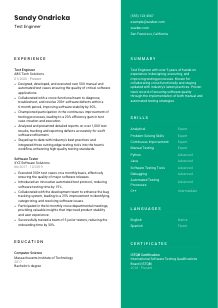
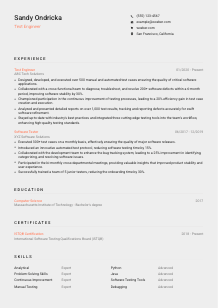
Breaking codes, but your resume feels scrambled? Check out this Test Engineer resume example, created with Wozber free resume builder. Learn how to showcase your quality assurance prowess to meet job requirements, crafting a career narrative as sleek and reliable as your test results!
Test Engineers are trusted to catch failures before customers do. That means your resume needs to show more than general QA exposure. It should make clear how you build and run test coverage, work through defects with developers, and improve release quality through repeatable manual and automated testing.
When that detail is missing, a hiring team can struggle to tell whether you mainly executed test scripts, owned automation, or influenced the broader quality process. Wozber's free resume builder helps shape that experience into an ATS-compliant resume by aligning your wording with the job description and surfacing the testing work that matters most first.
This section is brief, but it still carries practical weight. For a Test Engineer, the header should immediately present you as a technical candidate who is easy to contact and already aligned with any location or communication requirements in the posting.
Place your name at the top in a clean, readable format. Test engineering roles often involve multiple interview stages across QA, development, and hiring teams, so your resume should be simple to reference and easy to revisit in a stack of candidates.
Add "Test Engineer" directly under your name when that matches the role you are pursuing. This helps recruiters and ATS systems connect your profile to the position quickly, especially when your prior title may have been "Software Tester" or another QA variation.
Include a reliable phone number and a professional email address. If you also share a website or LinkedIn profile, make sure it supports your application with relevant QA content, such as automation projects, test frameworks, or release-quality work, rather than acting as a placeholder link.
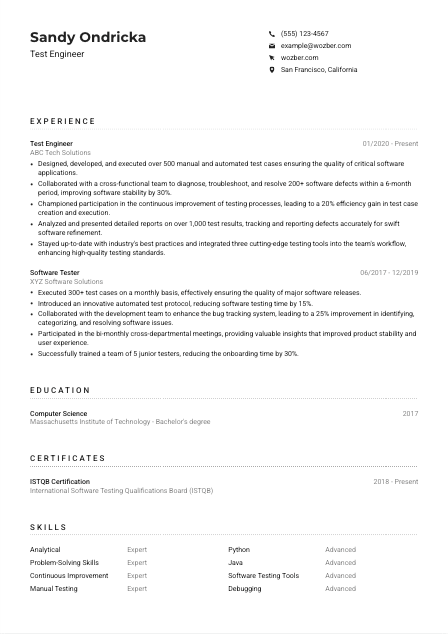
If the employer specifies a location requirement, reflect it clearly in your header when it applies to you. In this example, listing "San Francisco, California" immediately answers a stated requirement and removes a common screening question before it slows the application down.
A portfolio, GitHub, or LinkedIn profile can strengthen your application when it shows something useful for testing work, such as Python test scripts, automation examples, bug-tracking contributions, or tool familiarity. Include it only if the content is current and consistent with the resume.
Keep your personal details clean, complete, and aligned with the posting. This section should remove friction and confirm the basics fast so the rest of the resume can focus on your testing work.




Hiring teams spend most of their time here because Test Engineers are judged by execution. They want to see how you handled test design, defect reporting, automation, collaboration with developers, and measurable quality outcomes across real releases.
Start by marking the responsibilities and technical expectations that appear repeatedly in the posting. For a Test Engineer, that usually includes manual and automated test execution, defect analysis, debugging support, reporting, and collaboration with engineering teams. Those themes should guide which bullets you keep, rewrite, or move higher for ATS optimization.
List your jobs in reverse chronological order with company, title, and dates. If your background includes related titles such as QA Analyst or Software Tester, the progression should still show growing ownership in testing activities, from executing test cases to improving test processes or introducing automation.
Use bullets that show scope and results, not just participation. Numbers work especially well in testing because they can show volume, speed, defect reduction, coverage, or efficiency. The sample resume does this effectively with details such as "500 manual and automated test cases," "200+ software defects," and a "30%" stability improvement.
Prioritize bullets that show where you contributed in the quality lifecycle. That may include writing test cases, building automated checks, validating releases, reproducing bugs, reporting defects in a tracking system, or improving regression coverage. Hiring teams need to see whether you mainly supported execution or drove part of the process yourself.
Mention relevant programming languages, frameworks, and workflows naturally inside your bullets when they reflect real work. For this kind of role, that might include Python, Java, C++, automated testing frameworks, bug-tracking tools, regression testing, or test reporting. Specific language helps both ATS matching and human reviewers understand your technical range.
Your experience should show how you test software in practice, how you work through defects with others, and what changed because of your work. If those points are easy to spot, your resume will read like that of a Test Engineer rather than a general software candidate.
For many Test Engineer openings, education is a qualification check before it becomes a differentiator. Keep it direct, accurate, and easy to scan, especially when the posting calls for a technical degree such as Computer Science or Electrical Engineering.
When the job asks for a Bachelor's degree in Computer Science, Electrical Engineering, or a related field, make sure your degree and field are clearly stated. If you meet the requirement, do not bury it behind abbreviations or inconsistent wording.
List degree, field of study, school, and graduation year or date in a clean order. This makes the section readable for both ATS parsing and quick recruiter review, especially when they are checking minimum qualifications before moving on to your testing background.
Use the formal wording of your degree where possible, particularly if it closely matches the posting. In the example, "Bachelor's degree" in "Computer Science" maps directly to the employer's requirement, which helps confirm technical eligibility without extra interpretation.
If you are early in your career or your professional testing experience is limited, include coursework, labs, or academic projects tied to software quality, debugging, programming, or systems testing. For more experienced candidates, those details are optional unless they strengthen a specialized application.
Add honors, research, technical clubs, or engineering projects only if they support your profile as a testing professional. A project involving automation, fault detection, embedded systems validation, or software reliability is far more useful here than unrelated campus activities.
Your education section should confirm that you have the technical foundation the role requires. Once that is clear, the hiring focus returns quickly to your testing experience and results.
Certifications are not required for every Test Engineer job, but they can strengthen your profile when they point to recognized QA knowledge. They are especially useful when a posting names a certification directly or when you want to show continued development in testing practices.
If you hold ISTQB or another recognized software testing certification, list it prominently. In this job description, ISTQB is mentioned as a plus, so including it immediately strengthens alignment with the employer's stated preference.
Choose certificates connected to software quality, automation, test management, or related engineering practices. A short, relevant list is more persuasive than a long list of unrelated online courses.
Add the certifying body and the date earned so employers can understand both credibility and recency. The sample resume does this well by naming the International Software Testing Qualifications Board and showing when the certification was obtained.
Testing tools, frameworks, and quality practices evolve quickly. Updating this section over time shows that you are staying engaged with the discipline, whether through formal certifications or newer role-relevant credentials tied to automation and quality engineering.
A relevant certification will not replace hands-on testing experience, but it can reinforce your grounding in QA principles and show that you take the discipline seriously.
A Test Engineer skills section should read like the toolkit behind your delivery. Employers are looking for a mix of testing methods, technical fluency, and problem-solving ability that matches the level of ownership in the role.
Pull skill terms directly from the posting when they reflect your actual background. For this role, that includes Python, Java, C++, manual testing, automated testing processes, debugging, analytical ability, and problem-solving. Matching the employer's language improves ATS alignment and makes your profile easier to classify quickly.
Put the most relevant testing skills first. For many Test Engineer roles, that means test case design, automation, defect tracking, debugging, regression testing, and the programming languages or tools used to support those tasks. Soft skills matter, but they should support the technical story rather than replace it.
If you have a broad range, organize skills into useful categories such as testing methods, programming languages, tools, and collaboration strengths. The sample resume combines technical items like Python and automated testing with analytical and continuous improvement strengths, which works well when the list stays focused on QA performance.
Your skills section should quickly confirm that you can execute the testing work in the job description. Keep it relevant, technically grounded, and consistent with the tools and methods shown elsewhere on the resume.
Testing work depends on clear communication. Bug reports, defect triage, test summaries, and handoffs all rely on precise language, so any language requirement in the posting should be handled directly and without exaggeration.
If the role requires fluent English, list English clearly with an honest proficiency level. That matters in testing because written defect reports, test documentation, and collaboration with engineers depend on accurate communication, not just conversational comfort.
Additional languages can be useful in global product teams, distributed QA environments, or customer-facing software contexts. They are usually a secondary factor, but they can add range when they are presented accurately.
Choose simple terms such as Native, Fluent, Advanced, or Conversational and be truthful about your level. Overstating language ability can become a problem quickly when interviews, documentation, or cross-team meetings depend on it.
List languages that you can actually use in a professional setting. A shorter, credible section is better than filling space with minimal knowledge that has no practical value in engineering or QA collaboration.
When a language is explicitly required, make sure it appears clearly and early. In this case, English should come first because it is named in the job description, while any additional language can remain a secondary bonus.
Language skills are part of how you operate on a team. For a Test Engineer, they should support clear reporting, accurate collaboration, and smooth communication across the release process.
The summary is your chance to frame your candidacy before the reader gets into the bullet points. For a Test Engineer, it should quickly establish your years of experience, testing focus, technical strengths, and the kind of quality work you have handled.
Open with your job title, years of experience, and the kind of testing you do. If you work across manual and automated testing, say so early. If your background leans more toward automation, release validation, or defect analysis, make that clear in the first line.
Mention the programming languages, testing methods, or quality areas that define your work. For this role, relevant summary details could include Python or Java proficiency, automated test development, debugging, or improving testing processes across software releases.
Bring in the requirements that matter most for the specific application. Here, that includes experience with manual and automated test cases, collaboration with cross-functional teams, and reporting on defects and test results. The sample summary handles this well by combining testing process improvement with software quality outcomes.
Aim for a few lines that a recruiter or engineering manager can absorb quickly. Avoid broad claims about being passionate or hardworking unless they are backed by actual testing scope, tools, or outcomes. Precision is more convincing than enthusiasm in this section.
After reading your summary, the employer should already understand your level, your testing focus, and the kind of quality work you can step in and handle. That context makes the rest of the resume easier to read in the right frame.
A tailored Test Engineer resume should make your testing scope, technical tools, and quality impact easy to trace from top to bottom. When your title, experience, skills, and summary all reinforce the same story, hiring teams can quickly see whether you fit their release process and engineering environment.
Use Wozber's free resume builder to shape that content into an ATS-friendly resume template, strengthen ATS optimization with the ATS resume scanner, and align your wording with the job description. The final result should make one thing clear fast: you know how to find defects, improve test coverage, and support better software releases.




