



Use Wozber and land your dream job
Create Resume
No registration required
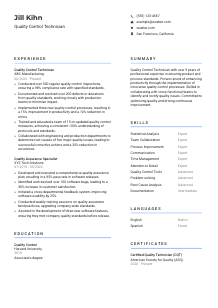
Ensuring excellence, but your resume feels faulty? Check out this Quality Control Technician resume example, created with Wozber free resume builder. Learn how to streamline your precision to meet job criteria, paving the way for a career as flawless as your inspections!

Quality control work gets judged in the details long before a product leaves the floor. Hiring teams want to see whether you can inspect against standards, document defects accurately, trace recurring issues back to root causes, and work with production or engineering to keep output reliable. Your resume should make that operating discipline visible, not just say that you are detail-oriented.
For this kind of role, resume tailoring changes how quickly a reviewer can connect your background to inspection work, corrective action, and process improvement. Wozber's free resume builder helps you align your wording with the posting and build an ATS-compliant resume that reflects the right quality terminology without sounding forced. That makes it easier to show where you have improved compliance, reduced errors, or supported consistent production standards.
Quality Control Technician resumes usually move fast through an initial screen, so your personal details need to answer the practical questions immediately. Keep this section clean, accurate, and aligned with any stated requirement that affects eligibility for the role.
Use your full name in a clear, readable format so it stands out instantly at the top of the page. Skip decorative styling. In a role built on accuracy and control, a clean header already sets the right tone.
Place "Quality Control Technician" directly under your name when that is the role you are pursuing. Matching the posted title helps frame your experience around inspections, defect tracking, and quality procedures from the first line.
Include a working phone number and a professional email address. Check them carefully. Small errors in contact information undermine the same attention to detail that the role itself depends on.
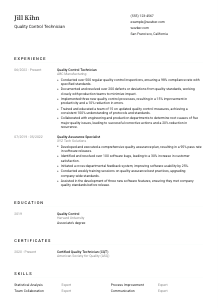
Some openings include a location requirement as a hard filter. Here, San Francisco, California is explicitly requested, so listing that city and state removes an avoidable question early. Treat location this way when a posting makes on-site presence or local availability part of the screening.
A LinkedIn profile or professional website can support your application if it reflects the same work history, certifications, and quality-focused achievements shown on the resume. Keep it current. If the content is thin or inconsistent, leave it off.
Your personal details do not need personality flourishes. They need accuracy, professionalism, and any required logistics such as location, so the hiring team can move straight to your inspection experience and quality results.




This section carries the most weight for a Quality Control Technician. Employers want to see how you handled inspections, documented nonconformities, supported corrective action, and improved process consistency in real operating environments.
Read the job description line by line and map it to your own history. If the role emphasizes regular inspections, defect reporting, staff training, and root cause analysis, build bullets around those exact activities. The sample resume does this well by showing inspection volume, compliance rate, defect resolution, and cross-functional corrective action.
List your most recent role first, then work backward with job title, employer, and dates in a format that is easy to scan. For quality roles, a straightforward timeline helps reviewers quickly track progression from broader QA work into hands-on quality control responsibilities.
Do not stop at "conducted inspections" or "worked with production teams." Show what happened because of your work. A bullet such as conducting 500+ inspections with a 98% compliance rate tells a reviewer far more than a generic responsibility line ever could.
Numbers belong naturally in this field because quality work is measured through compliance rates, defect counts, recurrence reduction, scrap reduction, pass rates, productivity gains, and error reduction. The example metrics, including a 15% productivity improvement and 20% drop in issue recurrence, make the process impact easy to understand.
Prioritize experience that shows inspection discipline, documentation accuracy, process improvement, quality software or statistical work, and collaboration with production, engineering, or operations. If a prior role was adjacent rather than identical, frame the parts that transfer directly, such as audit support, testing, issue tracking, or training on standards.
Your experience section should show that you can maintain standards in day-to-day operations and improve them when issues repeat. When the bullets are specific, measurable, and tied to actual quality workflows, your fit for the role becomes much easier to judge.
Education carries different weight depending on your experience level, but it still helps establish technical grounding for quality systems, inspection methods, documentation standards, and statistical thinking. Present it clearly and keep the emphasis on relevance.
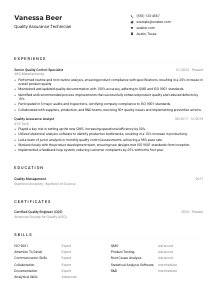
If the posting asks for an associate's degree in a related field, make sure that qualification is easy to find. The example resume lists an Associate's degree in Quality Control, which directly supports the requirement. If your field is adjacent, use the official degree title and let your experience reinforce the connection.
List school, degree, field of study, and graduation year or date. That is usually enough. A simple structure keeps the section readable for both human reviewers and ATS parsing.
When your coursework or academic focus connects to quality inspection, process control, manufacturing systems, or statistics, make that visible through the field of study or an added detail if space allows. This matters most when you are earlier in your career or changing from a related function.
Include relevant coursework only if it strengthens your case. Subjects such as statistical process control, quality assurance, manufacturing processes, measurement systems, or technical documentation can help when your work history is still developing.
A project, lab, or capstone can earn space if it involved inspection methods, data analysis, defect reduction, process validation, or compliance documentation. Keep the description brief and outcome-focused so it supports the resume instead of slowing it down.
Education does its job when it quickly confirms the baseline qualification and supports your technical credibility. Let it reinforce your quality background, then allow your experience and certifications to carry the heavier proof.
In quality roles, certifications often signal practical commitment to standards, methods, and continuous improvement. They are especially useful when an employer mentions a preferred credential or when you want to show deeper investment in the field.
When a job notes ASQ certification as preferred, place your relevant credential where it is easy to spot. The example uses the Certified Quality Technician credential from ASQ, which directly answers that preference. If you hold another respected quality certification, include it as long as it supports the role.
List credentials that connect to inspection, auditing, root cause analysis, process control, manufacturing quality, or continuous improvement. A shorter list of highly relevant certifications is stronger than a long list of unrelated training.
Add earned dates and renewal ranges when relevant, especially for certifications that need maintenance or signal current qualification. This helps reviewers see that your training is active rather than outdated.
Quality standards, documentation practices, and statistical methods evolve with the industry. Ongoing coursework, refresher training, or additional credentials can show that you stay current with the tools and frameworks used to reduce defects and improve consistency.
Certifications work best when they reinforce the kind of quality work the employer needs done. They can strengthen your case quickly, especially when they align with inspection practice, process control, or a preferred credential such as ASQ.
A Quality Control Technician skills section should read like the toolset behind reliable inspections and corrective action. Mix technical capabilities with the operational judgment needed to spot deviations, document findings, and work with others to prevent repeat issues.
Start with the actual wording in the job description, then match it to your experience. If the employer asks for quality control tools and software, statistical techniques, problem-solving, and attention to detail, those belong near the top when they are genuine strengths you have used on the job.
Include hands-on quality skills such as statistical analysis, root cause analysis, documentation, process improvement, inspection methods, and familiarity with quality software. Pair them with practical collaboration skills that matter in this work, such as training staff, communicating defects clearly, and coordinating with production teams.
Do not crowd the section with every general skill you possess. Choose the abilities that best support inspection accuracy, issue resolution, compliance, and process consistency. The example list works because it stays close to quality work instead of drifting into generic resume filler.
Your skills section should make sense alongside your experience bullets. When the same strengths appear in both places, reviewers can connect your stated capabilities to actual inspection work, process improvements, and quality outcomes.
Language skills matter in quality environments because inspection findings, deviation reports, training instructions, and corrective actions all rely on precise communication. Present your language ability in a way that supports the actual communication demands of the job.
If the posting requires English proficiency, list English clearly with an honest level such as Native, Fluent, or Professional. Quality work often depends on reading standards, writing defect reports, and communicating issues without ambiguity, so this is more than a checkbox.
Other languages can be useful when a facility works with multilingual teams, suppliers, or documentation across regions. In the example, Spanish adds another layer of communication value, but English remains the primary requirement to foreground.
Choose standard labels and be accurate about your level. Overstating language ability can become a problem quickly if the role involves training staff, documenting quality events, or participating in cross-functional investigations.
If the role includes communication with production teams, vendors, field staff, or international partners, language skills may support smoother issue resolution and training. Include them when they strengthen your ability to work in that environment, not simply to fill space.
Language listings should support communication needs that are relevant to quality work. Treat them as functional workplace skills, especially when they help with documentation, instruction, or collaboration across teams.
For a Quality Control Technician, language ability is most useful when it improves the accuracy of reporting and the clarity of communication on the floor. List what you can genuinely use in a professional setting.
The summary sits at the top of the resume, so it should quickly establish your level, your area of quality experience, and the kinds of results you have delivered. Keep it brief, specific, and tied to the work this role actually involves.
Before writing the summary, identify the themes that show up most often in the posting. Here, those themes include inspections, standards compliance, statistical techniques, process improvement, training, and corrective action. Your summary should reflect the mix that genuinely defines your background.
Lead with a direct introduction such as your title and years of experience in quality control, manufacturing quality, or a related area. This immediately places you in the right lane for the reviewer.
Use the next lines to mention what you actually do well, such as maintaining product standards, reducing errors through process changes, documenting nonconformities, or collaborating on root cause analysis. The example summary works because it connects quality control experience with productivity gains and cross-functional problem solving.
Aim for three to five lines. Avoid soft claims that are not supported elsewhere on the resume. A concise summary that mirrors your strongest inspection, compliance, and improvement themes will do more than a paragraph full of general enthusiasm.
A well-built summary gives the hiring team an immediate read on your quality background and operating strengths. By the time they reach your experience section, they should already expect to see inspections, defect control, process improvement, and reliable collaboration backed by results.
A Quality Control Technician resume works when it shows how you protect standards, document issues accurately, and help reduce repeat defects in real production or process settings.
Use Wozber's free resume builder and ATS resume scanner to tighten your wording, strengthen ATS optimization, and present your experience in an ATS-friendly resume format that keeps the focus on compliance, corrective action, and measurable quality results.
When each section supports the same story, your resume makes it easier to judge whether you can step into the role and keep quality under control from day one.