



Use Wozber and land your dream job
Create Resume
No registration required
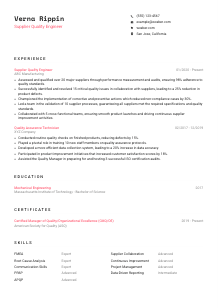
Fine-tuning supplies, but your resume seems a bit off-standard? Check out this Supplier Quality Engineer resume example, created with Wozber free resume builder. It shows how to seamlessly match your quality mastery with job specifics, making sure your career narrative is as flawless as the products you oversee!

Supplier quality work sits where manufacturing risk becomes visible. A hiring team scanning your resume wants to see whether you have actually improved supplier performance, closed quality issues with structured methods, and kept launches or production flowing when incoming parts, process controls, or validation results fell short. Generic quality language does not do much here. Your resume needs to show how you handled audits, supplier corrective action, process validation, and measurable defect reduction.
The first review often turns on whether your background clearly maps to supplier-facing quality work rather than general QA. Using Wozber's free resume builder to tailor your wording and keep an ATS-compliant resume structure makes it easier to surface terms like PPAP, APQP, FMEA, CAPA, audits, and root cause analysis in the places screeners expect to find them. That helps your resume quickly show that you can manage supplier quality performance, not just inspect finished products.
Supplier Quality Engineer roles usually move fast from resume review to practical questions about supplier exposure, technical background, and location. Your personal details should answer the basic logistics cleanly so the reader can move straight into your audit, validation, and improvement experience.
Use your full name in a clean, readable format at the top of the page. Keep it slightly larger than the rest of the text so it is easy to find when your resume is reviewed alongside other engineering candidates.
Place "Supplier Quality Engineer" directly under your name if that is the role you are pursuing. Matching the posted title helps frame your background around supplier audits, process validation, and quality improvement work from the first line.
Include a reliable phone number and a professional email address. Keep this section simple. Hiring teams coordinating interviews with engineering managers, supplier quality leaders, or manufacturing partners should not have to hunt for your contact information.
If the posting specifies a location requirement, include your city and state. In this example, listing "San Jose, California" immediately answers a stated requirement. If you plan to relocate, note that clearly instead of leaving the employer to guess.
Add your LinkedIn profile or professional portfolio if it supports your resume. For this field, that usually means a profile consistent with your resume's job titles, certifications, quality methods, and manufacturing experience, not a generic online presence.
This section does not need personality flourishes. It needs to confirm who you are, where you are, and which engineering role you are targeting so the reader can move quickly into your supplier quality track record.




This is where Supplier Quality Engineer resumes usually separate. Employers want to see what kind of supplier base you handled, how you resolved nonconformances, whether you led validation work, and what changed because of your actions. Focus on process, scope, and measurable results.
Before writing bullets, mark the responsibilities that define the job. For this role, that includes supplier qualification, audits, performance measurement, corrective and preventive action, process validation, product launch support, and reporting. Those themes should appear across your experience section in language that matches your actual work.
List roles in reverse chronological order with company name, title, and dates. Supplier quality hiring teams often look for progression from general quality work into supplier-facing ownership, so a clear timeline helps them see how your responsibility expanded from inspection or QA support into audits, supplier development, or validation leadership.
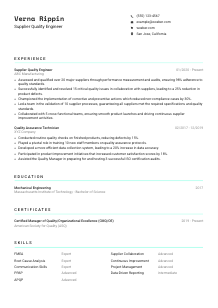
Each bullet should show what you did, how you did it, and what improved. Strong examples include qualifying suppliers through audits, leading PPAP or validation activities, driving CAPA closure, or reducing defect rates tied to supplier issues. The sample resume does this well by linking supplier assessments, validation work, and corrective actions to outcomes like 98% adherence and a 25% defect reduction.
Use numbers that belong to the work. Supplier counts, audit volume, defect reduction, non-compliance reduction, validation count, launch support scope, and adherence rates all help. Metrics make your bullets more credible because they show the size of the supplier portfolio and the effect of your interventions, not just your participation.
General manufacturing or quality experience can stay if it connects to supplier quality fundamentals such as inspection trends, ISO audit support, nonconformance handling, or data reporting. Trim bullets that do not help explain your ability to manage supplier performance, solve quality issues, or work across engineering, sourcing, and operations.
Your experience section should make it easy to see where you owned supplier quality work and what business outcome followed. When the reader can track your audits, corrective actions, validations, and defect improvements, your fit becomes much clearer.
Most Supplier Quality Engineer postings ask for an engineering or related technical degree because the work involves drawings, specifications, process capability, and manufacturing controls. Your education section should confirm that technical foundation without overcomplicating it.
If you hold a bachelor's degree in engineering or a closely related technical field, make that easy to spot. This role specifically asks for that baseline, so your degree should appear clearly and accurately.
List your degree, field of study, school, and graduation year. That is usually enough for an experienced Supplier Quality Engineer. Clear formatting keeps attention on the qualification itself rather than decorative detail.
Use the formal degree wording from your records. If your background is in Mechanical Engineering, Industrial Engineering, Manufacturing Engineering, or a similar discipline, state it directly. In the example, "Bachelor of Science in Mechanical Engineering" aligns well with the technical expectations of supplier validation and quality analysis.
Coursework can help if you are early in your career or moving into supplier quality from another quality path. Include classes tied to quality systems, statistics, manufacturing processes, materials, reliability, or process control if they support the role better than another line on the page.
Academic projects, senior design work, or honors are worth adding when they connect to process improvement, validation, manufacturing systems, or quality engineering. Keep the link clear. A project involving failure analysis or process capability is more useful here than a general extracurricular highlight.
This section does not need much space once you have experience. It simply needs to confirm the engineering foundation behind your supplier audits, validation decisions, and quality methods.
Certifications matter most when they reinforce the quality systems knowledge behind your day-to-day decisions. For supplier quality roles, they can support your credibility in audits, corrective action, process control, and cross-functional quality leadership.
Start with certifications that directly match the employer's wording. Here, a quality management credential such as ASQ-CMQ/OE is preferred, so it deserves prominent placement if you hold it.
Choose certifications that support supplier quality work, quality systems, auditing, reliability, or manufacturing improvement. A short list of relevant credentials carries more weight than a long list of unrelated training.
Include the year earned and, if applicable, renewal status or active dates. That helps the employer understand whether your certification is current, especially for credentials tied to ongoing professional standing.
If you are still developing your profile, pursue certifications that support supplier audits, root cause analysis, quality management systems, or continuous improvement. They are especially useful when you want to move from a broader QA role into deeper supplier ownership.
A relevant certification adds another layer of trust to your resume. It tells the reader that your approach to audits, CAPA, and supplier improvement is grounded in recognized quality practice.
A Supplier Quality Engineer skills section should read like the toolkit behind your decisions. Name the methods, quality processes, and collaboration strengths that show up in supplier audits, failure analysis, process validation, and launch support.
Start with the tools and practices named in the posting. For this role, that means PPAP, FMEA, APQP, and Root Cause Analysis, along with strong communication for supplier and internal stakeholder work. These are not filler keywords. They are core parts of how supplier quality engineers diagnose issues and prevent recurrence.
Include both hard skills and applied collaboration skills. Technical methods such as 8D, CAPA, process validation, SPC, or audit execution pair naturally with supplier collaboration, stakeholder communication, and cross-functional project support. The sample resume handles this mix well by combining tools like FMEA and APQP with supplier collaboration and data-driven reporting.
Do not pad this area with every quality or engineering term you know. Choose the skills you can support through experience bullets. A tighter list gives more weight to the methods and capabilities most likely to matter in supplier performance management and issue resolution.
When this section is focused, the reader can quickly see the methods and working style behind your results. That matters in supplier quality, where terminology often signals the depth of your actual hands-on experience.
Language ability matters in supplier quality when the role involves audits, corrective action meetings, reporting, and cross-functional coordination. If a posting names a required language, treat it as a formal qualification, not a minor detail.
If the job calls for English proficiency, list English clearly with your level. In this case, that requirement is explicit, so it should appear prominently in the section.
Place the required language first, then list any additional languages that could help with supplier communication, factory visits, or global manufacturing coordination. Keep the order practical rather than personal.
Extra language capability can be useful when suppliers, plants, or quality teams operate across regions. It is not mandatory for every Supplier Quality Engineer role, but it can add value in organizations with international sourcing or manufacturing networks.
Use clear levels such as native, fluent, advanced, or intermediate. If you may need to discuss nonconformances, specifications, or corrective actions in that language, accuracy matters.
When your language skills have practical relevance, they can strengthen your profile by suggesting smoother supplier communication and fewer handoff issues. Still, keep this section proportional. It supports your engineering case rather than replacing it.
For this role, language skills matter most when they help you communicate quality expectations clearly across suppliers and internal teams. Present them that way.
Your summary should quickly establish the kind of supplier quality engineer you are. Focus on years of experience, the quality methods you use, the supplier-facing scope you have handled, and the results you have delivered.
Pull out the few priorities that define the target role. Here, the essentials are supplier qualification, quality issue resolution, process validation, cross-functional launch support, and data-driven reporting. Your summary should reflect the parts of that mix you genuinely own.
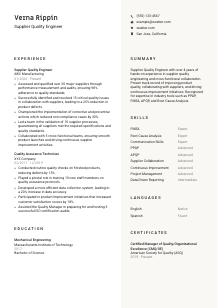
Start with a direct line that states your title and depth of experience, such as a Supplier Quality Engineer with 4+ years in supplier quality or related quality engineering work. This gives the hiring manager immediate context before they read your bullets.
Mention a few high-value strengths such as PPAP, APQP, FMEA, root cause analysis, supplier audits, validation, or corrective action leadership. Then tie them to outcomes like improved supplier adherence, defect reduction, or smoother product launches. The example summary works because it connects hands-on supplier quality experience with measurable quality improvement and core tools.
Aim for a short paragraph that reads cleanly in one pass. Three to five lines is usually enough. Avoid broad claims about being dynamic or results-driven unless the next phrase explains results in actual supplier quality terms.
A good summary gives the reader an immediate picture of your supplier quality scope, methods, and results. Once that is clear, the rest of the resume has a stronger frame.
A Supplier Quality Engineer resume works when every section supports the same story: you can evaluate suppliers, solve quality problems methodically, and improve performance with data, validation, and cross-functional follow-through.
Use Wozber's free resume builder to organize that story in an ATS-friendly resume format, align your wording to the posting, and refine sections with the ATS resume scanner so the right supplier quality terms appear where they belong. The finished resume should make your audit experience, quality methods, and supplier improvement results easy to judge.




