



Use Wozber and land your dream job
Create Resume
No registration required
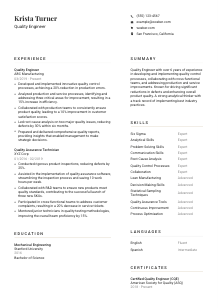
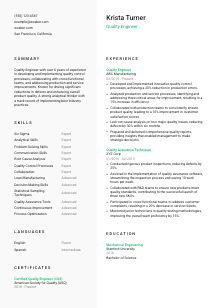
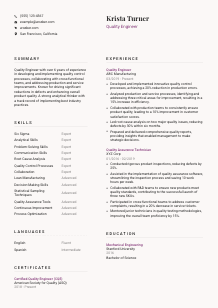
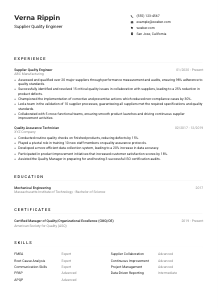
Maintaining the standards, but your resume doesn't measure up? Gauge this Quality Engineer resume example, created with Wozber free resume builder. Learn how to clearly spotlight your quality expertise to meet job benchmarks, positioning your career where precision and excellence come together!
Quality Engineers are brought in when product consistency, defect trends, and process discipline start affecting throughput, cost, or customer trust. Your resume needs to make that operational value visible fast. Hiring teams want to see how you improve control plans, investigate non-conformances, work with production, and turn quality data into actions that hold up on the floor.
Screening often hinges on whether your resume clearly connects quality methods to measurable manufacturing results. Wozber's free resume builder helps you tailor that language into an ATS-compliant resume by aligning your wording with the job ad, while keeping process improvement, root cause analysis, and reporting strengths easy to spot in both ATS scans and human review.
The top of a Quality Engineer resume should be clean, practical, and easy to act on. This section is simple, but it still sends useful signals. It shows whether you present information with the same clarity expected in quality documentation, reports, and controlled processes.
Use your full name as the most visible text on the page. Keep the formatting straightforward and professional. Quality work depends on traceability and accuracy, and even small details at the top of the resume should feel precise rather than decorative.
Place "Quality Engineer" directly under your name if that is the role you are pursuing. This immediately frames your background around process control, defect reduction, CAPA work, and continuous improvement instead of leaving the reader to infer your direction from past job titles alone.
If the posting requires you to be in a specific area or open to relocation, state that clearly. Here, listing San Francisco, California directly addresses a stated requirement and removes uncertainty early. Use this only when location is relevant to the opening, not as a default line for every application.
A LinkedIn profile is usually enough, provided it matches your resume. If you also maintain a professional site that shows quality projects, process improvement work, or technical documentation, include it. Consistency matters. Dates, titles, and scope should line up across every professional touchpoint.
Your contact section should answer the basics quickly and reflect the same clarity expected in a quality environment. Accurate details, a matching title, and any relevant location cue help the reader move straight to your engineering work.




This is the section that carries the most weight for a Quality Engineer. Hiring teams look for proof that you can reduce defects, tighten processes, investigate failures, and work across production, service, and management teams. The strongest bullets connect quality methods to outcomes people track, such as scrap reduction, yield improvement, complaint trends, inspection efficiency, or customer satisfaction.
Read the posting for the actual quality work behind the title. In this case, the priorities include building quality control processes, using statistical sampling, improving production and service workflows, leading root cause analysis, and presenting quality metrics. Those points should shape which projects and accomplishments you feature first.
List positions in reverse chronological order and give each entry enough context. Include employer, title, and dates, then use bullets to show what quality systems, products, or operations you supported. If you moved from a technician role into engineering ownership, that progression is worth making obvious.
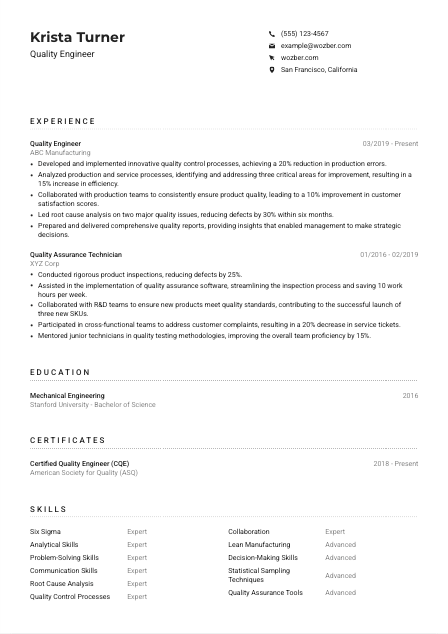
Generic statements like "responsible for inspections" do not show engineering impact. Focus on what changed because of your work. The sample resume does this well with bullets such as reducing production errors by 20% and cutting defects by 30% after leading root cause analysis. That kind of phrasing shows method, ownership, and result in one line.
Numbers matter when they reflect how quality performance is actually measured. Good examples include defect rate, first-pass yield, rework, complaint volume, audit findings, cycle time, hours saved, efficiency gains, or customer satisfaction movement. The sample's 15% efficiency increase and 10 work hours saved per week are strong because they tie quality work to operational improvement.
You do not need to preserve every task from every job. Keep bullets that show process improvement, cross-functional collaboration, problem-solving, sampling, reporting, or corrective action work. If a bullet could belong to almost any manufacturing role, rewrite it until the quality engineering angle is clear.
A hiring manager should be able to scan your experience and quickly understand where you improved quality, how you analyzed problems, and what results followed. That is the level of clarity that turns past work into a credible case for the next Quality Engineer role.
For many Quality Engineer openings, education is a straightforward requirement, but it still matters how you present it. This section should confirm that you meet the technical foundation expected for engineering work, especially when the posting asks for a bachelor's degree in engineering or a related field.
If the role asks for a bachelor's degree in Engineering or a related field, place that information clearly in your education entry. Do not bury the degree name or field. Recruiters and ATS filters often check this requirement early, especially for regulated, manufacturing, or process-driven roles.
List degree, field of study, school, and graduation year in a clean order. That structure is easy to scan and works well in an ATS-friendly resume format. Avoid adding extra design elements that make straightforward academic details harder to parse.
If your degree lines up closely with the work, let that connection speak clearly. A degree like Mechanical Engineering, Industrial Engineering, Manufacturing Engineering, or a related discipline supports quality engineering credibility because it ties directly to production systems, tolerances, and process improvement. The example's Mechanical Engineering degree is a strong match.
Early-career candidates can use this section to surface relevant academic work, especially if it involved statistics, manufacturing systems, quality methods, reliability, or process analysis. Keep it selective. Mention coursework or projects only when they add evidence that your resume cannot yet show through full-time experience.
Honors, research, or a capstone can help if they relate to engineering analysis, process optimization, or product quality. If you already have several years of quality experience, these details are secondary. Use them only when they add useful context rather than clutter.
Your education section should confirm the academic requirement quickly and cleanly. Once that box is checked, the rest of the resume can focus on how you apply engineering judgment in quality work.
Certifications can strengthen a Quality Engineer resume when they reinforce methods, standards, or systems used on the job. They are especially useful when the role mentions structured quality approaches such as Six Sigma or Lean Manufacturing, even if no specific credential is formally required.
Choose certifications that support the work named in the posting. For Quality Engineers, that often means credentials linked to quality engineering, Six Sigma, Lean, auditing, or continuous improvement. A Certified Quality Engineer credential, as shown in the example, fits naturally because it supports process control, analysis, and corrective action work.
Do not overload this section with unrelated training. Focus on credentials that strengthen your ability to run investigations, improve processes, interpret quality data, or support manufacturing standards. A short, relevant list is usually more persuasive than a long catalog.
Add the year earned and, if relevant, renewal status or validity period. Dates help the reader understand whether your training is current, especially for certifications that reflect active practice in quality methods or regulated environments.
Quality engineering changes with industry standards, production technology, and reporting expectations. If you are moving toward more ownership in process improvement or plant-level quality leadership, certifications in Lean, statistical methods, supplier quality, or audit frameworks can strengthen that direction on future applications.
Relevant certifications add weight when they support the same quality tools and improvement approaches your experience already demonstrates. They work best as confirmation of practice, not as filler.
A Quality Engineer skills section should read like the toolkit behind your results. Employers are looking for the methods, analysis, and collaboration skills that support product quality and process performance. The best lists mix technical quality capabilities with the interpersonal strengths needed to work with production, operations, suppliers, and management.
Start with the terms the employer already uses. Here, that includes quality assurance tools and methodologies, Six Sigma, Lean Manufacturing, analytical ability, problem-solving, decision-making, and cross-functional communication. Those terms should appear naturally if they reflect your experience, because they are likely part of both ATS screening and human review.
Lead with the capabilities most central to the job, such as root cause analysis, quality control processes, statistical sampling, continuous improvement, CAPA-related work, process optimization, and relevant quality tools. The example skills list handles this well by surfacing Six Sigma, Root Cause Analysis, Quality Control Processes, and Lean Manufacturing rather than burying them under generic strengths.
A long list of disconnected skills weakens the section. Prioritize the technical abilities that support inspection strategy, process improvement, defect analysis, and reporting, then add a few human skills that matter in the role, such as communication and collaboration. Quality Engineers rarely work in isolation, so your skill list should reflect both analysis and coordination.
Your skills section should tell the reader what quality methods you can apply and how you work with others to improve outcomes. When the terms match the role and your background supports them, this section becomes much more than a keyword list.
Language ability matters in quality roles when the work involves customer communication, cross-functional coordination, documentation, or support across diverse teams. If the job description names a required language, treat it as a clear screening point rather than a minor detail.
If the posting asks for English proficiency for customer interactions, list English prominently and state your level clearly. For a Quality Engineer, this matters because reports, issue escalation, audit communication, and customer-facing quality discussions all depend on precise language.
After the required language, include additional languages that may support plant communication, supplier interaction, or broader team collaboration. In some manufacturing settings, that can be useful, but it should remain secondary to the core engineering qualifications.
Use direct labels such as Fluent, Intermediate, or Basic. That helps hiring teams judge whether you can handle customer calls, technical documentation, or day-to-day shop floor communication without guessing.
Some quality positions involve supplier calls, customer complaint handling, service reviews, or global documentation handoffs. If your language ability supports those workflows, it is worth listing. If not, keep the section brief and accurate.
Language skills are most useful when they support the real communication surfaces of the job. In quality engineering, that might mean clearer issue resolution with customers, smoother coordination across teams, or stronger documentation exchange in a multilingual workplace.
For Quality Engineers, language skills matter when they improve communication around defects, documentation, and customer expectations. Present them plainly so the reader can judge how they support the role.
Your summary should quickly establish the kind of Quality Engineer you are. This is where you connect years of experience, technical focus, and business impact in a few lines. A hiring manager should come away knowing whether you are strongest in process improvement, defect reduction, manufacturing quality, customer-facing quality work, or some combination of those areas.
Look at the posting and identify the work that matters most. Here, that includes quality control processes, process analysis, collaboration with production teams, root cause analysis, and reporting metrics to management. Those themes should shape the summary instead of generic statements about being hardworking or detail-oriented.
Start with a direct line that states your title and experience, such as "Quality Engineer with 6+ years of experience in manufacturing quality and process improvement." The example summary does this effectively by establishing experience right away and then moving into quality control and cross-functional work.
Choose strengths that reflect how you deliver results. For this kind of role, that could mean developing quality control processes, leading root cause investigations, improving production efficiency, or presenting quality metrics to management. Keep the phrasing specific enough to sound operational, not generic.
Aim for a short paragraph that blends scope and results. A summary works best when it hints at measurable impact, such as defect reduction, process improvement, or better product quality, without repeating every metric from the experience section. Save the detailed proof for the bullets below.
A well-written summary tells the reader, in a few seconds, where your quality background is strongest and why it matches the opening. When it is tailored well, the rest of the resume reads with much more context.
With the right details in place, your resume should show how you improve processes, reduce defects, work with production teams, and report quality performance in a way that management can trust. That is the combination this kind of role is usually hired for.
Use Wozber's free resume builder to shape that experience into an ATS-friendly resume template, refine role-specific wording with AI support, and strengthen ATS optimization before you apply. The finished resume should make it easy to see your judgment, methods, and impact in quality engineering.




