




Use Wozber and land your dream job
Create Resume
No registration required
Setting quality standards, but your resume seems a bit off-spec? Gauge the greatness of this Quality Technician resume example, created with Wozber free resume builder. Learn how to weave your testing talents to match job requirements, ensuring your career trajectory is as flawless as the products you inspect!
Quality technicians work where small deviations turn into scrap, rework, customer complaints, or audit findings. Hiring teams look quickly for proof that you can inspect parts accurately, read specifications, document findings cleanly, and work with production to correct problems before they spread. Your resume should make that hands-on quality discipline visible from the first section.
When the resume is tailored well, the difference between general manufacturing experience and true quality work becomes much clearer, especially in ATS screening. Wozber's free resume builder helps you align your wording with the posting and organize it in an ATS-friendly resume format, so inspections, measurement tools, corrective actions, and reporting work are easy to spot. That clarity matters when a team needs someone who can step into the floor, lab, or audit trail and contribute fast.
For a Quality Technician, the contact section should read as cleanly as a controlled document. The basics matter here because this role depends on accuracy, traceability, and following requirements without introducing avoidable errors.
Use your full name in a clear, readable format at the top of the page. Keep it simple and professional so the document starts with the same clarity expected in inspection logs, nonconformance reports, and quality records.
Place the job title directly under your name when it matches the role you are pursuing. Using "Quality Technician" helps frame your background around inspection, testing, compliance, and process support instead of broader production or operations work.
Add a current phone number and a professional email address, then check both for accuracy. In quality roles, a typo in basic information can undercut the careful, detail-driven image you want to project.
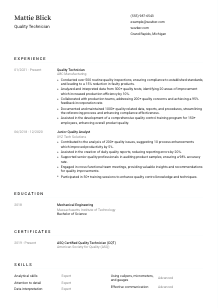
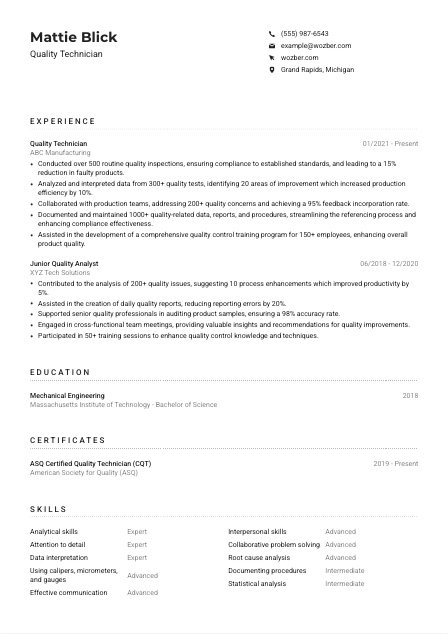
If a posting calls for local candidates, show your city and state. Here, listing Grand Rapids, Michigan directly addresses the employer's location requirement and removes a practical question early in the review.
Include LinkedIn or a professional website only if it supports your application with useful detail, such as certifications, manufacturing experience, or quality-related project work. Make sure the title, dates, and achievements there match your resume exactly.
This section is brief, but it still sets a standard. Accurate contact details, the right title, and any required location information show the same discipline employers expect when you are handling measurements, records, and compliance documentation.




This is the section that carries the most weight for a Quality Technician. Employers want to see whether you have actually inspected products, interpreted test data, documented issues, and worked with production teams to improve process control.
Start by marking the repeated tasks and terms in the job description. For this role, that includes routine inspections, audits, data analysis, corrective actions, documentation, collaboration with production, and training support. Those should shape your bullets so your experience reads like quality work, not general manufacturing support.
List jobs in reverse chronological order with your title, employer, and dates. If you moved from a junior quality or analyst role into a technician role, keep that progression visible because it shows growing responsibility in inspection, reporting, and process improvement.
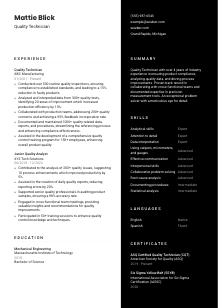
Focus each bullet on what you checked, what you found, what you improved, or what you helped prevent. The sample resume does this well with specifics like conducting 500+ inspections, analyzing 300+ tests, and documenting over 1,000 quality records. That kind of wording tells a hiring manager you understand day-to-day quality operations.
Use metrics tied to defects, compliance, reporting accuracy, throughput, or process improvement. A line such as reducing faulty products by 15 percent or increasing production efficiency by 10 percent lands well because it connects inspection work to measurable manufacturing results.
Cut or trim bullets that do not support the target role. For quality technician openings, prioritize inspections, measurements, root cause work, CAPA support, audits, documentation control, and cross-functional issue resolution over unrelated production tasks. Every line should reinforce that you can protect standards on the floor.
A hiring manager should be able to scan this section and understand your quality scope within seconds. If your bullets show inspection volume, tool use, problem solving, and process results, your experience will already be doing most of the selling.
Education usually supports the application rather than driving it for this role, but it still helps establish your technical base. In manufacturing and quality environments, a degree or training in engineering, industrial technology, or a related field can reinforce your ability to read specs, understand tolerances, and work with structured processes.
List education that supports quality, manufacturing, or technical work. A degree such as Mechanical Engineering, shown in the example resume, strengthens your profile because it connects naturally to measurement, tolerances, materials, and process understanding.
Include degree, field of study, school, and graduation year. This section should be easy to scan, much like a clean quality record with the necessary fields completed and no extra clutter.
If a job posting asks for a specific technical background, make sure that information is impossible to miss. Even when no degree is required, relevant academic training can help distinguish you from candidates whose experience is broader but less quality-focused.
You do not need to turn this into a class list. Include coursework, labs, or projects only when they connect directly to inspection methods, manufacturing systems, statistical analysis, materials testing, or process improvement.
Honors, technical societies, or strong project work can help early-career candidates who have less full-time experience. If those extras connect to quality systems, Six Sigma, manufacturing design, or data analysis, they are worth keeping.
Your education section should quietly reinforce that you can work comfortably with specifications, measurements, and structured quality processes. Keep it concise, relevant, and aligned with the level of technical understanding the job calls for.
Certifications carry real weight in quality roles because they show structured training in standards, inspection practices, and improvement methods. When a posting mentions a credential like ASQ CQT, this section moves from helpful to highly relevant.
List any certification that directly matches the posting near the top. In this case, ASQ Certified Quality Technician aligns closely with the requirement and immediately tells the employer you understand recognized quality practices and terminology.
Prioritize credentials tied to inspection, quality systems, process improvement, or manufacturing excellence. A Six Sigma Yellow Belt can support your profile because it reinforces process analysis and continuous improvement, while unrelated certificates usually do not add much here.
Add issue dates and renewal status when relevant. For active certifications, clear dates help employers confirm that your credentials are current and that your training is not outdated.
Quality work changes with standards, customer requirements, and production methods. If you continue building skills through certifications or formal training, that supports your credibility in audits, corrective action work, and shop-floor problem solving.
For a Quality Technician, the right certification does more than decorate the page. It supports your technical credibility, especially when the role includes inspections, data review, process improvement, and compliance documentation.
The skills section should read like the toolkit of someone who can inspect parts, interpret results, and communicate findings clearly. For quality technician roles, the most effective lists balance measurement capability, analytical thinking, documentation habits, and shop-floor collaboration.
Read the job description for both direct and implied skill requirements. Here, the obvious ones are calipers, micrometers, gauges, analytical skills, attention to detail, communication, and teamwork. The implied ones include troubleshooting, documentation, and process improvement support.
List the hard and soft skills you can genuinely back up with experience. The example resume handles this well by pairing precision measurement tools with analytical skills, root cause analysis, documenting procedures, and collaborative problem solving. That combination reflects how quality work is actually done.
A long skill dump weakens this section. Keep the list focused on the capabilities the role depends on, such as inspection tools, data interpretation, audit support, nonconformance documentation, corrective action participation, and cross-functional communication. The goal is a shortlist that matches the work environment.
If this section is tailored well, it should sound like a technician who can measure accurately, document consistently, and work through quality issues with production and engineering. Keep it practical and closely tied to the experience section.
Language ability is usually a supporting detail for Quality Technician roles, but it can still matter. Clear English is especially important when the work involves inspection records, audit notes, procedures, and communication about defects or corrective actions.
Review the posting for any stated language expectation before building this section. In this case, strong English is a direct requirement, so it deserves a clear place on the resume rather than being left implied.
List English first and label your proficiency accurately. For a role involving documentation, reports, and collaboration with cross-functional teams, this quickly reassures the employer that you can handle written and verbal quality communication.
Additional languages can be useful in diverse manufacturing environments, supplier communication, or global operations. If you speak another language fluently, keep it on the resume, but do not let it distract from the core quality qualifications.
Terms like "Native," "Fluent," "Intermediate," and "Basic" are enough. Avoid vague labels, and be honest because language ability can affect training, reporting, and issue escalation in real production settings.
If the company works across multiple sites, suppliers, or international teams, additional languages may carry more value. For many quality technician roles, though, English proficiency matters most because procedures, specifications, and corrective action records depend on precision.
For this profession, language is mainly about accurate communication in reports, procedures, and team discussions. List what is required, state it clearly, and treat extra languages as a useful bonus rather than a centerpiece.
The summary should quickly establish you as someone who can inspect, analyze, document, and improve. In a Quality Technician resume, that means combining years of experience with the kind of quality work you have handled and the business results it influenced.
Before writing, identify the main priorities in the posting. For this role, that means quality inspections, data interpretation, corrective action, production collaboration, documentation, and familiarity with measurement tools. Those points should drive the summary instead of generic claims about being hardworking or detail-oriented.
Start with your title and years of experience, then anchor it in the kind of quality environment you know. A line like "Quality Technician with 4+ years of experience in product inspection, compliance checks, and process improvement" tells the reader much more than a broad introduction.
Mention the technical and collaborative strengths that the employer will care about first. The sample summary works best where it references product compliance, quality data, cross-functional work, and precision measurement tools. Those details make the summary sound grounded in actual quality practice.
Aim for three to five sentences with no filler. Skip soft claims that are not backed up elsewhere, and avoid repeating your entire experience section. The summary should give a fast, credible read on your quality background and why your profile fits the opening.
When this section is written well, it frames the rest of the resume before the reader reaches your first job entry. A concise summary built around inspections, measurements, documentation, and process improvement tells the employer they are looking at a true quality candidate.
A Quality Technician resume works best when every section points back to the same essentials: accurate inspection work, reliable documentation, useful data analysis, and practical collaboration with production teams. That is what hiring managers need to see quickly, whether they are reviewing the file themselves or first reading it through an ATS.
Use Wozber's free resume builder to shape that information into a clean, ATS-compliant resume, then refine it with targeted language from the posting so your measurement tools, certifications, and quality results are easy to find. The finished resume should make one thing clear at a glance: you can protect standards, solve quality issues, and contribute on day one.