



Use Wozber and land your dream job
Create Resume
No registration required
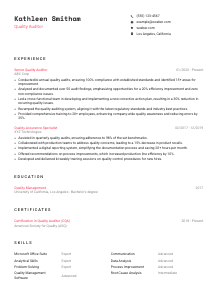
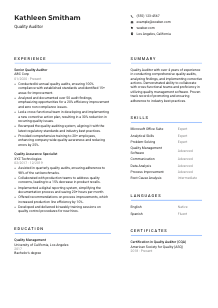
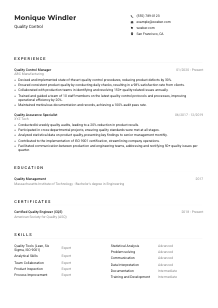
Checking standards, but your resume isn't up to par? Check out this Quality Auditor resume example, created with Wozber free resume builder. It shows how to highlight your audit accuracy to match job criteria, making sure your career stands out for all the right reasons!
Quality Auditors are trusted to catch gaps before they turn into compliance failures, repeat defects, or costly process breakdowns. That makes your resume less about listing quality tasks and more about showing how you audit against standards, document findings clearly, drive corrective action, and help teams improve how work is done.
When the resume is tailored well, reviewers can quickly tell whether your background is rooted in audit execution or in broader quality support work. Wozber's free resume builder helps you shape that story into an ATS-compliant resume, using the language and structure that make audit scope, compliance results, and corrective-action work easier to spot early.
For a Quality Auditor, the top of the resume should confirm basic eligibility fast and stay clean enough for both ATS parsing and human review. Keep this section factual, professional, and aligned with any practical requirement the employer has called out.
Use your full name as the visual header of the page in a clear, readable font. Quality work depends on precision, and that expectation starts with presentation. Avoid nicknames or decorative formatting that distracts from a straightforward professional identity.
Place "Quality Auditor" directly under your name if that is the role you are pursuing. This keeps your positioning clear from the first line and helps distinguish you from adjacent profiles such as Quality Assurance Specialist or Compliance Analyst unless you are intentionally targeting those titles too.
List a reliable phone number and a professional email address, then check them carefully. An error here undercuts the credibility of someone applying for a role built on accuracy, documentation, and follow-through. If you include a website or LinkedIn profile, make sure the content supports your audit background and matches your resume dates and titles.
If a posting specifies a city or relocation expectation, reflect that requirement plainly. In the example, listing Los Angeles, California immediately answers a stated employer filter. If location is not central to the job, city and state are usually enough.
A LinkedIn profile can help if it expands on audit scope, certifications, regulated environments, or cross-functional quality work. Keep it aligned with your resume instead of treating it as a separate story. Hiring teams will notice if your summary says one thing and your profile shows different dates, titles, or certification details.
This section does not need personality flourishes. It needs to confirm that you are reachable, professionally presented, and, when relevant, available where the role is based.




This is the section hiring teams read most closely for Quality Auditor roles. They want to see how often you audited, what standards or requirements you worked against, how you documented findings, and what changed because of your recommendations or corrective-action work.
Read the job description line by line and mark the core work: regular and ad hoc audits, compliance review, findings documentation, CAPA collaboration, system upkeep, and training. Then rebuild your experience bullets around matching evidence from your own roles. If you have worked in quality assurance as well as auditing, make the audit-facing parts more visible instead of leaving them buried under general quality duties.
List positions in reverse chronological order so reviewers can follow your progression from quality support into deeper audit ownership. For each role, include job title, employer, and employment dates. That clean structure helps ATS systems parse your history and helps hiring managers quickly place your level of responsibility.
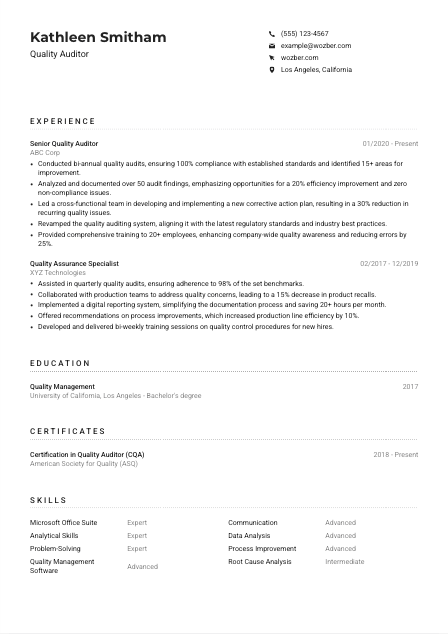
Quality Auditor experience reads best when the bullets move beyond monitoring and into results. Show what you reviewed, what you found, what you documented, and what improvement followed. The sample resume does this well with points such as identifying 15+ improvement areas, reducing recurring quality issues by 30%, and training 20+ employees to improve quality awareness.
Use numbers that fit the job naturally: audit frequency, compliance rate, number of findings, reduction in non-conformances, time saved in reporting, error reduction, recall reduction, or efficiency gains after corrective action. Metrics like "100% compliance," "50 audit findings analyzed," or "20+ hours saved per month" give hiring teams a clearer picture of audit volume and business impact than general claims about being detail-oriented.
Do not turn this section into a full career archive. Prioritize work that shows compliance knowledge, documentation discipline, root-cause thinking, quality system maintenance, process improvement, and collaboration with production, operations, or other cross-functional teams. If an older role is less relevant, keep it brief and let your strongest audit work carry the section.
The best experience sections make one thing easy to see: you do not just inspect quality issues, you document them, escalate them appropriately, and help the business reduce repeat problems.
Education matters here because many Quality Auditor postings set a degree requirement before the interview stage. Keep the section straightforward, and use the wording that confirms you meet the academic baseline for quality, business, or a related field.
If the posting asks for a bachelor's degree in Quality Management, Business Administration, or a related discipline, make sure your degree and field are written plainly. The example resume does this directly with a bachelor's degree in Quality Management, which aligns neatly with the stated requirement.
A simple order works best: degree, field of study, school, and graduation year. That makes the section easy to review and easy for an ATS to parse without confusion. Skip extra formatting that adds no value.
If your credential genuinely matches the employer's language, use that wording. For example, writing "Bachelor's degree" instead of shortening or rephrasing can help when the posting uses the full term. Accuracy matters more than gaming keywords, but exact alignment helps when it reflects your real education.
Relevant coursework can help early-career candidates, career changers, or applicants whose degree field is adjacent rather than directly in quality. Courses in quality systems, statistics, process improvement, regulatory compliance, or operations management can add context. If you already have several years of audit work, keep education concise unless a course or project is unusually relevant.
Honors, research, or capstone projects are worth mentioning if they connect to auditing, compliance, process analysis, or quality management systems. For most mid-level Quality Auditors, though, recent work experience and certifications will carry more weight than older academic detail.
This section should confirm your academic qualification quickly, then get out of the way so your audit experience and certification can do the heavier lifting.
Certifications matter in quality functions because they signal formal training in audit methods, standards, and professional practice. When a posting specifically asks for a credential such as CQA, this section moves from helpful to essential.
If the employer asks for ASQ's Certified Quality Auditor or an equivalent certification, list it prominently and use the full official name. That requirement is explicit in the job description here, so it should be impossible to miss on the resume.
Lead with credentials that support auditing, compliance, quality systems, root-cause analysis, or continuous improvement. A shorter, more relevant list is better than a long collection of loosely related certificates. For this type of role, CQA belongs ahead of general learning badges or unrelated software courses.
Add the earned date and, if relevant, renewal or active status. Certifications in regulated or standards-driven environments carry more weight when employers can see that they are current. The example's "2018 - Present" format signals that the credential remains active.
Quality auditing changes with industry standards, regulatory expectations, and reporting practices. If you hold additional training in CAPA, ISO frameworks, internal auditing, supplier quality, or process improvement, include it when it supports the role you are targeting. That helps show that your methods are current, not dated.
Relevant credentials back up your audit knowledge with formal recognition. For roles that require CQA or similar certification, this section should confirm eligibility at a glance.
A Quality Auditor's skills section should reflect how the work gets done: reviewing records, analyzing data, spotting non-conformance patterns, documenting findings, and working with teams on corrective action. Keep the list targeted to tools and capabilities that belong in real audit work.
Start with the technical and functional skills that the role uses every week. In this case, that includes quality management software, advanced Excel, analytical ability, problem-solving, communication, and likely process improvement or root-cause analysis. Build the section from real tasks you have handled, not from generic strengths that could belong to any office role.
When a posting names specific capabilities, use those terms if they describe your background. This helps ATS matching and also makes the resume easier to scan. The example resume mirrors the job well by listing Microsoft Office Suite, quality management software, analytical skills, problem-solving, communication, data analysis, and process improvement.
Put the highest-priority audit skills first. For many Quality Auditor roles, that means leading with audit-related analysis, quality systems, compliance tools, documentation, and Excel before broader interpersonal skills. Communication still matters because auditors report findings and train teams, but the list should first establish your ability to perform the technical core of the role.
A focused skills section should read like someone who can step into audits, analyze evidence, document issues, and support corrective action from day one.
Language ability is relevant for Quality Auditors because the role depends on clear written findings, accurate communication with stakeholders, and, in some workplaces, training across diverse teams. Include languages when they help confirm a stated requirement or add practical value to your profile.
If the posting asks for good English proficiency, list English clearly and rate it honestly. Audit reports, non-compliance documentation, training notes, and corrective-action discussions all depend on precise language, so this is more than a formality.
After the required language, include any others that could support plant communication, supplier coordination, or multicultural team training. In the example, Spanish is a useful addition because it can support communication across varied teams, even though it is not stated as a requirement.
Extra languages matter most when they help you explain procedures, gather information during audits, or train employees more effectively. If your work has included bilingual reporting, cross-site communication, or supplier interaction, the language section becomes more meaningful.
Terms like "Native," "Fluent," "Advanced," or "Conversational" work well when they reflect your real working level. Overstating proficiency is risky in a role where communication accuracy affects findings, training, and compliance follow-up.
Not every Quality Auditor role needs more than one language, but some industries, regions, and operational settings benefit from it. If multilingual communication helps you work with production teams, external vendors, or frontline staff, it is worth showing as part of your overall audit effectiveness.
For this role, language skills matter most when they support reporting accuracy, training clarity, and day-to-day communication across the people involved in quality work.
The summary sits at the top of the resume and shapes how the rest of the document is read. For a Quality Auditor, it should quickly establish your audit experience, your compliance and documentation strengths, and the kind of improvements your work has helped deliver.
Before writing, identify the few points the employer needs to understand first: years of audit or quality experience, type of audit work handled, strength in analyzing findings, familiarity with quality systems, and ability to support corrective and preventive action. Keep the opening grounded in actual audit practice rather than broad statements about being detail-oriented.
Lead with your professional identity and years of relevant experience. A line such as "Quality Auditor with 4+ years of experience in internal audits, compliance reviews, and corrective-action follow-up" gives immediate context and sets up the rest of the summary efficiently.
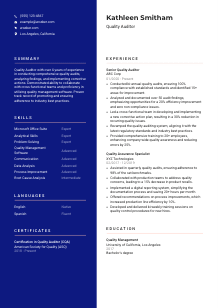
Choose proof points that match the posting. This could include improving compliance rates, reducing recurring quality issues, strengthening reporting systems, or working across departments to close findings. The example summary works because it mentions comprehensive audits, corrective actions, cross-functional collaboration, and quality management software proficiency without drifting into vague claims.
Aim for three to five lines that read cleanly on screen. Avoid repeating information that already appears in your skills list or experience bullets unless it helps frame your value at a glance. The summary should make a reviewer expect solid audit work when they move into the rest of the resume.
A well-written summary should quickly establish that you can audit against standards, report clearly, and help turn findings into measurable process improvement.
A Quality Auditor resume should read like the work itself: accurate, structured, and grounded in findings, compliance, and follow-through. When each section clearly shows your audit scope, corrective-action involvement, tools, and measurable improvements, hiring teams can see where you fit immediately.
Use Wozber's free resume builder to organize that experience into an ATS-friendly resume format, then sharpen the wording with its ATS resume scanner and AI-driven tailoring features so the final version reflects the standards and terminology of the role you are targeting. The result should make your audit judgment, documentation discipline, and improvement mindset easy to recognize.




