



Use Wozber and land your dream job
Create Resume
No registration required
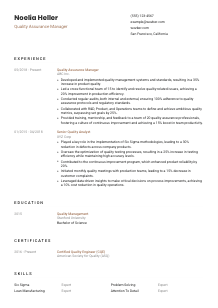
Setting quality standards high, but your resume seems off-spec? Browse this Quality Assurance Manager resume example, created with Wozber free resume builder. Learn how to show your quality control strengths in line with job requirements, ensuring your career shines with the same precision as your inspections!
Quality Assurance Managers are trusted with more than inspection. They build the systems that keep products consistent, audits clean, defects under control, and teams aligned across operations, product, engineering, and customer expectations. A resume for this level of work needs to show how you improve quality at scale, not just that you care about doing things right.
When the resume is tailored well, reviewers can quickly see your command of quality frameworks, audit discipline, process controls, and team leadership instead of sorting through generic management claims. Wozber's free resume builder helps you shape that story into an ATS-compliant resume using the same terminology the employer uses, so your background reads clearly as QA leadership with measurable operational impact.
This section is brief, but for a Quality Assurance Manager it still needs to communicate accuracy, professionalism, and any non-negotiable logistics the employer flagged. Get the basics right, and the hiring team can move straight to your quality systems, audits, and leadership record.
Use your full name prominently and keep the formatting clean. For a management-level QA resume, the top of the page should feel controlled and organized, much like the documentation standards you would expect in a regulated or process-driven environment.
Place "Quality Assurance Manager" directly under your name if that is the role you are pursuing. Matching the title used in the posting helps frame your experience around leadership in quality management systems, audits, process controls, and cross-functional issue resolution from the first glance.
List a phone number you answer, a professional email address, and make sure every detail is error-free. In QA leadership roles, small mistakes in contact information can undercut the very strengths you want to project, especially when the job emphasizes attention to detail and communication across the organization.
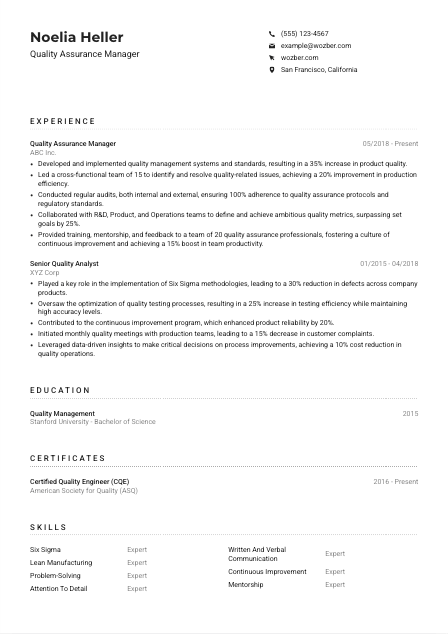
If the employer requires someone to be in a specific market, state your city and state clearly or indicate relocation readiness. In the example, listing San Francisco, California immediately removes a practical objection because the posting specifically asks for local availability or willingness to relocate.
Include LinkedIn or a professional website if it supports your candidacy. For QA managers, that profile should reinforce your resume with consistent titles, certifications, and career progression across areas such as compliance, defect reduction, Lean initiatives, supplier quality, or team leadership.
This section does not need flair. It needs to confirm who you are, how to reach you, and whether you meet practical requirements so the rest of the resume can focus on your quality leadership.




For a Quality Assurance Manager, the experience section carries most of the decision weight. Hiring teams want to see whether you have led quality programs, improved process performance, managed audits, partnered with operations and product teams, and coached people while keeping standards high.
Start by identifying the operating priorities in the posting. Here, that includes building quality management systems, leading cross-functional teams, conducting internal and external audits, setting quality metrics, and developing QA staff. Those points should shape which achievements you select and how you describe them.
List each position with company name, title, and dates, starting with the most recent role. This format makes it easy to track your growth from hands-on quality work into leadership, such as moving from a senior analyst position into full responsibility for quality systems, team management, and continuous improvement programs.
Your bullets should show what changed because of your work. Instead of saying you were responsible for quality systems or audits, show outcomes such as improved product quality, reduced defects, stronger audit compliance, faster testing cycles, or better production efficiency. The example does this well by tying system implementation to a 35% increase in product quality and audit work to 100% protocol adherence.
Numbers matter in QA because they show whether your process changes actually improved performance. Use metrics that fit the work, such as defect reduction, first-pass yield, audit pass rates, customer complaint reduction, CAPA closure times, production efficiency, cost of quality, or team productivity. Figures like a 20% efficiency gain or a 30% defect reduction tell a far clearer story than broad claims about improvement.
Choose bullets that reflect the level of the role you want now. A hiring manager for a QA Manager position will care more about building standards, guiding root-cause analysis, coordinating with R&D or Operations, and mentoring teams than about routine test execution alone. If earlier roles are more tactical, frame them around progression into process ownership, data-driven decision-making, and broader quality influence.
By the end of this section, the reader should understand the systems you improved, the teams you led, and the measurable quality outcomes you delivered. That is what separates QA management experience from general operations support.
Education is rarely the main selling point for an experienced Quality Assurance Manager, but it still needs to confirm that you meet the baseline requirement and that your academic background supports work in quality, engineering, manufacturing, or process improvement.
Start with the credential the employer asked for. In this case, a bachelor's degree in a relevant field is required, so a degree such as Quality Management, Engineering, Industrial Technology, or a closely related discipline should be easy to find in your resume.
Include degree, field of study, school, and graduation year or date. Keep it straightforward. For ATS optimization and human review alike, a clean education entry is easier to scan than extra commentary or overly detailed formatting.
If your degree closely matches the posting, spell it out clearly. "Bachelor of Science in Quality Management" aligns directly with the kind of background this employer requested and reinforces your grounding in quality systems, methods, and process improvement.
If you are earlier in your career, relevant coursework in statistics, quality engineering, manufacturing systems, regulatory compliance, or process control can help. For more experienced candidates, keep the emphasis on the degree itself unless an academic honor or project clearly supports the role.
If you have continuing education in Lean, Six Sigma, auditing, or regulatory standards, mention it where it fits best and avoid cluttering this section. Formal degrees belong here, while professional certifications usually deserve their own dedicated space.
For this role, your education section needs to verify the required foundation quickly and cleanly. Once that is clear, the rest of the resume can carry the heavier proof through experience, certifications, and measurable quality outcomes.
Certifications matter in QA because they show structured training in methods, standards, and continuous improvement. They are especially useful when the job description emphasizes frameworks such as Six Sigma, Lean manufacturing, auditing, or broader quality management discipline.
Start with credentials that reinforce the way the company describes its quality work. When a posting mentions Six Sigma, Lean manufacturing, or formal QA methodologies, certifications tied to those areas carry more weight than general professional development courses.
Choose certifications that strengthen your case for managing quality systems, leading corrective action, and improving process performance. A credential like Certified Quality Engineer is a strong example because it speaks directly to quality tools, analysis, process control, and systems thinking.
If a certificate is active, renewed, or especially recent, include the date range or issue date. That helps show your knowledge is current, which matters in environments shaped by changing standards, audit expectations, and continuous improvement practices.
QA leaders are expected to keep refining their approach to root-cause analysis, statistical methods, process capability, compliance, and team management. A current or recently maintained credential signals that you stay engaged with the discipline rather than relying only on past experience.
Use this section to strengthen your technical and process credibility. The best certifications on a QA Manager resume are the ones that connect directly to the systems, standards, and improvement methods you apply on the job.
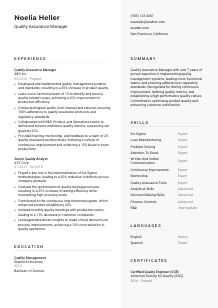
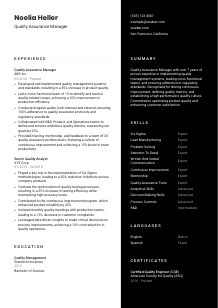
A Quality Assurance Manager skills section should read like a concise map of how you run quality, solve problems, and lead improvement. The best version balances methodology, operational judgment, and collaboration rather than listing broad traits with no clear application.
Look beyond the obvious keywords. This description directly names Six Sigma, Lean manufacturing, analytical ability, decision-making, communication, and quality assurance methodologies. It also implies skills in audits, process controls, metrics definition, cross-functional leadership, and team development. These are the terms worth reflecting when they match your background.
Lead with capabilities that show you can run a quality function, not just contribute to one. Quality management systems, audit leadership, CAPA, root-cause analysis, continuous improvement, process controls, team mentorship, and cross-functional collaboration usually matter more at this level than narrower testing tools alone.
Group and order skills so the most relevant ones appear first. A clean list that includes methods like Six Sigma and Lean, leadership strengths such as mentorship, and operational capabilities such as process controls and analytical problem-solving gives both the ATS and the reader a faster, more accurate picture of your fit.
The right skills list should support the rest of the resume, not repeat it vaguely. When chosen well, it tells the employer that you understand quality frameworks, can act on data, and can lead people through process improvement work.
Language ability is a practical consideration in QA leadership because the role often involves audit communication, training, documentation, issue escalation, and coordination across departments. If a posting specifies a language requirement, address it directly and without ambiguity.
Start with what the employer explicitly asked for. Here, the role requires comfort communicating in English, so your resume should clearly show your proficiency level rather than leaving it implied.
If English is native or fluent for you, place it first. Quality Assurance Managers need to explain nonconformances, present findings, write corrective actions, and communicate with stakeholders at multiple levels, so strong business communication in the required language matters.
Additional languages can be useful in manufacturing, supplier quality, international audits, or cross-site collaboration. In the example, Spanish adds extra value, but it works as a supporting strength rather than replacing the need to show clear English proficiency.
Stick to labels such as Native, Fluent, Advanced, or Intermediate. Overstating language ability can create problems quickly in roles that rely on training delivery, policy communication, customer-facing issue management, or audit discussions.
If the company works across regions, suppliers, or multilingual teams, language skills may deserve more visibility. If the role is primarily local, keep the section concise and make sure it still supports the communication demands of QA leadership.
Use this section to show you can handle the reporting, training, and cross-functional communication the role requires. For QA management, clarity matters more than a long list of languages.
The summary sits at the top of the resume, so it should establish your level quickly. For a Quality Assurance Manager, that means naming your years of experience, your command of quality systems and improvement methods, and the business results you have driven through leadership, audits, and process control.
Read the posting closely and identify the central demands. Here, the role combines quality management systems, continuous improvement, audits, metrics, cross-functional coordination, and team development. Your summary should bring those themes together rather than offering a generic statement about being results-driven.
Start with a direct line such as your current or target title, followed by your years of experience and primary QA focus. "Quality Assurance Manager with 7+ years of experience in quality systems, audit compliance, and continuous improvement" immediately gives the reader useful context.
Choose highlights that reflect the role's priorities. That can include improving product quality, reducing defects, leading cross-functional problem solving, defining quality metrics, or building high-performing QA teams. The example summary works because it combines management scope with outcomes in systems implementation, regulatory adherence, and customer satisfaction.
Aim for a short paragraph of 3 to 5 sentences. Every line should earn its place by clarifying your leadership level, quality methodology, operational impact, or ability to raise standards across teams and processes.
A well-written summary tells the reader, within seconds, that you can run quality systems, improve performance, and lead people effectively. That framing makes the rest of the resume easier to read in the right context.
A Quality Assurance Manager resume works when it makes your process discipline, improvement record, and leadership scope easy to follow from top to bottom. Use Wozber's free resume builder to organize that experience into an ATS-friendly resume format, align your language with the posting, and strengthen ATS optimization without losing the operational detail that matters in quality roles.
The final read should make one thing clear: you know how to build standards, lead teams, and improve product quality in a measurable way.




