



Use Wozber and land your dream job
Create Resume
No registration required
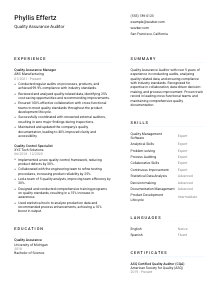
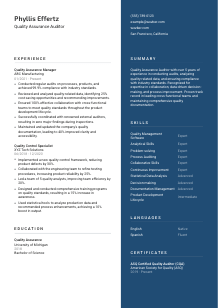
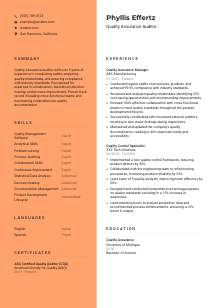
Ensuring top-notch quality, but your resume lacks an audit trail? Check out this Quality Assurance Auditor resume example, created with Wozber free resume builder. Prime your credentials to match job specifics, so your career reflects the high standards you audit!
Quality Assurance Auditors are trusted to catch process drift before it becomes a compliance issue, customer complaint, or costly defect trend. That responsibility shapes how your resume should read. Hiring teams want to see where you audited, what standards you worked against, how you handled findings, and whether your reviews led to stronger documentation, corrective actions, or measurable quality gains.
A tailored resume helps separate true audit experience from broader quality support work. When your wording matches the role's language around audits, quality data, compliance, and cross-functional coordination, an ATS-compliant resume is far more likely to surface the right experience early. Wozber's free resume builder helps organize that language clearly, so both screening systems and hiring managers can quickly see your audit scope and your contribution to quality performance.
Quality roles value control, accuracy, and traceability, and your contact section should reflect that same standard. Keep it clean, professional, and aligned with the role so the first lines of your resume already show attention to detail.
Place your full name at the top in a larger, easy-to-read format. For a Quality Assurance Auditor, this section should feel orderly and precise from the start, much like a well-maintained audit record or controlled document.
Add "Quality Assurance Auditor" directly under your name when that matches the role you are pursuing. This helps anchor your resume around audit work rather than broader quality, manufacturing, or compliance positions, and it immediately reinforces role alignment for both recruiters and ATS filters.
List a reliable phone number and a professional email address with zero room for error. In a profession built on accuracy, even a small typo can undermine confidence. Use straightforward contact information that looks business-ready and is easy to verify.
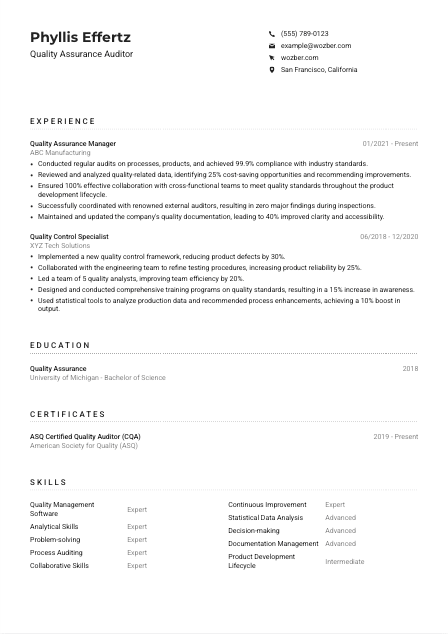
If the employer specifies a location requirement, reflect that in your contact details. Here, the posting asks for someone based in or able to relocate to San Francisco, California, so showing San Francisco on the sample resume answers a practical screening question immediately.
Include LinkedIn or a professional website if it supports your audit background with certifications, project context, or quality-focused experience. Make sure the titles, dates, and credentials match your resume exactly, especially if you highlight standards work, audit leadership, or training in quality systems.
This section should confirm that you are reachable, professional, and aligned with any practical requirements tied to the opening. Keep it tidy and exact, because quality hiring starts noticing detail immediately.




This is where a Quality Assurance Auditor proves range and credibility. Audit planning, compliance review, data analysis, corrective action follow-through, and documentation control all belong here, but they need to be framed through outcomes, not generic responsibilities.
Read the job description with an auditor's eye and identify the repeated themes. In this case, the employer emphasizes regular audits, analysis of quality-related data, collaboration across the product development process, support during external inspections, and maintenance of controlled documentation. Those themes should shape which bullets you keep and how you phrase them.
Prioritize roles and bullet points that show direct experience with process audits, product quality reviews, compliance checks, CAPA-related improvements, or coordination with engineering, operations, and regulatory stakeholders. If part of your background sits in a broader quality title such as Quality Assurance Manager or Quality Control Specialist, make the audit and compliance parts unmistakable.
Numbers carry weight in quality work because they show whether your reviews changed performance. Use metrics tied to compliance rates, defect reduction, cost savings, output improvement, inspection findings, or documentation effectiveness. The sample resume does this well with results such as 99.9% compliance, 25% cost-saving opportunities, and zero major findings during external audits.
Keep the section centered on quality systems, process control, analysis, and improvement work that maps to the target role. If an older bullet does not support your ability to audit, interpret data, strengthen procedures, or work through quality issues with cross-functional teams, cut it or rewrite it so the relevance is clear.
Cross-functional teamwork matters in QA auditing because findings often move through engineering, production, quality control, suppliers, and leadership before they become corrective action. Show how you worked with those groups to close gaps, refine procedures, improve testing methods, or maintain standards across the product lifecycle. The example's bullet about full collaboration throughout product development works because it connects teamwork to a quality outcome.
By the end of this section, a reader should understand what you audited, how you measured quality, who you worked with, and what changed because of your work. That is the core of a convincing Quality Assurance Auditor resume.
For QA audit roles, education usually sets the baseline rather than doing the heavy lifting. Still, it should confirm that you have the academic foundation to work with quality systems, technical processes, documentation standards, and data-driven review.
If the posting calls for a bachelor's degree in Quality Assurance, Engineering, or a related field, list your degree in a way that makes that connection obvious. The sample resume's Bachelor of Science in Quality Assurance is a direct match, which helps remove doubt at the first screening stage.
Keep the entry easy to scan by listing degree, field, school, and graduation year. Quality hiring often moves quickly through baseline requirements, so a simple structure makes your qualifications clear without forcing the reader to decode anything.
Write the exact discipline whenever it supports the role. "Quality Assurance," "Industrial Engineering," "Manufacturing Engineering," or another relevant field gives more useful context than a vague degree label alone, especially when the work involves process control, compliance, or systems review.
Most experienced candidates do not need course lists, but they can help when your degree is adjacent rather than direct or when you are earlier in your career. Include courses tied to statistics, quality systems, process validation, regulatory compliance, or root cause analysis only if they add real relevance.
Honors, research, or academic memberships can be worth listing when they reinforce technical discipline or quality-related focus. Keep them brief. Once you have several years of audit or quality experience, they should support your profile rather than compete with your work history.
Your education section should quickly confirm that you meet the role's academic requirement and understand the technical foundation behind quality work. After that, let your audit experience carry the stronger argument.
Certifications matter in quality assurance because they point to recognized knowledge of audit methods, management systems, and compliance standards. When a role mentions ISO 9001 or ASQ CQA, treat that as a clear tailoring opportunity rather than an optional extra.
If the employer calls out quality assurance or quality management system certifications, place your matching credentials in plain view. This posting names ISO 9001 and ASQ Certified Quality Auditor as plus factors, so those credentials deserve prominent placement when you hold them.
Prioritize certifications that directly strengthen your fit for auditing, compliance review, documentation control, or quality system management. ASQ CQA, ISO 9001-related credentials, internal auditor training, or sector-specific quality certifications usually carry more value here than broad professional development courses.
List dates earned and, where relevant, indicate that the certification remains active or current. In quality work, current credentials matter because standards, audit expectations, and documentation practices evolve over time.
Review this section whenever you renew a credential or complete new training in audit methods, statistical analysis, CAPA, supplier quality, or regulatory systems. Fresh certifications can strengthen your case, especially when the job leans heavily on formal quality frameworks.
The right certificates show that your quality knowledge has been tested against recognized standards. For audit-focused roles, that extra layer of credibility can help move your resume forward faster.
A Quality Assurance Auditor's skills section should read like a practical toolkit for auditing, analysis, compliance, and follow-up. Focus on the systems, methods, and judgment the work actually requires, not a padded list of generic strengths.
Use the job description to identify the abilities that matter most. Here, the employer points to quality management software, statistical data analysis tools, analytical thinking, problem-solving, decision-making, and English communication. Those should shape both your skills section and the language used elsewhere in the resume.
Choose skills you can support through experience bullets, certifications, or project examples. For this profession, that often includes process auditing, quality management systems, statistical analysis, corrective action support, documentation management, continuous improvement, and collaboration with technical teams. The sample resume combines software-related, analytical, and audit-specific skills in a way that fits the role well.
Organize the section so technical capabilities stand out quickly. You might separate audit and compliance skills from data analysis and communication strengths, or simply order them by relevance to the role. Either way, keep the list focused enough that a hiring manager can immediately see your operating range in quality environments.
Every skill listed here should show up somewhere else in your resume through outcomes, tools, or responsibilities. That consistency is especially important in quality roles, where claims are expected to hold up under review.
Language skills matter in quality assurance when the work depends on clear documentation, audit interviews, training, and communication during inspections. Even when only one language is required, you should present it clearly because communication errors can affect compliance and execution.
If the posting calls for English proficiency, make sure English appears clearly with an honest proficiency level. This job treats English communication as critical, which makes it more than a routine detail for a Quality Assurance Auditor.
Use standard labels such as Native, Fluent, Advanced, or Conversational so the employer can quickly understand your working level. Quality roles often involve written procedures, audit notes, and cross-functional communication, so ambiguity here does not help.
Additional languages can strengthen your profile when you work with diverse teams, international suppliers, global documentation, or multi-site operations. In the sample resume, Spanish adds useful breadth without distracting from the required English proficiency.
Do not overstate fluency. If you can handle meetings, reports, or audit interviews in a language, say so accurately. If your skill is more limited, label it accordingly. In quality work, precision matters even in the language section.
Some Quality Assurance Auditor roles involve supplier audits, regulatory visits, or documentation that crosses borders and business units. Extra language capability can support those environments, but only list it when it is real and usable on the job.
For this role, language skills should confirm that you can document clearly, discuss findings accurately, and work effectively with the people involved in quality decisions. Keep the section honest and functional.
Your summary should quickly establish what kind of quality professional you are, how much audit-related experience you bring, and what results tend to follow your work. Keep it grounded in standards, analysis, and improvement rather than broad claims about excellence.
Start with the core demands of the target role. For a Quality Assurance Auditor, that usually means auditing processes or products, analyzing quality data, supporting compliance, maintaining documentation, and helping teams act on findings. Your summary should reflect that operating reality in a few lines.
State your title or closest equivalent, then add your years of experience and main area of strength. The sample summary works because it quickly establishes more than 5 years in audits, quality analysis, and standards-driven work without wasting space on generic adjectives.
Include concise proof of what your work achieves. That might be stronger compliance performance, defect reduction, audit readiness, process improvements, or better documentation control. Save the full metrics for the experience section, but let the summary hint at measurable impact.
Aim for 3 to 5 lines that sound tailored to the opening in front of you. If the role leans more toward manufacturing audits, supplier quality, or regulated environments, shift your wording accordingly. This section should read like a focused overview, not a generic career statement.
When this section is doing its job, the reader understands your audit background, your quality focus, and the level of responsibility you have handled before reaching the first work-history bullet. That context makes the rest of the resume easier to trust.
A well-tailored Quality Assurance Auditor resume shows more than familiarity with quality standards. It makes your audit scope, analytical judgment, documentation discipline, and improvement results easy to follow from top to bottom.
Use Wozber's free resume builder to shape that content into an ATS-friendly resume format, strengthen ATS optimization with role-specific terminology, and present your experience in a way that supports both automated screening and human review.
When your resume clearly connects audits, findings, collaboration, and measurable quality outcomes, hiring teams can quickly judge whether you are ready to step into the role.




