




Use Wozber and land your dream job
Create Resume
No registration required
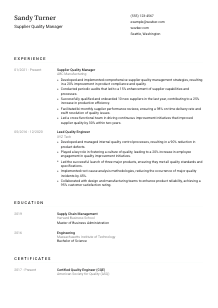
Maintaining standards, but your resume feels like a shipment gone astray? Follow the quality trail with this Supplier Quality Manager resume example, created with Wozber free resume builder. Learn how to seamlessly weave your sourcing expertise and quality assurance prowess to match job specifics, so your career trajectory never faces a delivery delay!
Supplier Quality Managers sit where product quality, supplier capability, and operational risk meet. Hiring teams look for resumes that make this visible fast. Your resume should show how you have audited suppliers, managed corrective actions, partnered with engineering and purchasing, and improved quality performance across the supply base.
A tailored resume changes how quickly that story comes through, especially when an ATS first scans for terms like supplier audits, quality management systems, CAPA, and continuous improvement. Wozber's free resume builder helps you align that language cleanly in an ATS-compliant resume, so the hiring team can immediately see your scope, supplier-facing judgment, and track record of raising quality standards.
The top of the resume should remove basic questions before anyone reaches your experience. For a Supplier Quality Manager, that means presenting clear contact details, the target title, and any location information that matters for supplier site visits, cross-functional work, or a stated relocation requirement.
Use your full name in a larger, clean font so it anchors the document right away. Keep it simple and easy to read. This role often moves through HR, procurement leaders, and quality stakeholders, so a clear header helps everyone navigate the resume quickly.
Place "Supplier Quality Manager" under your name if that is the role you are targeting. This keeps your positioning tight and prevents your background from being read as general quality, manufacturing, or supply chain experience when your actual focus is supplier performance and quality systems.
List a phone number you answer and a professional email, ideally in a straightforward format such as "firstname.lastname@email.com." If you include a website or LinkedIn profile, make sure it reflects the same titles, dates, and quality-related accomplishments shown on the resume.
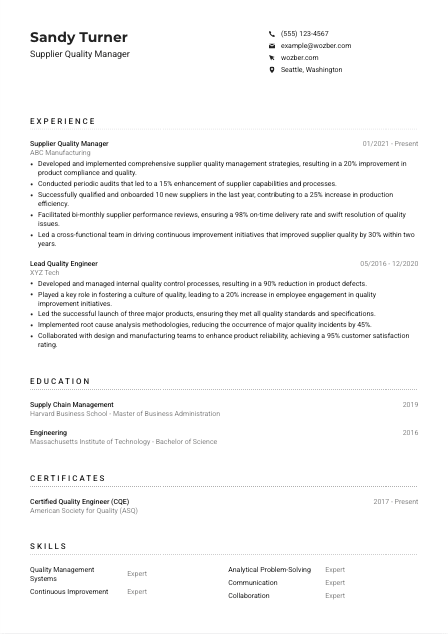
If the employer specifies a city or relocation requirement, state that clearly in your personal details. In this example, showing Seattle, Washington directly supports the stated requirement and avoids unnecessary screening friction. Use this only when location is relevant to the posting, not as a rule for every application.
A LinkedIn profile can strengthen your application when it reinforces your supplier quality work with consistent job titles, certifications, and achievements such as audit programs, supplier qualification, or continuous improvement results. Leave it out if it is outdated or thin.
Your header should tell the employer who you are, what role you are pursuing, and whether any basic requirement like location is already covered. That lets the rest of the resume focus on supplier quality performance, not missing logistics.




This section carries the most weight for a Supplier Quality Manager. Employers want to see how you handled supplier audits, qualification, performance reviews, nonconformance trends, corrective actions, and cross-functional quality issues, not just that you worked in quality.
Read the posting line by line and mark the operating priorities behind it. Here, the essentials include supplier quality strategy, audits and assessments, supplier qualification, corrective actions, performance reviews, and continuous improvement. Use those themes to choose which achievements earn space on the page.
List roles in reverse chronological order with title, company, and dates. That structure helps the reader track your move from broader quality work into supplier-facing responsibility, which matters when comparing candidates with similar years of experience but different depth in supplier management.
Each bullet should connect a supplier-quality responsibility to a business result. Good examples include auditing suppliers, closing corrective actions, improving incoming quality, qualifying new suppliers, or reducing defects tied to supplier processes. The sample resume does this well with bullets on supplier audits, onboarding 10 new suppliers, and leading regular performance reviews tied to delivery and quality outcomes.
Numbers matter when they reflect how supplier quality is judged in practice. Include improvements in compliance, defect reduction, audit findings closed, supplier scorecard performance, on-time delivery, escape rate, or production efficiency. Statements like "improved product compliance by 20%" or "achieved a 98% on-time delivery rate" work because they connect quality management to operational results.
Prioritize work that shows supplier oversight, root cause analysis, process improvement, and collaboration with engineering, manufacturing, or purchasing. Earlier roles outside direct supplier quality can still help if they show transferable quality leadership, such as defect reduction, product launches, or reliability improvement, but trim bullets that do not advance that story.
By the end of the experience section, the reader should understand the scale of your supplier quality work, the kinds of problems you solved, and the measurable effect you had on quality and supply chain performance.
Education is usually not the deciding factor at this level, but it still needs to confirm that you meet the baseline for a role tied to engineering judgment, supplier processes, and operational quality systems. Present it cleanly so the reader can quickly connect your academic background to the work.
When the posting asks for a bachelor's degree in Engineering, Supply Chain Management, or a related field, make sure that credential is easy to find. In this example, a Bachelor of Science in Engineering directly matches the stated requirement and supports the technical side of supplier quality work.
List degree, field, school, and graduation year in a consistent order. Clear formatting matters because this section is often reviewed quickly, especially when employers are confirming baseline qualifications before spending more time on your audit, supplier development, or quality systems experience.
If your degree title is broad, specify the field so its relevance is obvious. "Bachelor of Science in Engineering" tells the reader more than just "Bachelor of Science" and immediately supports work involving process capability, manufacturing quality, and supplier assessment.
Most experienced candidates do not need course lists, but they can help if your degree field is adjacent rather than direct. Include coursework only when it sharpens your profile in areas like quality systems, statistics, manufacturing processes, supply chain operations, or continuous improvement.
Honors, research, or major projects are worth adding if they relate to quality engineering, operations, supply chain, or process improvement. For experienced Supplier Quality Managers, keep this brief unless the achievement connects clearly to the target role.
This section should confirm that you meet the academic requirement and support the technical credibility behind your supplier quality decisions. Then let your experience carry the heavier proof.
Certifications can strengthen your profile when they point to recognized quality methods, audit discipline, or continuous improvement capability. For Supplier Quality Manager roles, they work best when they support the experience already shown in your audit, supplier development, and problem-solving work.
Lead with credentials that connect directly to supplier quality work, such as CQE, Six Sigma, lead auditor training, or other recognized quality certifications. The example's "Certified Quality Engineer (CQE)" is a strong match because it supports analytical rigor, quality systems knowledge, and structured problem-solving.
Include the certifications that strengthen your case for supplier audits, process control, corrective action leadership, and continuous improvement. A shorter list of relevant credentials is usually more persuasive than a long list of unrelated training.
Add the year earned, and if applicable, indicate active status. This is especially useful for certifications linked to current practice, ongoing membership, or standards-based work where employers want to see that your knowledge is still current.
Supplier quality sits close to changing customer requirements, manufacturing methods, and compliance expectations. Recent training in Six Sigma, auditing, quality systems, or supplier development can show that your methods are current and practical, not dated.
Certifications add weight when they clearly reinforce the kind of supplier quality work the job requires. Use them to deepen your credibility in audits, quality systems, and continuous improvement.
A Supplier Quality Manager skills section should read like the toolkit behind your day-to-day decisions. Focus on the methods, systems, and collaboration strengths that support supplier audits, scorecards, corrective actions, root cause analysis, and cross-functional quality improvement.
Look for explicit requirements, such as quality management systems, supplier evaluation metrics, analytical problem-solving, and Six Sigma. Then add adjacent skills the role typically relies on, such as root cause analysis, supplier qualification, CAPA management, audit planning, and stakeholder communication, if you genuinely use them.
Choose skills that are visible elsewhere in the resume. If you claim expertise in supplier evaluation metrics or continuous improvement, your experience bullets should show scorecards, audits, defect reduction, compliance gains, or process improvement outcomes that back that up.
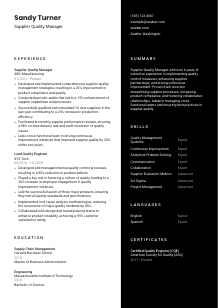
Do not overload this section with every quality or management term you know. A focused list works better. In the sample, skills like Quality Management Systems, Supplier Evaluation Metrics, Six Sigma, Communication, and Collaboration map closely to the role and support both ATS optimization and human review.
The best skills section confirms the methods and capabilities behind your experience. It should make your supplier quality background easier to recognize in seconds, not read like a generic keyword list.
Language ability matters more in some supplier environments than others, but clarity here is still important. If a posting names English fluency or if the role involves supplier communication across regions, list your language skills in a clean, honest way.
If the role specifies English fluency, include English with an accurate proficiency label. That removes a basic screening question and is especially relevant for a role that depends on audit communication, supplier reviews, and cross-functional coordination.
List English at the top when it is the required working language. Use a clear level such as "Native" or "Fluent" based on your real ability to run meetings, write corrective action requests, and discuss quality issues without friction.
Additional languages can be useful when supplier networks are global or when manufacturing partners operate across regions. Spanish, for example, may support communication in some supply chains, but include extra languages as added value rather than trying to make them the centerpiece.
Stick with standard descriptors such as "Native," "Fluent," "Intermediate," or "Basic." Avoid vague wording. Hiring teams need to know whether you can actually handle supplier calls, audit discussions, documentation review, or issue escalation in that language.
For some Supplier Quality Manager jobs, multilingual ability is highly useful because supplier development and issue resolution cross borders and time zones. For others, English alone may be enough. Let the posting and supplier environment determine how much emphasis this section needs.
This section should quickly show whether you can operate in the languages the job requires, especially in supplier-facing conversations where clarity affects quality, timelines, and corrective action follow-through.
Your summary should give a concise read on your level, supplier quality focus, and results. For this role, that means leading with years of experience and then pointing to the kind of work that matters most, such as supplier audits, quality systems, corrective actions, qualification, and continuous improvement outcomes.
Start by identifying the few requirements that define the job. Here, that includes supplier quality management, analytical problem-solving, continuous improvement, and cross-functional collaboration. Use those themes to shape the summary instead of writing a generic leadership statement.
Open with your title or closest equivalent and your years of relevant experience. A line such as "Supplier Quality Manager with 6+ years of experience" works because it quickly places you at the right level for a posting asking for at least five years in quality management.
Mention the capabilities that define your value in this field, then anchor them with results. The sample summary points to improving product compliance, strengthening supplier partnerships, and driving continuous improvement, which aligns well because those are central to supplier quality leadership.
Aim for a short paragraph that a hiring manager can absorb in one pass. Save detail for the experience section. In the summary, every phrase should earn its place by clarifying your specialty, your operating level, or your quality impact.
A well-written summary should immediately position you as someone who can manage supplier quality, work across functions, and improve measurable outcomes. It sets the tone for the rest of the resume.
A Supplier Quality Manager resume works when it makes your supplier oversight, quality judgment, and improvement record easy to see. Every section should support that story, from the headline and location details to the metrics in your experience and the methods in your skills.
Use the job description to guide your wording, especially around audits, supplier qualification, corrective actions, scorecards, and continuous improvement. Wozber can help you shape that into an ATS-friendly resume format, align language with the posting, and strengthen ATS optimization without losing the substance of your work.
Before you apply, read the document once as if you were reviewing a supplier quality hire. The key question should have a clear answer: can this candidate improve supplier performance and protect product quality?




