



Use Wozber and land your dream job
Create Resume
No registration required
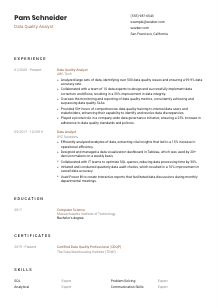
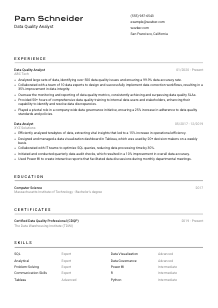
Scrubbing datasets, but your resume feels a bit messy? Check out this Data Quality Analyst resume example, created with Wozber free resume builder. Learn how to showcase your precision and validation skills to match job specifications, ensuring your career profile sparkles with the highest accuracy ratings!
Data Quality Analysts work where reporting, operations, and decision-making depend on data that can actually be trusted. Hiring teams look past generic analytics language quickly. They want to see how you find root causes behind bad records, track accuracy or integrity over time, and work with data owners to fix issues before they spread across dashboards, workflows, or downstream systems.
When that work is tailored well on the page, the resume reads less like a general data analyst profile and more like someone who can improve data reliability in production. Wozber's free resume builder helps you shape that story into an ATS-compliant resume by aligning your wording with the job description and keeping the structure clean enough for both screening systems and hiring managers to spot your SQL strength, data quality metrics, and governance work fast.
This section is simple, but it still does screening work. For a Data Quality Analyst, your contact details should present you as organized, easy to reach, and already aligned with any logistical requirements the employer has set.
Use your full name in a clean, readable format at the top of the resume. Data quality work depends on accuracy and consistency, and even the header should reflect that standard. Keep it professional and easy to scan.
Place "Data Quality Analyst" directly under your name if that is the role you are targeting. This helps position your background immediately, especially if your recent titles include adjacent work such as Data Analyst or Reporting Analyst. A direct headline reduces ambiguity from the first line.
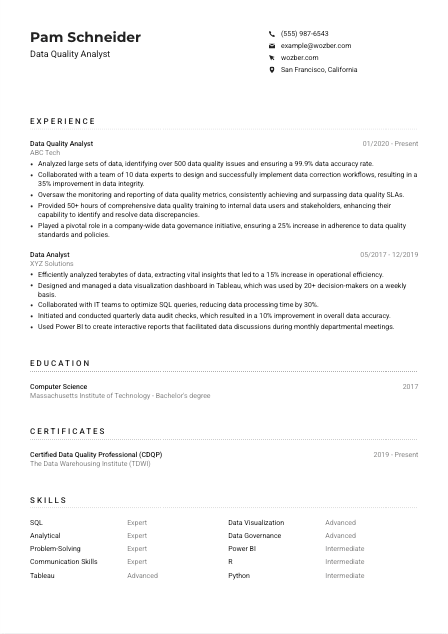
If the posting requires a specific location or relocation, reflect that here. In the example, listing "San Francisco, California" instantly answers a stated requirement. Use this approach when geography matters, but treat it as job-specific tailoring rather than a standard rule for every Data Quality Analyst resume.
Include LinkedIn or another professional profile if it strengthens your application. For this kind of role, that profile can reinforce tools, certifications, project scope, or data governance work. Make sure titles, dates, and core achievements match your resume exactly.
A well-handled header removes easy objections. It should confirm who you are, what role you do, and whether you meet practical requirements before the reader reaches your experience.




This is the section that carries the most weight. Data Quality Analysts are hired on demonstrated impact: issue detection, correction workflows, SLA performance, governance support, and the ability to improve trust in the data people use every day.
Read the description line by line and mark the work that defines success in the role. For this position, that includes identifying data quality issues, improving accuracy and integrity, monitoring metrics, supporting SLAs, training users, and participating in governance initiatives. Those themes should shape which bullets you keep, rewrite, or move higher.
List jobs in reverse chronological order with title, employer, and dates. That format lets a hiring manager quickly gauge whether you meet experience thresholds such as 3+ years in data analysis or data quality work. Clear chronology also helps ATS parsing and makes career progression easier to read.
Focus each bullet on a data quality action and its result. Strong bullets show what you analyzed, what issue you found, what process you improved, or what standard you supported. The example does this well with lines like identifying more than 500 data quality issues and improving data integrity through correction workflows. Those are much stronger than broad claims about being detail-oriented or analytical.
Quantification matters here because data quality is measured. Accuracy rates, issue volumes, SLA attainment, processing improvements, audit frequency, user adoption, training hours, and governance compliance all make sense in this field. "Ensured a 99.9% data accuracy rate" and "reduced processing time by 30%" work because they show operational results, not generic effort.
Prioritize experience tied to data validation, SQL analysis, dashboards, root-cause investigation, remediation processes, and stakeholder support. If an older bullet does not help prove those capabilities, trim it or rewrite it. A Data Quality Analyst resume should read like someone who improves the reliability of business data, not just someone who has touched datasets.
By the end of this section, the reader should understand what data environments you worked in, how you improved data quality, and what measurable results followed. That is the core proof most hiring teams want first.
Education is usually a straightforward section for this role, but it still matters because many data quality openings ask for a bachelor's degree in Computer Science, Information Systems, or a related discipline. Present it clearly so the requirement is easy to confirm.
If your degree matches the posting directly, make that clear. A bachelor's degree in Computer Science, Information Systems, Data Analytics, or a related field usually satisfies what employers want for this type of position. The example's Computer Science degree is a clean match to the requirement.
List degree, field of study, school, and graduation year or date range in a consistent order. Keep the section compact and readable. Hiring teams usually scan this section quickly unless you are early in your career or the posting places unusual weight on academic background.
Be specific about your area of study rather than shortening it too aggressively. "Bachelor's degree, Computer Science" gives clearer context than listing only the degree level. For technical and analytical roles, the field often matters because it signals exposure to databases, statistics, systems, or data modeling.
Coursework is most useful if you are a recent graduate or your degree title is broad. Classes in SQL, database systems, data management, statistics, information quality, or visualization can help connect your education to the role. Leave coursework out if your professional experience already makes that connection obvious.
Honors, research projects, capstones, or student work are worth adding when they support your data background. A project involving data cleaning, dashboarding, or governance policy design can be relevant. If you already have solid industry experience, keep these details brief so the section does not crowd out stronger professional proof.
This section does not need much space. It just needs to confirm that your academic foundation supports the technical and analytical work expected in data quality roles.
Certifications are not always mandatory for Data Quality Analysts, but they can add weight when they reinforce your specialization in data quality, governance, business intelligence, or related disciplines. Use them to show focused development, not to fill space.
If the employer mentions data quality certification as a plus, move relevant credentials into clear view. For this role, something like Certified Data Quality Professional or a related governance credential supports your positioning well. The sample resume uses CDQP effectively because it connects directly to the job's preferred qualification.
Choose certifications that support the actual work of the role, such as data quality, BI, SQL, governance, or analytics platforms used in your field. Avoid filling this section with unrelated learning badges that do not strengthen your case for improving data accuracy, integrity, or reporting quality.
Add earned dates and renewal periods where relevant, especially for certifications with active status or expiration windows. This helps hiring teams understand whether your knowledge is current, which matters in roles tied to evolving data practices, governance standards, and reporting tools.
Data quality work changes as organizations mature their governance models, monitoring processes, and tooling. Ongoing certification or structured learning shows that you keep up with how quality rules, controls, and stakeholder expectations evolve. That is valuable when the role involves both analysis and process improvement.
A short, relevant certification section can sharpen your profile quickly. It works best when every credential connects to the way Data Quality Analysts improve trust in data.
The skills section should reflect how data quality work actually gets done. That means balancing technical tools with the judgment and communication needed to investigate issues, explain findings, and work across teams on corrective action.
Start with the posting's explicit requirements, then add closely related skills you genuinely use. Here, SQL, Tableau or Power BI, analytical ability, problem-solving, and communication all appear directly. Those belong near the top because they align with both ATS screening and human review.
List the tools and capabilities that support actual job execution. For a Data Quality Analyst, that may include SQL, data visualization, data governance, root-cause analysis, data auditing, issue tracking, and stakeholder training. The example balances hard skills like Tableau and Power BI with softer but still role-critical strengths such as communication and problem-solving.
A shorter, targeted skills list usually works better than a long inventory. Prioritize the tools and strengths you can back up in your experience section. If you name SQL, Tableau, governance, or training, your bullets should show where you used them to improve metrics, reduce errors, or support data users.
This section should reinforce your experience, not compete with it. When the skills, tools, and outcomes line up, your profile reads as consistent and technically grounded.
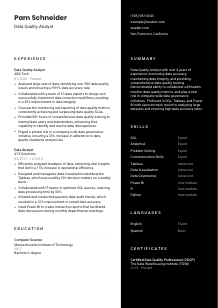
Language proficiency matters more in this field than many candidates assume. Data Quality Analysts often explain issues to business users, document standards, run training, and coordinate with technical teams, so communication needs to be clear as well as accurate.
If English proficiency is mentioned, state your level plainly. Terms such as "Fluent" or "Native" are clear and easy to scan. In this example, listing English prominently supports a stated preference in the job description.
Put the most professionally important language first. If the role requires reporting, training, or stakeholder communication in English, lead with English and then add other languages in descending order of relevance or proficiency.
Use accurate levels such as Basic, Intermediate, Advanced, Fluent, or Native. Overstating fluency creates risk in interviews and on the job, especially in roles where you may need to explain data quality findings, document standards, or lead user training sessions.
Extra languages can be helpful if the company operates across regions or if data users, vendors, or business teams span multiple markets. They are usually secondary to your SQL and data quality capabilities, but they can still add context to your collaboration range.
For this profession, language ability is not just a nice extra. It can support smoother handoffs, clearer training, and better communication around data discrepancies or policy adherence. Include it when it strengthens how you work with people around the data.
List languages in a way that helps the employer understand how you communicate in real work settings. For a role that combines analysis with stakeholder support, that context can matter.
The summary sits at the top of the resume, so it needs to establish your direction quickly. For this role, that means naming your data quality focus, your experience level, and a few capabilities that directly match how the position operates.
Before writing, identify the two or three themes the job emphasizes most. In this case, data accuracy, issue identification, correction workflows, metrics reporting, governance participation, and stakeholder support all matter. Use those themes to decide what belongs in your opening lines.
Start with a clear statement of who you are professionally and how long you have worked in the field. The example summary does this well with "Data Quality Analyst with over 4 years of experience" because it establishes both specialization and seniority immediately.
Use the next lines to name the capabilities that best match the posting. SQL proficiency, data accuracy improvement, SLA tracking, governance work, dashboard tools, or training experience can all fit here if they are real strengths. Keep the claims grounded in things the rest of the resume will support.
Aim for a compact paragraph that can be read in seconds. Three to five lines is usually enough to cover your role, experience level, key tools, and one or two outcomes. Save detailed metrics and project examples for the experience section, where they carry more weight.
A strong summary tells the reader early that you work on data accuracy, integrity, and process improvement, not just general analysis. That framing makes the rest of the resume easier to read in the right context.
A Data Quality Analyst resume should make one thing clear fast: you know how to find data issues, improve reliability, and work with others to keep quality standards in place. When your experience, skills, and summary all point to that same story, the application reads with much more authority.
Use Wozber's free resume builder to tighten the wording, keep an ATS-friendly resume format, and refine alignment with the posting through targeted ATS optimization. The final version should make it easy to see your command of SQL, quality metrics, correction workflows, and governance support.




