



Use Wozber and land your dream job
Create Resume
No registration required
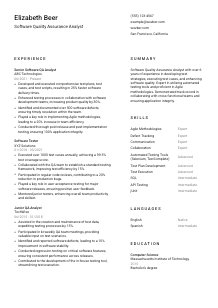
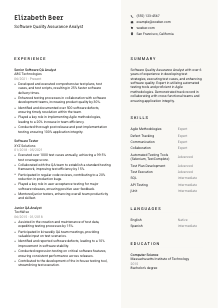
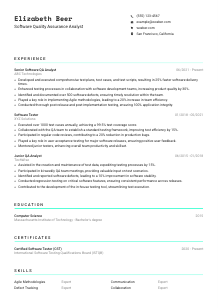
Ensuring code crosses the "i's" and dots the "t's"? Check out this Software Quality Assurance Analyst resume example, created with Wozber free resume builder. Learn how to plug your testing talents into the job's API, making your career trajectory as glitch-free as the software you scrutinize!
Software Quality Assurance Analysts are trusted to catch defects before users do, translate acceptance criteria into reliable test coverage, and work closely with developers when releases are moving fast. A resume for this field needs to show more than general technical experience. It should make your testing discipline, defect management habits, automation exposure, and Agile collaboration easy to understand in a few seconds.
That clarity also affects how your application moves through ATS screening. When your resume uses the same language as the role, such as test plans, defect tracking, post-release testing, and automation tools, Wozber's free resume builder helps you shape an ATS-compliant resume that is easier to rank and easier for a hiring team to read as genuine QA experience. The result should be a document that quickly shows where you improve software quality and how you work with engineering teams.
This section is simple, but it still does important work. For a Software Quality Assurance Analyst, the header should immediately confirm who you are, what role you are targeting, and whether basic requirements such as location and contactability are already covered.
Use your full name as the main heading in a clean, readable format. QA work depends on precision, and even the top of the page should reflect that standard with consistent formatting and zero clutter.
Place "Software Quality Assurance Analyst" directly beneath your name when that is the role you are pursuing. Matching the job title helps the reader connect your background to testing, quality processes, and release support right away instead of guessing whether you come from development, support, or business analysis.
Include a professional email address and a phone number you actually answer. Check every character. A resume built around careful test execution loses credibility fast if the hiring team cannot reach you because of a typo.
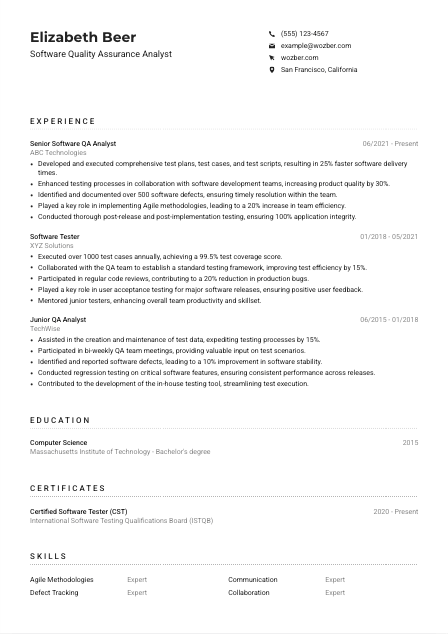
If the employer asks for a specific location, include it clearly. In the example, "San Francisco, California" matters because the posting requires local presence. That does not make location critical for every QA job, but when it is named in the posting, put it in the header so recruiters do not have to hunt for it.
Link to your LinkedIn profile or a professional site if it supports your QA story. For this profession, that might include details on automation projects, testing tools, bug triage experience, or release work. Make sure the information there matches your resume titles, dates, and scope.
Your header should confirm the essentials without distraction. When the role, contact details, and any required location are obvious from the start, the reader can move straight to your test experience and quality results.




For Software Quality Assurance Analyst roles, experience is where employers look for the real substance. They want to see how you build test coverage, work through defects, support releases, and collaborate inside an Agile delivery cycle, not just that you held a QA title.
Read the posting line by line and mark the responsibilities you have handled before. For this role, that includes test plans, test cases, test scripts, automation tools, defect tracking, Agile ceremonies, and post-release validation. Those are the terms and workflows your experience bullets should reflect if they match your background.
List jobs in reverse chronological order with company name, title, and dates. That structure lets the reader see progression from junior testing work into broader QA ownership, such as moving from regression support and test data maintenance to framework improvements, cross-functional coordination, or release-level quality oversight.
Each role should show what you executed and what changed because of your work. Strong bullets often combine scope, method, and result, such as creating test plans, improving a testing process with developers, or driving defect resolution faster. The sample resume does this well with specifics like improving product quality by 30% and identifying more than 500 defects to resolution.
Quantify outcomes where you can with delivery speed, defect volume, coverage, escaped bug reduction, framework efficiency, release stability, or post-release integrity. Numbers feel most credible when they reflect how QA work is actually measured. Examples like 25% faster delivery times or 99.5% test coverage tell a hiring team far more than broad claims about being results-driven.
Keep the strongest space for work that mirrors the role's day-to-day demands. If the position emphasizes automation and Agile teamwork, lead with bullets about Selenium, TestComplete, regression suites, sprint ceremonies, bug triage, and collaboration with developers or product teams. Older or less relevant experience can stay shorter unless it adds useful testing depth.
Your experience section should make it easy to trace your impact across planning, execution, defect management, and release support. When those pieces are visible, hiring teams can quickly picture how you would contribute to their QA workflow.
Education is usually a straightforward section for QA roles, but it still matters when the posting names a degree requirement. Present it clearly so the hiring team can confirm your academic background without digging through the page.
If the posting requires a bachelor's degree in Computer Science, Information Technology, or a related field, list that information plainly. In the example, a Bachelor's degree in Computer Science checks the requirement directly and needs no extra explanation.
Include the degree, field of study, school name, and graduation year. QA resumes usually win on practical testing experience, so the education section should be easy to scan rather than overloaded with extra detail.
When your degree aligns with software development or systems work, state the field clearly. Computer Science, Information Technology, Software Engineering, and similar programs support the analytical and technical foundation expected in QA environments.
Relevant coursework can help if you are early in your career or if it supports the role with subjects like software testing, databases, programming, systems analysis, or quality engineering. Skip it if your work history already shows strong hands-on testing experience.
Projects, honors, or technical activities are worth mentioning only when they connect to QA work. A capstone involving test automation, API validation, or defect analysis is useful. Generic campus involvement usually is not needed once you have several years of professional experience.
This section does not need elaborate detail. It needs to show, quickly and cleanly, that you meet the educational baseline for the role and have the technical foundation to work effectively with software teams.
Certifications are not mandatory for every Software Quality Assurance Analyst job, but they can reinforce your testing credibility, especially when they point to structured knowledge of QA practices, test design, or automation.
Start with certifications that support the kind of QA the role calls for. The posting here does not require one, but a credential such as ISTQB or another recognized software testing certification can add weight if your target jobs value process knowledge, test methodology, or quality standards.
Include certifications that strengthen your case for software testing, automation, quality engineering, or Agile delivery. A short list of relevant credentials is more useful than a long list of general tech courses that do not clearly connect to test execution or quality improvement.
Add the earned date and, if applicable, the active period or renewal window. That helps employers understand whether the certification is current, especially for credentials tied to evolving tools, QA standards, or Agile practices.
As QA roles expand into automation, API testing, CI workflows, and broader quality engineering, updated certifications can help you stay competitive. Treat them as proof of continued learning in the parts of testing that are showing up most often in your target roles.
A relevant certification can support the technical story your experience already tells. It works best when it adds recognizable QA knowledge, current practice, or role-specific depth rather than filling space.
A Software Quality Assurance Analyst skills section should read like the toolkit behind your testing results. Hiring teams want to see the methods, tools, and collaboration skills that support release quality, defect prevention, and reliable execution inside a development cycle.
Start with the language in the job description and identify both named tools and working methods. Here, that includes automated testing tools such as Selenium or TestComplete, Agile methodologies, communication, collaboration, and core QA activities like test planning and defect tracking.
List the skills that matter most to the target role near the top. For a QA analyst opening, that usually means automation tools, test case design, regression testing, defect management, Agile participation, API or database testing, and clear communication with developers and product teams. The sample resume handles this well by pairing tool knowledge with process skills such as Agile Methodologies and Defect Tracking.
Do not turn this section into a full inventory of everything you have touched. Choose the skills that support the work described in your experience section. A focused list is stronger because it connects directly to your test execution, bug analysis, reporting, and release support.
Your skills section should reinforce the testing story told elsewhere on the resume. When the tools, methods, and collaboration skills line up with your experience bullets, your QA profile feels credible and well targeted.
QA analysts spend a lot of time turning product expectations into test cases, reporting defects clearly, and discussing behavior with developers, product managers, and other stakeholders. If a posting names language ability, treat it as a real job requirement, not a minor extra.
When the posting specifically requires English communication, list English clearly with your proficiency level. Written bug reports, test documentation, and Agile discussions all depend on precise language, so this is directly relevant to the job.
Lead with the language the team will use for standups, defect tickets, release notes, and cross-functional collaboration. In this case, English belongs at the top because the employer explicitly asks for clear expression in English.
Additional languages can still be worth listing, especially in global product teams or customer-facing software environments. They are a secondary advantage, though, so keep the ordering centered on what the role actually requires.
Choose straightforward levels such as Native, Fluent, Intermediate, or Basic. Overstating language ability can become a problem quickly in QA work, where detail-heavy communication and precise defect reporting are part of the job.
If your extra language skills have helped with distributed teams, regional releases, or user acceptance testing across markets, they can add value. If not, they can still remain a brief supporting detail without taking focus away from your testing qualifications.
For QA roles, language skills matter most when they support clear documentation and smooth collaboration. Present them plainly so employers can see you can communicate test findings and product issues without friction.
The summary sits at the top of the resume, so it should quickly establish your level, testing focus, and the kind of environments you work in best. For Software Quality Assurance Analyst roles, that usually means combining years of experience with testing strengths, tool exposure, and quality outcomes.
Start with your title and years of relevant experience so the reader immediately knows your place in the field. For example, "Software Quality Assurance Analyst with 6+ years of experience" is stronger than a broad introduction because it anchors the rest of the summary in actual QA work.
Use the next sentence to cover the testing areas you handle most confidently, such as test strategy, manual and automated test execution, regression coverage, defect tracking, or post-release validation. The sample summary does this effectively by referencing test strategies, test cases, automation tools, and application integrity.
Bring in the elements that match the role, especially if the posting emphasizes Agile delivery, cross-functional collaboration, and automated testing. This helps distinguish you from adjacent profiles such as developers, business analysts, or support specialists who may have touched testing but did not own it.
Aim for three to five lines with concrete language. Avoid generic traits unless they are tied to QA work. "Collaborated with cross-functional teams to improve release quality" says more than broad claims about being detail-oriented or passionate about technology.
A well-written summary should tell the hiring team, in a few lines, what testing environments you know, how you contribute to product quality, and why your background fits the opening. Keep it concise, specific, and grounded in real QA work.
Once each section reflects the way you plan tests, track defects, support Agile teams, and protect release quality, your resume starts reading like a hiring-ready QA profile instead of a generic tech document.
Use Wozber's AI resume builder, ATS resume scanner, and ATS-friendly resume format to align your wording with the job description, strengthen section-level targeting, and present your experience in a clean structure that supports ATS optimization.
The finished resume should make one thing clear fast: you know how to turn requirements into reliable software quality.




