



Use Wozber and land your dream job
Create Resume
No registration required
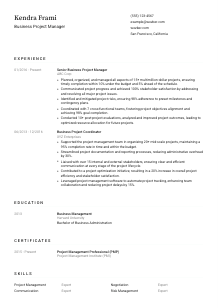
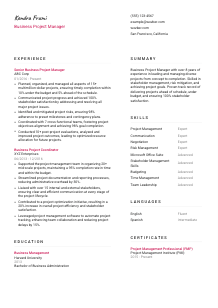
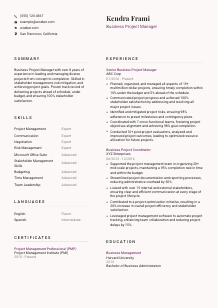
Orchestrating projects, but your resume feels out of sync? Check out this Business Project Manager resume example, created with Wozber free resume builder. Learn how to seamlessly harmonize your managerial expertise with job specifics, ensuring your career is always leading the right business beat!
Business Project Managers are trusted to keep moving parts under control when budgets tighten, timelines shift, and stakeholders want answers. A resume for this role has to show more than involvement in projects. It needs to make your planning discipline, cross-functional coordination, risk handling, and business judgment visible in a few quick scans.
When the resume is tailored well, hiring teams can quickly separate someone who tracked tasks from someone who actually drove delivery, managed scope, and kept stakeholders aligned. Wozber's free resume builder helps structure that story in an ATS-friendly resume format, so the first read surfaces the project outcomes, communication range, and execution standard that matter for a Business Project Manager.
This section is simple, but it still does real work. For a Business Project Manager, the header should immediately confirm who you are, what role you target, and whether basic requirements like location and contact access are already covered.
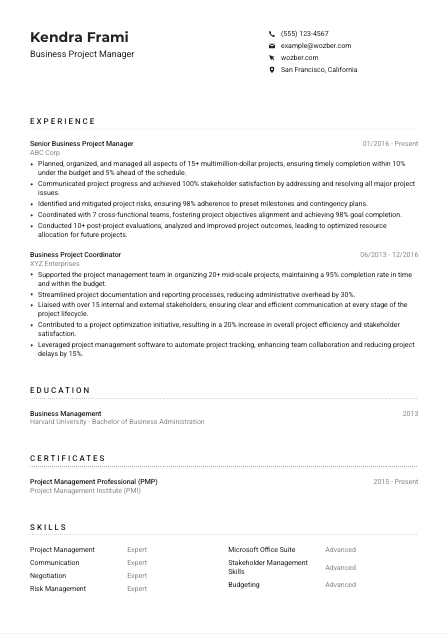
Use your full name as the clearest visual anchor on the page. Keep it larger than the body text and easy to read. Project management resumes often carry dense experience sections, so a clean header helps the document feel organized from the first line.
Place "Business Project Manager" beneath your name if that is the role you are pursuing. This keeps your positioning clear and aligns with the language used in the posting, which matters for both recruiter review and ATS matching.
List one reliable phone number and a professional email address. Business Project Managers are expected to communicate clearly with executives, vendors, and internal teams, so even small details like contact information should look polished and dependable.
If a role has a location requirement, reflect it plainly in your header. In this example, "San Francisco, California" helps confirm you meet a stated hiring condition without forcing the reader to hunt for it later.
Include LinkedIn or a personal professional website if it supports your candidacy. For this role, that profile should reinforce project scope, delivery results, certifications, and tools used across business initiatives. Make sure the content matches your resume dates and titles.
A clean header gives hiring teams the basics they need right away. For a Business Project Manager, that means clear identity, direct role alignment, reliable contact information, and any location detail the employer has asked to confirm.




This is the section most hiring teams read first for project management roles. They want to see whether you have owned delivery, handled risk, worked across functions, and produced business results rather than simply attended meetings or updated trackers.
Read the posting for the operating demands behind the title. Here, the employer is looking for someone who can manage projects within scope, time, and budget, communicate progress and issues, coordinate cross-functional teams, and run post-project evaluation. Those points should shape which roles, bullets, and achievements you emphasize first.
List roles in reverse chronological order with your job title, company name, and dates clearly shown. For Business Project Manager positions, progression matters. Titles such as Coordinator, Project Manager, and Senior Project Manager tell a story of growing ownership, larger budgets, and broader stakeholder responsibility.
Write bullets that show what you planned, who you coordinated, and what changed because of your work. Strong examples in this field include delivering initiatives ahead of schedule, improving milestone adherence, resolving major project issues, or aligning multiple teams around business goals. The sample resume does this well by showing ownership of multimillion-dollar projects and cross-functional delivery, not just participation.
Metrics carry extra weight in project management because delivery is measured. Use figures tied to budget performance, schedule variance, milestone completion, team count, project volume, stakeholder satisfaction, process efficiency, or delay reduction. Statements like "10% under budget" or "5% ahead of schedule" are much more useful than generic claims about success.
Choose experience that reinforces your ability to run business projects, communicate with stakeholders, manage risk, and improve outcomes. If an older bullet does not show planning, coordination, reporting, budgeting, or problem resolution, replace it with one that does. Every line should strengthen your case for project ownership.
The best experience sections make project leadership tangible. When your bullets show scope, pace, stakeholder range, and measurable delivery results, hiring teams can picture you running the next initiative instead of just supporting it.
Education usually plays a supporting role for experienced project managers, but it still matters when a posting names a degree requirement. Present it cleanly so the reviewer can confirm your academic background in seconds and move back to your delivery record.
If the employer asks for a bachelor's degree in Business Management, Project Management, or a related field, make that information easy to find. A degree such as a Bachelor of Business Administration in Business Management directly supports the requirement and should be listed without extra wording.
Use a simple structure: degree, field of study, school, and graduation year. That is enough for most Business Project Manager resumes and keeps the section easy to scan alongside more detailed experience and certification sections.
When your degree aligns with business operations, management, or project work, keep that field visible. It helps connect your formal training to the business-facing side of project management, where planning and execution need to support broader organizational goals.
If you are early in your career, selected coursework in operations, finance, business analysis, or project planning can help fill out your profile. If you already have 5+ years of experience managing projects, that space is usually better spent on delivery results and tools.
Honors, leadership roles, or major academic projects are worth listing only when they add something relevant, such as team leadership, process improvement, or structured business analysis. For more senior candidates, keep the section lean unless the achievement is particularly strong.
For this role, education should confirm that you meet the stated baseline and support your business credibility. Once that is clear, the rest of the resume can focus on how you manage projects in practice.
Project management certifications matter because they show formal command of planning frameworks, delivery discipline, and project governance. When a posting lists PMP as preferred, this section becomes a meaningful advantage rather than a minor add-on.
If the employer mentions PMP or an equivalent credential, list it clearly and exactly. For a Business Project Manager, that certification supports your credibility in scheduling, risk management, scope control, and stakeholder communication.
Lead with credentials that connect directly to project execution, governance, business analysis, agile delivery, or process improvement. Leave out unrelated certificates that do not strengthen your case for managing complex business initiatives.
Include the issue date and any active period if relevant. That helps the reader understand the credential's currency, especially for certifications that require maintenance. In the sample resume, the PMP entry signals both qualification and continued standing.
If you have continued training in project software, agile methods, change management, or reporting frameworks, include the most relevant items. Business Project Managers are often expected to improve delivery processes over time, so current learning can reinforce that point.
A well-chosen certification section adds professional weight fast. For Business Project Manager roles, it tells employers that your project approach is backed by recognized standards, not just on-the-job familiarity.
The skills section should mirror how the role is actually performed. For a Business Project Manager, that means balancing execution tools with people-facing strengths such as negotiation, reporting, and stakeholder communication.
Pull out the capabilities the employer names directly, then compare them with your real strengths. In this case, project management software, Microsoft Office Suite, communication, negotiation, and stakeholder management should all be considered for inclusion because they reflect daily operating needs.
Do not list only broad soft skills. Combine core project capabilities such as risk management, budgeting, scheduling, reporting, and project management software proficiency with communication and team leadership skills. That mix reflects the real work of coordinating delivery across business teams.
Prioritize the skills most likely to matter in screening and early interviews. A shorter, sharper list is better than a long inventory of generic abilities. The sample resume works because it keeps the section centered on project leadership, stakeholder management, budgeting, and related execution strengths rather than filling space with vague traits.
A useful skills section gives a quick picture of how you operate. For Business Project Manager roles, it should point to delivery control, business coordination, and the tools and communication habits that keep projects on track.
Language proficiency matters more when the role depends on clear reporting, stakeholder updates, and issue resolution across teams. For a Business Project Manager, communication quality is part of execution, so list languages in a way that is direct and credible.
If the posting explicitly requires fluent English, place English first and state your proficiency clearly. That reflects the role's need for status reporting, negotiation, and written communication that holds up in business settings.
List the language most important to the job first, then add others in descending order of usefulness. This keeps the section practical and ensures the employer sees the required communication capability right away.
Extra languages can strengthen your profile when projects involve diverse teams, external partners, or regional coordination. They are usually secondary to delivery experience, but they can still add value when clearly presented.
Choose standard labels such as Native, Fluent, Intermediate, or Basic. Business Project Managers often act as the communication bridge between groups, so overstating language ability can create problems later in interviews or on the job.
If a company works across regions or with multilingual stakeholders, language capability can support smoother meetings, clearer follow-up, and better relationship management. If not, keep the section concise and let project results stay in the foreground.
Language skills should support the picture your resume already builds. For this role, they are most valuable when they reinforce your ability to communicate clearly, manage stakeholder expectations, and keep work moving across teams.
Your summary should quickly establish scope, experience level, and the kind of outcomes you deliver. For a Business Project Manager, the best summaries combine project leadership with business impact, rather than relying on broad claims about being organized or results-driven.
Read the posting and identify the few themes that matter most. Here, those include project ownership, budget and schedule control, stakeholder communication, risk management, and cross-functional coordination. Those are better anchors for your summary than generic leadership language.
Start with a direct statement of who you are and how long you have worked in project management. A line such as "Business Project Manager with 8+ years of experience leading business initiatives from planning through post-project review" gives immediate context without wasting words.
Use achievements that reflect the metrics hiring teams expect in project roles, such as delivering ahead of schedule, staying under budget, improving efficiency, or maintaining strong stakeholder satisfaction. The sample summary is effective because it ties years of experience to schedule, budget, and stakeholder outcomes in one compact paragraph.
Aim for 3 to 5 lines with tight wording and role-relevant terms. Avoid filler adjectives and broad promises. The summary should prepare the reader for the experience section by showing the scale of projects you manage and the business results you influence.
A sharp summary helps the rest of the resume land faster. When it states your level, your project scope, and the results you consistently deliver, hiring teams can immediately place you in the Business Project Manager conversation.
A Business Project Manager resume should make one thing clear quickly: you can take ownership of a project, coordinate the right people, manage risk, and deliver against business goals. When each section supports that message with relevant detail, metrics, and role-specific language, the document becomes much easier to trust.
Use Wozber's free resume builder to shape that experience into an ATS-compliant resume, refine wording with its AI resume builder features, and check alignment with an ATS resume scanner before you apply. The final result should make your planning judgment, stakeholder management, and delivery record easy to recognize.




