



Use Wozber and land your dream job
Create Resume
No registration required
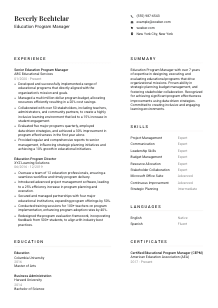
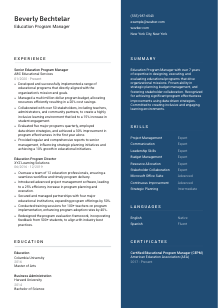
Shaping curriculums, but your resume feels like recess? Check out this Education Program Manager resume example, created with Wozber free resume builder. It shows how to present your instructional work to match job expectations, making your career journey as enlightening as opening a fresh textbook!
Education Program Managers sit at the point where instructional goals, operational planning, and stakeholder coordination meet. Hiring teams want to see that you can turn an educational vision into programs that launch on time, stay on budget, support educators and learners, and improve through measurable feedback. Your resume should make that management range visible early, not bury it under generic education language.
When your resume is tailored to the posting, it becomes much easier to distinguish program leadership from broader teaching or school administration experience. Wozber's free resume builder helps you align your wording with the role, keep an ATS-compliant resume structure, and surface the program outcomes, budget scope, and collaboration patterns that matter most for this kind of hire.
The top of the resume should read like a professional header, not an afterthought. For an Education Program Manager, this section needs to make you easy to contact, easy to place, and immediately aligned with the role you want.
Use your full name in the largest text on the page so it is instantly identifiable. Keep the presentation clean and professional, matching the leadership level of a role that involves program oversight, reporting, and cross-functional coordination.
Place "Education Program Manager" directly beneath your name when that is the role you are pursuing. This helps frame the rest of the resume around program development, budgeting, evaluation, and stakeholder leadership from the first line.
Include a phone number you answer regularly and a professional email address. Since this role depends on reliable communication with administrators, teachers, partners, and senior leadership, even small errors in contact details can undermine the impression of operational consistency.
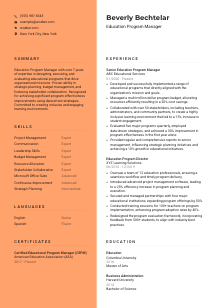
If the employer names a city or region, include your location clearly. In the example, listing New York City, New York immediately answers a posting-specific requirement and removes doubt about local availability. If you are relocating, say so plainly rather than leaving the employer to guess.
A LinkedIn profile or professional website can reinforce your credibility, especially if it reflects program launches, partnerships, reporting responsibilities, or education leadership milestones. Make sure the titles, dates, and accomplishments match your resume exactly.
This section is brief, but it does important work. A clear header tells the employer that you handle details carefully and already present yourself as someone ready to manage programs, people, and communication.




This section carries the most weight because Education Program Managers are hired on execution. Employers want to see programs built, budgets managed, stakeholders aligned, and results tracked over time.
Read the posting closely and mark the recurring responsibilities. For this role, the clearest priorities are program development, budget and resource management, stakeholder collaboration, program evaluation, and reporting to senior leadership. Those themes should shape which bullets you keep, rewrite, or move higher.
List your work in reverse chronological order and make sure the most relevant titles are easy to scan. Positions such as Education Program Manager, Program Director, Academic Program Lead, or comparable education leadership roles carry more weight here than earlier classroom or support roles unless those positions included real program scope.
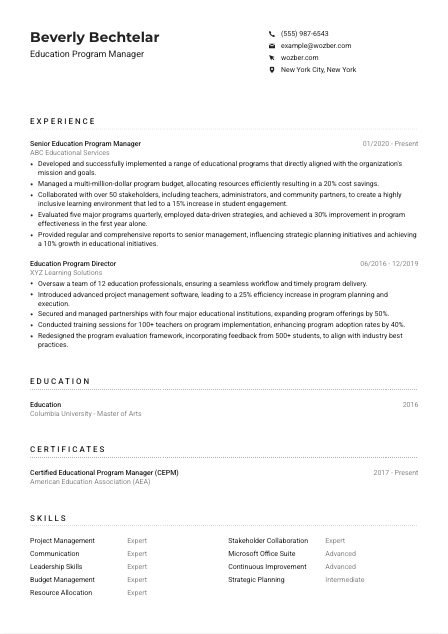
Each bullet should show what you built, improved, launched, or managed. The example does this well with statements about developing educational programs aligned to mission and collaborating with more than 50 stakeholders to strengthen the learning environment. That framing tells a hiring team far more than a generic line about being responsible for programs.
Education leadership is often measured through resource use, delivery efficiency, participation, adoption, and program results. Metrics such as a 20% cost savings, a 15% increase in student engagement, or quarterly evaluation across five major programs help the reader understand your management scope quickly. Use numbers that reflect real program impact, not filler percentages.
Prioritize experience that shows scheduling, staff coordination, feedback loops, training, partnerships, and strategic reporting. If a bullet does not support the role you want, cut it or rewrite it. Your goal is a focused record of educational program management, not a full archive of everything you have done in education.
A hiring team should finish this section with a clear picture of the programs you led, the resources you managed, and the outcomes you influenced. That is what turns experience into a credible case for the next role.
For this role, education is a baseline qualification, but the way you present it still matters. Degrees help confirm subject-matter grounding and can strengthen your position when the field aligns with education, business, administration, or program leadership.
Since the posting asks for a bachelor's degree in Education, Business, or a related field, make sure your degree title, field of study, and school are easy to find. In the example, a Bachelor of Science in Business Administration directly covers one part of that requirement.
Start with your highest completed degree and work backward. This keeps advanced study visible while preserving the credential the employer explicitly requested. A clean sequence also helps when hiring teams scan quickly for degree level and relevance.
If your degree is in Education, Business, Public Administration, Organizational Leadership, or a closely related field, let that relevance stand on its own. The sample resume pairs a Master of Arts in Education with a business-focused bachelor's, which is a useful illustration of both instructional and operational preparation.
You do not need to overload this section, but targeted academic detail can help early-career candidates. Coursework in curriculum design, educational leadership, program evaluation, budgeting, or organizational management can support your resume when direct program experience is still developing.
Academic honors, research, student leadership, or relevant volunteer initiatives can be worth including if they reflect planning, coordination, or education-focused leadership. Keep the emphasis on contributions that connect to program delivery or learning outcomes rather than general student activity.
This section should confirm that you meet the formal requirement and, where possible, reinforce your preparation for leading education initiatives. Relevance matters more than detail volume here.
Certifications are optional in many Education Program Manager searches, but they can still sharpen your profile. They are most useful when they support program leadership, education operations, evaluation, or continuous improvement.
If a certification is not required, do not force one in just to fill space. Instead, choose credentials that strengthen the employer's likely concerns, such as program oversight, education leadership, compliance, assessment, or structured project delivery.
List certifications that clearly relate to educational programming or management. The example uses "Certified Educational Program Manager (CEPM)," which works because it reinforces the exact type of leadership the resume is selling.
Add the year earned or the active date range when it helps the reader understand whether the credential is current. This is especially helpful for certifications tied to professional standards, training renewal, or ongoing membership-based recognition.
For education leaders, ongoing learning matters when standards, reporting expectations, instructional models, or technology platforms change. A current certification can suggest that you keep your methods current and stay engaged with the field beyond day-to-day program delivery.
A well-chosen certification adds weight when it connects directly to the work ahead. Keep this section concise and relevant, and let it support the larger story of program leadership.
Education Program Managers need a blend of operational, analytical, and people-facing skills. The best skill sections reflect the actual mechanics of the role, from planning and budgeting to collaboration and continuous improvement.
Start with the skills the employer named directly. Here, that includes project management software, Microsoft Office Suite, budget management, resource allocation, communication, interpersonal ability, and leadership. Mirroring the posting's language helps your resume stay aligned for both human review and ATS screening.
A useful skills section combines execution skills and leadership skills. Include competencies such as program planning, stakeholder collaboration, data-driven evaluation, strategic planning, teacher training, and inclusive learning environment development when they reflect your real background. The sample resume handles this well by pairing budget and resource management with collaboration and continuous improvement.
Group or order skills so the most job-relevant ones appear first. Do not crowd the section with broad claims that could apply to any office role. Skills should help the reader picture you running timelines, coordinating partners, reviewing program data, and presenting updates to senior management.
This list should reinforce the operational and leadership profile already established in your experience section. When the right skills appear in the right language, your resume reads as a closer match for education program management.
Language ability matters in education when programs involve diverse student populations, community engagement, or cross-functional collaboration. Even when only one language is required, this section can still help clarify communication readiness.
If the posting specifies language ability, list that language at the top. Here, English fluency is a stated requirement, so mark it clearly as "Native" or "Fluent" based on your actual level.
Additional languages can strengthen your profile when programs involve multilingual families, community partners, or broader outreach. In the example, Spanish adds practical value because it suggests stronger communication across diverse education settings.
Choose clear terms such as Native, Fluent, Advanced, Intermediate, or Basic. Avoid vague wording. Education roles rely on trust and communication, so accurate self-reporting matters.
Not every Education Program Manager role needs multiple languages, but some do benefit from them, especially in community-based programs, international education, or districts serving multilingual populations. Include languages when they genuinely expand your ability to collaborate or deliver programs effectively.
Language skills can support teacher training, family engagement, community partnerships, and inclusive communication practices. If a second language improves how you build relationships or deliver programming, it belongs on the resume.
Keep this section honest and practical. For Education Program Manager roles, language ability is most persuasive when it clearly supports stakeholder engagement and program delivery.
The summary sits at the top of the resume, so it should quickly establish your level, your area of responsibility, and the kind of outcomes you deliver. For Education Program Manager roles, that usually means connecting educational mission with execution, measurement, and leadership.
Use the posting to decide what belongs in these opening lines. For this position, the summary should reflect program design and implementation, budget and resource management, stakeholder collaboration, and data-informed improvement rather than broad statements about passion for education.
Start with a direct line that states your title or specialty and your experience level. The sample summary does this effectively by identifying more than 7 years in designing, executing, and evaluating educational programs, which immediately places the candidate in a credible leadership band.
Choose strengths that are central to the role and support them with substance. Budget management, strategic planning, stakeholder collaboration, and measurable gains in program effectiveness are all stronger than generic claims about being results-driven. A line about improving program effectiveness by 30% gives the summary real weight.
Aim for 3 to 5 lines that a hiring manager can absorb in seconds. Every phrase should earn its place by clarifying scope, leadership, or results. If a sentence could fit almost any education professional, sharpen it until it sounds specific to program management.
A well-written summary tells the reader, before they reach the first job entry, that you understand how to lead education programs from planning through evaluation. That early clarity helps the rest of the resume land faster.
An effective Education Program Manager resume shows more than commitment to learning. It demonstrates that you can build programs around organizational goals, manage budgets and resources responsibly, work across teachers, administrators, and partners, and use data to improve what is delivered.
Use Wozber's free resume builder to shape those strengths into an ATS-friendly resume format, refine language with role-specific terms, and check alignment with an ATS resume scanner before you apply. The final result should make it easy to judge your ability to lead educational initiatives with structure, collaboration, and measurable results.