



Use Wozber and land your dream job
Create Resume
No registration required
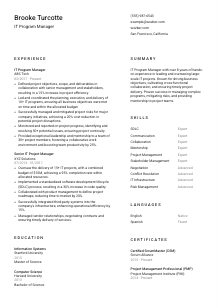
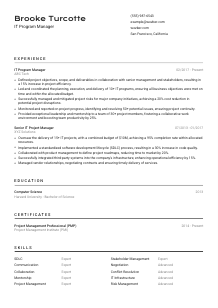
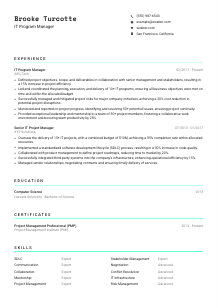
Orchestrating tech triumphs, but your resume seems lost in the code? Navigate this IT Program Manager resume example, created with Wozber free resume builder. Learn how to align your digital direction with job standards, paving the way for career advancement that always compiles successfully.
IT Program Managers are brought in when delivery gets complicated. Multiple teams, competing priorities, technical dependencies, vendor coordination, and executive expectations all have to move in the same direction without budget or timeline slipping. Your resume needs to show that you have managed that kind of operational load, not just that you have held project titles.
The first screen often separates candidates who have run isolated projects from those who have coordinated programs across infrastructure, integration, and SDLC workstreams. Wozber's free resume builder helps you shape an ATS-compliant resume around that distinction, so the language, structure, and priorities read clearly to both hiring teams and applicant tracking systems. That makes it easier to see your scope, delivery record, and leadership level early.
For an IT Program Manager, the header should confirm relevance fast and remove basic questions before the reader reaches your experience. Keep it clean, professional, and aligned with the role's practical requirements.
Put your full name at the top in a readable, professional format. Right below it, use the target title or a close match such as "IT Program Manager" so the role alignment is immediate. For senior technology delivery roles, this quick label matters because hiring teams often scan dozens of resumes looking for the right level of program ownership.
Include a current phone number and a professional email address. Keep both simple and credible. If a recruiter or hiring manager wants to discuss budget ownership, stakeholder leadership, or enterprise delivery scope, they should not hesitate because the basics look sloppy or outdated.
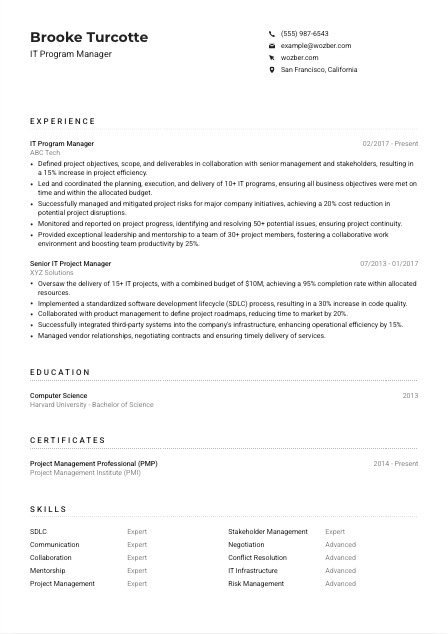
If the employer asks for a specific location, reflect that clearly in your header. Here, listing "San Francisco, California" directly supports a stated requirement and removes uncertainty around availability. Treat location this way when it is relevant to the posting, not as a universal rule for every IT Program Manager application.
Include LinkedIn or a personal site only if it reinforces your resume. For this profession, that might mean a profile showing large-scale program delivery, transformation work, infrastructure initiatives, vendor coordination, or PMO leadership. Make sure dates, titles, and major accomplishments match your resume exactly.
Skip extra personal details that do not support hiring decisions, such as full street address, headshot, or unrelated social links. In a senior IT resume, the header should do one job well: confirm who you are, where you are based if needed, and what role you are targeting.
When this section is done well, the reader can move straight into your program leadership background without pausing on logistics. That is exactly what you want at the top of an IT Program Manager resume.




This section carries the most weight for an IT Program Manager. Hiring teams want to see the scale of delivery you handled, the kind of technology environments you worked in, and whether you moved programs forward across stakeholders, risks, and constraints.
Start by identifying the delivery themes in the job description, then mirror them through your own history. For this role, that includes large-scale programs, cross-functional teams, senior stakeholder collaboration, risk management, and delivery against business objectives. Your bullets should make those patterns easy to spot instead of leaving them implied.
List roles in reverse chronological order and make the growth in your career visible. A move from project delivery into broader program leadership, multi-team coordination, or enterprise change management tells a stronger story than a flat list of similar duties. The example resume does this well by moving from Senior IT Project Manager into IT Program Manager with wider ownership.
Use metrics tied to program performance: number of programs delivered, budget size, completion rate, issue reduction, cost savings, time to market, team size, or productivity gains. Statements like leading 10+ IT programs, reducing disruption risk by 20%, or managing a $10M portfolio give the reader a concrete sense of scale and control.
Even at the program level, you need to show fluency in the work being coordinated. Mention areas such as IT infrastructure, systems integration, SDLC standardization, third-party platforms, or roadmap execution when they were part of your remit. That helps distinguish you from general operations managers who have delivery experience but not enough technical context.
Avoid generic lines like "responsible for project delivery." Instead, show what you defined, led, resolved, or improved. A bullet such as defining scope and deliverables with senior stakeholders and improving project efficiency by 15% shows governance, alignment, and results in one line. That is much stronger than a broad description of coordination duties.
By the end of your experience section, the reader should understand the size of programs you have run, the technical workstreams you have coordinated, and the business results you delivered. That is the core hiring question for this role.
Education matters here because the role sits close to technology delivery. A degree will rarely outweigh deep program experience, but it still helps establish your foundation in systems, software, and structured problem-solving.
If the posting asks for a bachelor's degree in Computer Science, Information Systems, or a related field, make that easy to find. List the degree, institution, field of study, and graduation year clearly. In the example, a Bachelor of Science in Computer Science directly matches the requirement.
Use a simple structure for every entry so the section scans quickly. Senior technology resumes do not need long academic descriptions unless a course, thesis, or project directly supports the target role. Clean formatting is enough to show the qualification without distracting from your delivery record.
If you also hold a master's degree or another advanced credential in a relevant area, include it when it supports your candidacy. A program-management-focused employer may view additional study in Information Systems, engineering, or business technology as a plus, especially for roles involving enterprise change or senior stakeholder engagement.
Early-career candidates can include relevant coursework, capstones, or technical projects tied to systems integration, software development, or infrastructure. For experienced IT Program Managers, those details usually matter less unless they clearly reinforce the kind of environment you now manage.
Honors, clubs, and extracurriculars are optional at this level. Include them only if they add something relevant, such as leadership, analytics, or technical depth. Once you have 8+ years in program or project management, your delivery history should remain the main story.
This section should confirm the technical and academic base behind your program leadership. It does not need to be long, but it should clearly satisfy the role's education requirement.
Certifications carry weight in program management when they sharpen your credibility around execution methods, governance, or agile delivery. They are especially useful when your target role involves large cross-functional programs and a mix of traditional and iterative workstreams.
Lead with credentials that hiring teams already associate with structured program execution, such as PMP, ScrumMaster, PRINCE2, SAFe, or similar frameworks that reflect how you run work. In the example, PMP and CSM both strengthen the case for someone managing complex IT initiatives across teams.
Do not crowd this section with every training course you have completed. A short list of certifications tied to project governance, agile delivery, risk control, or service management will land better than a long catalog of unrelated badges.
If a certification is current, renewable, or still valid, show that clearly. Dates signal that your knowledge is maintained, which matters in environments where delivery frameworks, agile practices, and compliance expectations evolve over time.
A current certification profile suggests that you keep your methods current as delivery models change. That can be particularly useful if the role spans infrastructure modernization, software teams, and external partners, where different governance approaches often intersect.
Relevant certifications help confirm that your program leadership is backed by recognized delivery practices. Keep the list focused and tied to the kind of IT work you actually manage.
This section should read like a concise map of how you operate as an IT Program Manager. The right mix includes technical delivery knowledge, governance capability, and the people skills required to move complex programs through conflict, dependency, and change.
Start with the skills you use in practice, then narrow them to the ones that matter most for the target role. For this job, that likely includes program management, stakeholder management, SDLC, risk management, IT infrastructure, systems integration, budgeting, vendor management, and reporting. The goal is a list that reflects actual program execution, not generic management language.
IT Program Managers need enough technical fluency to lead infrastructure and software initiatives credibly, plus strong communication to manage executives, engineers, vendors, and business teams. That is why skills like SDLC, integration, and infrastructure should sit alongside negotiation, conflict resolution, collaboration, and mentorship.
Place the most relevant capabilities near the top, especially those echoed in the posting. If the employer emphasizes cross-functional leadership and risk control, make those visible early. The example resume does this by foregrounding SDLC, stakeholder management, communication, mentorship, and risk management, which matches the role's core demands.
When this section is tailored well, it reinforces the exact mix of delivery discipline, technical context, and leadership range that the role requires. Every skill listed should connect back to work you can support elsewhere on the resume.
Language ability matters differently in program management than it does in many technical roles. You are often translating between executives, delivery teams, vendors, and business stakeholders, so clear communication can be a real operational advantage.
If the posting names a required language, list it clearly with an honest proficiency level. Here, English is essential, so placing it first and marking native or fluent proficiency addresses a stated hiring criterion right away.
Extra languages can strengthen your profile when programs involve distributed teams, offshore partners, regional stakeholders, or multinational vendors. They are not always required, but they can support cross-border coordination and smoother communication in complex delivery environments.
Choose direct terms such as Native, Fluent, Professional Working Proficiency, or Intermediate. Avoid vague descriptions. Hiring managers want to know whether you can run meetings, negotiate issues, or support documentation in that language.
Only include languages you can use with confidence in a business setting. Overstating proficiency can create problems quickly in a role that depends on accurate status updates, stakeholder alignment, and issue escalation.
If the role or company works across regions, language capability may deserve more prominence. If the work is entirely domestic, keep the section brief. In either case, tie language value back to delivery communication rather than treating it as a personal extra.
For IT Program Managers, language skills matter most when they improve coordination across teams and stakeholders. List them clearly, and let the level reflect what you can genuinely use on the job.
Your summary should quickly position you at the right level of responsibility. In this field, that means showing years of experience, the kind of programs you have led, and the business outcomes you are trusted to deliver.
Start with a direct line that names your role and tenure, such as "IT Program Manager with 8+ years of experience leading complex technology programs." This immediately aligns you with a posting that asks for extensive project or program management experience.
Pull in two or three of the role's main priorities, such as cross-functional leadership, IT infrastructure, systems integration, SDLC, stakeholder management, or on-time and on-budget delivery. The example summary does this effectively by combining large-scale project leadership, business objective alignment, and risk management.
A short summary gains credibility when it includes measurable context or a clear performance pattern. That might be delivering enterprise programs on schedule, improving project efficiency, reducing disruption risk, or leading large teams through complex implementation work.
Aim for three to five lines with no filler. Avoid broad claims like "results-driven professional" unless the next phrase proves it with actual program context. A hiring team should finish the summary already knowing your scale, technical environment, and leadership focus.
A well-written summary gives immediate context for everything that follows. For an IT Program Manager, it should quickly establish scope, technical grounding, and the kind of delivery results you are known for.
An effective IT Program Manager resume makes one thing clear fast: you can coordinate complex technology work across teams, stakeholders, and constraints without losing control of delivery. Every section should support that message, from the title at the top to the metrics in your experience bullets.
Use Wozber's AI resume builder to align your wording with the job description, sharpen ATS optimization, and present your background in an ATS-friendly resume format that reflects real program scope. When the tailoring is done well, hiring teams can quickly see whether you are ready to lead the kind of IT programs they need.