



Use Wozber and land your dream job
Create Resume
No registration required
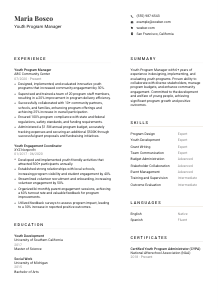
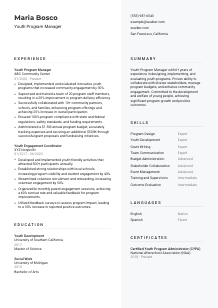
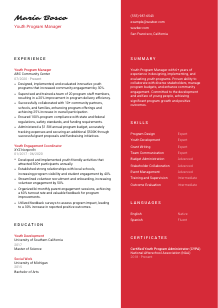
Shaping young minds, but your resume feels like a teenager's growth spurt? Check out this Youth Program Manager resume example, created with Wozber free resume builder. It shows how to articulate your impact and enthusiasm to align with job values, launching your career alongside the bright futures you cultivate!
Youth Program Managers are trusted with programs that must keep young people engaged, safe, and supported while still meeting community goals and funder expectations. Hiring teams look past broad statements about caring for youth. They want to see who has actually built age-appropriate programming, led staff or volunteers, handled families and school partnerships well, and kept delivery accountable through outcomes, compliance, and budget oversight.
A tailored resume changes how quickly that picture comes through. When your language reflects the posting's priorities, an ATS-compliant resume makes it easier to separate hands-on youth development leadership from adjacent nonprofit or education work. Wozber's free resume builder helps you line up your wording, structure, and ATS optimization with the role so reviewers can quickly recognize program scope, community impact, and management strength.
This section is simple, but it still carries practical weight. For a Youth Program Manager, clean contact details and the right location signal can remove friction early, especially when the role involves local community relationships, on-site leadership, or a stated city requirement.
Place your name at the top in a clear, readable format. Keep it slightly more prominent than the rest of the header so hiring teams can immediately connect your application, interview notes, and any follow-up communication. For community-facing roles, a polished header helps set a professional tone before they reach your program work.
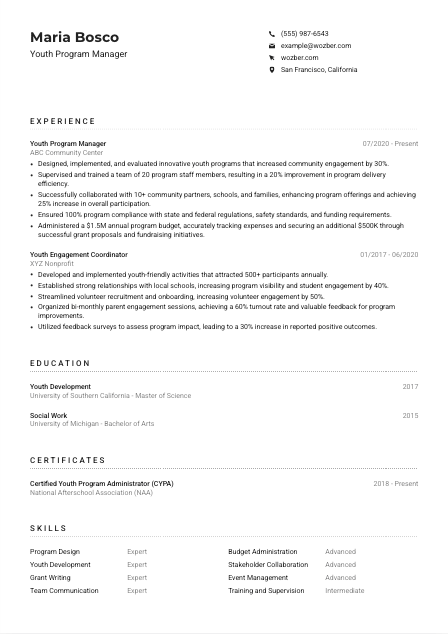
Put "Youth Program Manager" directly beneath your name if that is the role you are targeting. This keeps your positioning clear, especially if your background includes titles like Youth Engagement Coordinator, Program Lead, or Community Outreach Manager. In the example resume, using the target title helps bridge prior coordination work to current program leadership.
Include a reliable phone number and a professional email address. Double-check both. Youth-serving organizations often move quickly when scheduling panel interviews with directors, site leads, or HR, and a typo in your contact section can stall the process before your experience is even discussed.
If the posting asks for a specific location, show it clearly in your header. Here, listing "San Francisco, California" directly supports a stated requirement and helps avoid questions about relocation or local availability. Save the full street address for later paperwork. City and state are enough for the resume.
If you include LinkedIn or a professional website, make sure it reinforces your resume with consistent titles, dates, and program work. For this field, that profile can also support your credibility through community partnerships, speaking engagements, youth development initiatives, or board and volunteer leadership that fits the role.
Your header should answer the basic operational questions right away: who you are, how to reach you, and whether you match the role's stated location and title expectations.




This is where a Youth Program Manager resume earns attention. Employers need to see more than participation in youth services. They need proof that you have planned programs, guided staff, worked with families and partners, managed resources, and produced results that matter in community settings.
Read the posting closely and identify the working priorities behind it. For this role, that includes program design, supervision, community collaboration, compliance, budgeting, and funding support. Then shape your bullets so each major requirement appears through actual work you have done, rather than repeating the job ad word for word.
List positions in reverse chronological order and include your title, organization, and dates without clutter. That structure helps reviewers trace your progression from direct youth-facing work into management responsibility. In the example, moving from Youth Engagement Coordinator to Youth Program Manager makes that growth easy to understand.
Replace generic task language with action and result. "Managed youth programs" is far less persuasive than showing what you launched, improved, or evaluated. The sample does this well with bullets such as increasing community engagement by 30% and improving program delivery efficiency by 20%, which gives hiring teams a concrete sense of execution and scale.
Numbers work best when they reflect how youth programs are measured. Include participation growth, attendance, retention, survey outcomes, volunteer numbers, staff supervised, partner count, budget size, grant dollars raised, or compliance rates. A bullet about administering a $1.5M budget and securing an additional $500K in funding tells far more than a general claim about financial responsibility.
Prioritize experience tied to youth development, education, community services, or nonprofit program delivery. If you have broader experience, pull forward the parts that connect to age-appropriate programming, family engagement, staff training, safety practices, or reporting. Every bullet should help the reader picture you running a youth program, not just supporting one from the edges.
By the end of this section, your resume should make your management scope clear: the programs you ran, the people you led, the partners you worked with, and the outcomes you were trusted to deliver.
Education matters in this field because it gives context for how you understand adolescent development, community systems, learning environments, and supportive practice. Keep the section clean, but make sure it aligns with the degree background commonly requested for youth program leadership roles.
When a posting asks for a bachelor's degree in Youth Development, Education, Social Work, or a related field, make sure your degree is easy to find and clearly labeled. If your field is adjacent, use the exact formal major shown by your institution and let your experience reinforce the connection.
List degree, field of study, school, and graduation year in a consistent order. For Youth Program Manager roles, a straightforward layout works best because employers are usually checking qualification alignment quickly rather than looking for elaborate academic detail.
If you hold more than one degree, lead with the one that most directly supports the role. In the example, a Master of Science in Youth Development immediately strengthens alignment, while the Bachelor of Arts in Social Work reinforces a broader foundation in human services and support systems.
You do not need to list classes unless they sharpen your match. If you are earlier in your career, coursework in program evaluation, child and adolescent development, trauma-informed practice, education policy, or community-based intervention can help connect your academic background to the day-to-day demands of program management.
Academic honors, student leadership, or service work are worth mentioning when they point toward youth advocacy, mentoring, community outreach, or program coordination. Keep these additions concise. They should support your trajectory into youth programming, not distract from your professional experience.
Your education section should quickly confirm that your academic background supports the developmental, organizational, and community-facing work expected of a Youth Program Manager.
Certifications can add useful weight in youth-serving roles, especially when they reflect program administration, youth development standards, or current practice in safety and supervision. They are rarely the whole story, but they can reinforce that you take professional standards seriously.
If the employer asks for a relevant youth development certification, move yours into clear view. Here, a credential such as Certified Youth Program Administrator directly supports the role because it connects to program oversight, staff leadership, and quality standards in youth services.
Only include certifications that strengthen your case for this type of work. Youth development, program administration, safeguarding, trauma-informed care, CPR or first aid, and nonprofit management can all be relevant depending on the role. Skip certificates that do not connect to program delivery or leadership.
Include the year earned and, if relevant, the active period. That helps employers understand whether the credential is current. In regulated or grant-funded environments, an active certification can matter because it suggests current familiarity with standards, reporting expectations, or best practice guidance.
Youth programming evolves with new approaches in engagement, inclusion, mental health support, and outcome evaluation. Ongoing certification or professional development shows that your methods are not frozen in time. It also gives you stronger material for interviews when asked how you adapt programs to changing community needs.
Used well, certifications add another layer of confidence around your program leadership, youth development knowledge, and commitment to current practice.
A Youth Program Manager skills section should read like the toolkit behind your results. That means balancing relationship-driven work with operational capability. Hiring teams expect to see both the people side of youth programming and the management side that keeps programs funded, safe, and effective.
Start with the capabilities the employer has already prioritized. For this role, that includes program design, youth development, written and verbal communication, staff supervision, collaboration, budget administration, and evaluation. Mirroring that language helps both ATS matching and human review, as long as every skill reflects real experience.
Do not limit the section to soft skills. Include technical and operational strengths such as grant writing, outcome evaluation, expense tracking, volunteer training, partnership development, and compliance management alongside communication and relationship-building. The example skill list works because it covers both youth-centered programming and administrative responsibility.
A shorter list of role-specific skills is stronger than a long generic inventory. Choose the skills you can support through your experience bullets. If a hiring manager sees "Budget Administration" or "Training and Supervision" in your skills section, they should find matching proof in your work history right away.
Your skills should echo the daily reality of the job: designing programs, leading people, working across the community, and keeping the operation accountable.
Language ability can carry real value in youth programs, especially in communities where staff work closely with families, schools, and local partners. This section is usually short, but it can sharpen your profile when communication across cultures is part of the work.
If the posting names a language requirement, list it clearly. Here, English proficiency is required, so it should appear before any additional languages. That removes doubt for both ATS screening and human reviewers scanning for baseline communication readiness.
List the languages most useful to the community you serve first after the required one. In many youth programs, an additional language can support family engagement, parent meetings, outreach, and trust-building with partner organizations. The value comes from service delivery, not from listing languages for their own sake.
Choose clear levels such as Native, Fluent, Intermediate, or Basic. Youth-facing roles often involve live communication with families, staff, and community partners, so overstating ability can create real problems. Accurate labeling is more credible than inflated claims.
If you speak another language well, it can strengthen your candidacy in neighborhoods with multilingual families or culturally specific programming. In the example, Spanish adds practical value because it can support outreach, parent communication, and broader participation, though it is an added strength rather than a universal requirement.
Language development is worth maintaining when it supports the population you serve. Even modest improvement can help with relationship-building, youth engagement, and family communication, all of which matter in community-based program work.
Your language section should show whether you can meet required communication needs and whether you bring added capacity to serve diverse youth and families.
Your summary sits at the top of the resume, so it needs to do more than sound committed. For a Youth Program Manager, it should quickly establish management experience, program scope, and the kind of outcomes you have delivered for youth, staff, and the wider community.
Before writing, identify the few themes that define success in the target job. Here, those themes are engaging program design, staff leadership, partnership-building, budget oversight, and measurable youth outcomes. Build your summary around two or three of those ideas, not around broad passion statements.
Start with your title or professional identity, then state your years of experience and the kind of environments you have worked in. The sample summary opens well with "6+ years of experience" and immediately ties that experience to designing, implementing, and evaluating youth programs, which is exactly the kind of scope hiring teams want to see first.
Choose strengths that mirror the posting and have support elsewhere in the resume. Collaboration with schools and families, budget management, staff supervision, grant writing, or program evaluation all work when they are true to your background. This helps distinguish you from candidates whose experience is youth-adjacent but not management-level.
Aim for a short paragraph that reads cleanly and avoids vague mission language. A summary earns attention when it combines experience, program leadership, and results in plain terms. If possible, mention one outcome area such as community engagement, participation growth, or positive program results to make the opening sharper.
A well-written summary should make it easy to picture you leading youth programs from planning through delivery, partnership coordination, and measurable community impact.
A Youth Program Manager resume should show that you can build programming young people actually engage with, lead the adults who deliver it, and keep the operation aligned with budgets, compliance requirements, and community needs. When each section points back to those responsibilities, your experience reads with much more authority.
Use Wozber's free resume builder to shape that experience into an ATS-friendly resume template, then refine it with the ATS resume scanner so the final version stays closely aligned with the posting. The result should make one thing clear right away: you are ready to run youth programs with sound judgment, strong partnerships, and measurable outcomes.




