



Use Wozber and land your dream job
Create Resume
No registration required
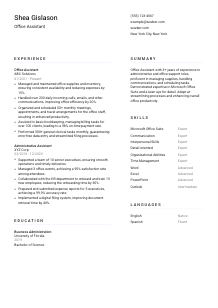
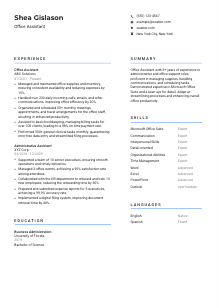
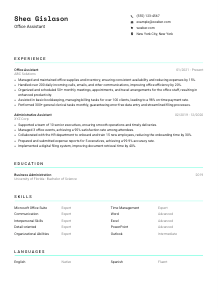
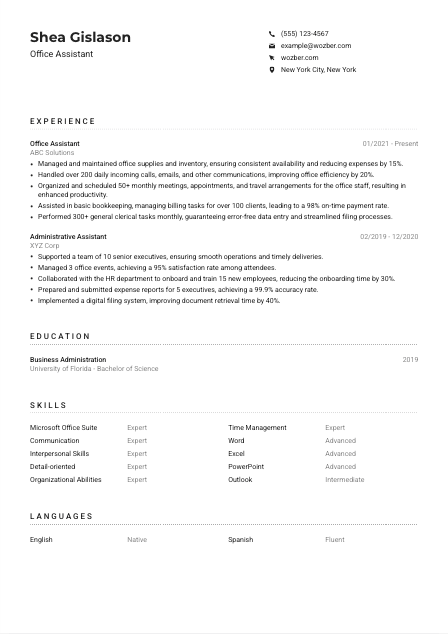
Juggling tasks like a one-person circus? Check out this Office Assistant resume example, built with Wozber free resume builder. It shows how to align your organizational prowess and multitasking might with any office's hit list, setting your career center stage!
Office Assistant work sits at the center of daily operations. When calls need answering, calendars shift, invoices need tracking, or supplies run low, this role keeps the office moving without drama or delay. That is why a resume for this position needs to show more than general helpfulness. It should make your coordination, follow-through, and administrative accuracy visible from the first section.
A tailored resume also helps separate true office support experience from broader customer service or entry-level admin backgrounds. Using Wozber's free resume builder to align your wording with the job ad and keep an ATS-compliant resume structure makes it easier to surface the right details first, such as scheduling volume, communication handling, bookkeeping support, and Microsoft Office fluency. That gives the employer a faster read on whether you can step into the office workflow with confidence.
For an Office Assistant, the top of the resume should feel orderly and dependable. This section does not need personality flourishes. It needs clean contact details, the right job title, and any practical information that removes friction for a hiring team reviewing administrative candidates.
Place your name at the top in a clear font and slightly larger size than the body text. Office support roles are built on clarity and organization, so even this small formatting choice should reflect that standard.
Add "Office Assistant" beneath your name when that is the role you are applying for. It creates immediate alignment with the posting and helps frame the rest of your resume around office coordination, communication handling, clerical support, and scheduling work rather than more general administration.
Include a reliable phone number, a professional email address, and your location. When a posting includes a location requirement, as this New York City opening does, matching it in your contact section removes an early question for the employer. Use the city and state only. Full street address is unnecessary.
If you have a LinkedIn profile or professional website, include it only when it supports your application with consistent job history, recommendations, or administrative accomplishments. For most Office Assistant candidates, a polished LinkedIn profile is enough.
Skip age, marital status, gender, photo, and other non-job-related details. Administrative hiring decisions should center on office support experience, software proficiency, communication, and reliability, not personal background.
This section should read like a well-run front desk. Clear, complete, and easy to act on. When the basics are handled neatly, the rest of your resume is already working in the right direction.




Hiring teams for Office Assistant roles look for evidence that you can handle recurring operational work accurately and without constant supervision. Your experience section should show how you supported office flow, managed administrative volume, and kept routine tasks from becoming problems.
Start by marking the responsibilities and tools that appear in the job ad. For this role, that includes managing office supplies, handling calls and emails, scheduling meetings and travel, assisting with billing, and performing clerical work. Your strongest bullets should mirror those functions where they match your real experience, using the employer's language naturally.
List roles in reverse chronological order with job title, employer name, and employment dates. That straightforward structure matters in administrative hiring because it quickly shows continuity, level of responsibility, and whether you have the two or more years of office support experience the employer prefers.
Office Assistant work can sound generic if you only list tasks. Show what changed because you handled them well. "Managed office supplies" becomes stronger when paired with a cost reduction, fewer stock issues, or smoother ordering. The example resume does this well by tying inventory management to a 15% expense reduction.
Metrics are especially useful in administrative resumes because they give scale to work that is otherwise easy to underrate. Calls handled per day, meetings scheduled per month, billing volume, retrieval time improvements, data entry accuracy, or payment timeliness are all relevant measures. In the sample, handling 200 daily communications and supporting billing for 100 clients gives a much clearer picture of capacity than a generic "assisted with communications" line ever could.
Prioritize accomplishments that show organization, responsiveness, discretion, and accuracy. If you also have experience in events, onboarding, or executive support, include it only when it strengthens your case for calendar management, document handling, vendor coordination, or internal communication. Every bullet should help the employer picture you running part of the office smoothly.
Your experience section should leave little doubt that you can manage the steady rhythm of office work. When your bullets show volume, tools, and operational outcomes, the role becomes much easier to picture in your hands.
Education usually plays a supporting role in Office Assistant hiring, but it still matters when the posting mentions a preferred degree. Present it clearly and let it reinforce your preparation for structured office work, business communication, and administrative processes.
If the employer asks for a bachelor's degree in Business Administration or a related field, list that qualification exactly. In the example, a Bachelor of Science in Business Administration lines up neatly with the posting and strengthens the application without needing extra explanation.
Include degree, field of study, school name, and graduation year or date. That is usually all an Office Assistant resume needs. Administrative resumes benefit from neat formatting everywhere, and the education section should follow the same standard.
Use the official title of your degree rather than paraphrasing it. If your background is adjacent, such as management, communications, or accounting support, list it accurately and let your experience section connect the dots to office operations.
Most experienced candidates can keep this section brief. If you are early in your career, relevant coursework in business communication, office administration, accounting, or information systems can help show familiarity with the kind of work the role involves.
Honors, leadership roles, or relevant campus office work can be worth mentioning when they support the story of organization, responsibility, or administrative support. Keep them concise so the section stays focused.
For this role, education should confirm preparation without taking over the resume. A clear degree entry, especially one aligned with business administration, adds credibility and lets your experience do the heavier lifting.
An Office Assistant skills section should read like a practical toolkit for keeping an office organized. Hiring teams want to see the software, communication habits, and coordination strengths that support daily administrative work, not a generic list of workplace traits.
Read the job description closely and separate technical skills from working-style skills. Here, Microsoft Office Suite is the clear technical requirement, while communication, interpersonal ability, attention to detail, and organization describe how the work gets done.
List skills that also appear in your experience bullets or summary. If you claim Excel, Outlook, scheduling, billing support, or data entry, the resume should show where you used them. The sample does this effectively by pairing Microsoft Office skills with measurable scheduling, communications, and bookkeeping achievements.
Choose the skills most relevant to running administrative workflows. Software such as Word, Excel, PowerPoint, and Outlook belongs here, along with organization, time management, written communication, call handling, filing, calendar coordination, and accuracy. A shorter, role-specific list is stronger than a long list of vague strengths.
A hiring manager should be able to glance at this section and understand how you would function in the office on day one. Lead with the tools and work habits that support scheduling, communication, recordkeeping, and dependable follow-through.
Language ability matters in Office Assistant roles when it affects communication with staff, clients, vendors, or visitors. Even when the role is primarily local, clear English communication is often essential because so much of the work involves calls, email, scheduling, and written follow-up.
If the posting states that English communication is required, list English prominently with an honest proficiency level. For office support work, that reflects more than conversation. It affects phone etiquette, email clarity, note taking, and accurate message handling.
Additional languages can be valuable when an office serves multilingual clients, vendors, or staff. In the example resume, Spanish adds useful range without distracting from the required English proficiency.
Terms such as Native, Fluent, Advanced, Intermediate, or Basic are usually enough. Avoid overstating ability. If you may need to answer calls, relay messages, or write emails in a language, your level should reflect that reality.
Some Office Assistant roles are heavily internal, while others involve front-desk interaction, cross-office coordination, or vendor communication. The more externally facing the job is, the more language skills can strengthen your value.
This section is strongest when it feels tied to office operations. Language ability can help with customer interaction, smoother coordination, and a better experience for people contacting the office, which is exactly where an assistant often shapes first impressions.
For an Office Assistant, language skills matter when they improve communication quality and response speed. Keep the section honest, relevant, and connected to the actual interactions the role handles.
The summary sets the tone for the rest of the resume. For an Office Assistant, it should quickly establish your level of experience, the administrative functions you handle well, and the tools or outcomes that make you useful in a busy office.
Before writing, identify the two or three biggest demands in the posting. Here, that means office support experience, Microsoft Office proficiency, communication handling, scheduling, and administrative accuracy. Your summary should bring those themes together in a compact way.
Lead with a direct statement such as "Office Assistant with 3+ years of experience" or the equivalent that accurately reflects your background. That opening works because it immediately places you in the right lane for the hiring team.
Follow with the areas where you contribute most, such as managing office supplies, coordinating calendars, handling high volumes of calls and email, supporting billing, or maintaining records. Mention core tools like Microsoft Office Suite when they are required. The example summary works because it stays close to these everyday office functions rather than drifting into generic claims.
Aim for 3 to 5 lines. You do not need to tell your whole story here. Focus on the combination of experience, tools, and operational strengths that best match the job. A concise summary is especially effective in administrative hiring because reviewers often scan for fit quickly.
A well-written summary should make the rest of the resume easier to read. When it names your experience level, core office functions, and key tools clearly, the employer can move into your work history already understanding the kind of support you provide.
A strong Office Assistant resume shows that you can keep communication moving, calendars organized, records accurate, and routine office tasks under control. When each section reinforces those strengths with clear examples and relevant tools, your application becomes much easier to trust.
Use Wozber's free resume builder to organize your content, tailor your wording to the posting, and produce an ATS-friendly resume format that highlights the administrative work you actually do well. The final result should make one thing clear quickly: you can step into the office and keep the day running smoothly.




