



Use Wozber and land your dream job
Create Resume
No registration required
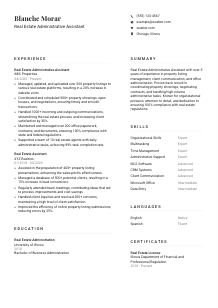
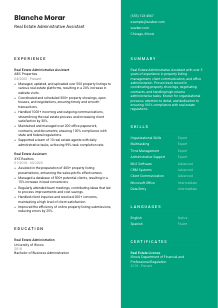
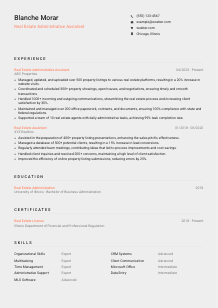
Organizing property particulars, but your resume feels like an open house with clusters of info? Check out this Real Estate Administrative Assistant resume example, created with Wozber free resume builder. Learn how to present your management skills and industry knowledge in a way that sets you up for a career of closing deals, not files!
Real estate administrative work runs on accuracy and follow-through. One missed showing update, one incomplete contract packet, or one outdated listing can slow a deal and create extra work for agents and clients. Your resume needs to make that operational reliability visible fast, especially through listing management, calendar coordination, client communication, and document control.
Hiring teams often scan first for whether you can keep transactions moving without dropping details. Using Wozber's free resume builder to tailor your wording and keep an ATS-compliant resume organized helps surface the terms that matter here, such as MLS, CRM systems, scheduling, compliance, and high-volume communication. That makes it easier to see that you can support agents, protect timelines, and keep real estate paperwork in order.
For this role, the header does more than identify you. It should immediately remove simple questions about title, location, and contact availability so the reader can move straight to your real estate experience.
Use your full name in the largest text on the page so it is easy to spot at a glance. Keep the styling clean and professional. Real estate support roles deal with client-facing communication and polished documents, so your formatting should already reflect that standard.
Place "Real Estate Administrative Assistant" directly below your name when that is the position you are pursuing. Matching the posted title helps frame your background correctly, especially when your earlier roles may have used nearby titles such as Real Estate Assistant or Office Coordinator.
Include a phone number you answer regularly and an email address that looks business-ready. If you add a website or LinkedIn profile, make sure it supports the application with relevant real estate experience, transaction support work, or software familiarity rather than unrelated content.
If a job specifies a local requirement, include your city and state in the header. In this example, listing Chicago, Illinois immediately answers a stated condition and avoids unnecessary doubt about availability or relocation.
A LinkedIn profile can strengthen your application when it echoes your resume with consistent dates, job titles, and real estate keywords. If it highlights listing coordination, client communication, or compliance-focused admin work, it becomes a useful extension of the resume rather than a placeholder link.
Your personal details should confirm that you are reachable, professionally presented, and aligned with any practical requirement the posting states. Once that is clear, the hiring manager can focus on whether you can keep listings, calendars, and paperwork under control.




This is the section that carries the most weight for a Real Estate Administrative Assistant. Employers want to see that you have supported agents, handled listing and client activity at pace, and kept documentation accurate while deadlines kept shifting.
Before rewriting bullets, mark the responsibilities that drive daily work. For this role, that includes uploading property listings, coordinating showings and open houses, managing calls and emails, maintaining contracts and paperwork, and supporting team calendars. Your experience section should mirror those functions using your own results and scope.
List positions in reverse chronological order with job title, company name, and dates. For administrative roles in real estate, this timeline helps the reader quickly track whether your experience is recent, continuous, and grounded in transaction support rather than general office work.
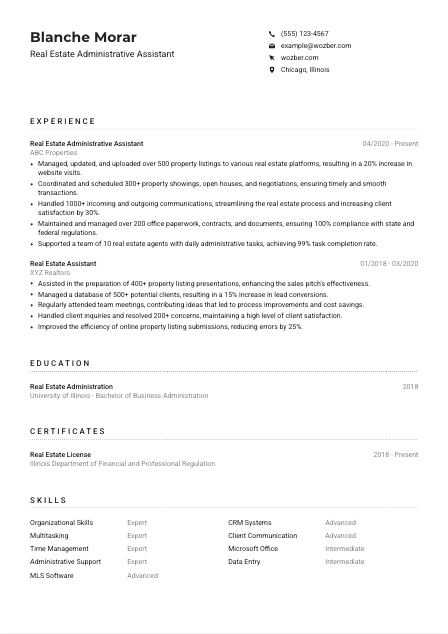
Generic bullets like "responsible for listings" do not say much. Stronger bullets show volume, pace, and outcome. The sample resume does this well with lines such as managing more than 500 listings and coordinating 300+ showings, which instantly tells the reader the candidate has handled active inventory and scheduling pressure.
Quantify work with metrics that fit the role: number of listings uploaded, showings scheduled, agents supported, documents processed, response volume handled, error reduction, lead conversion impact, or compliance rate. "Maintained 100% compliance" or "streamlined 1000+ communications" is far more persuasive than broad claims about being organized.
Prioritize experience that proves you can support a real estate office, agent team, or property workflow. If you include adjacent administrative work, frame it through transferable tasks such as calendar management, database accuracy, client correspondence, or deadline-driven documentation. The closer your bullets stay to listings, scheduling, CRM updates, and contract handling, the stronger your match will read.
After reading your experience section, a hiring manager should be able to picture you maintaining listings, coordinating appointments, handling client communication, and keeping transaction documents compliant without constant supervision. That is the standard this section needs to meet.
Education is usually not the deciding factor for this position, but it can still strengthen the application when it shows business, real estate, or administrative grounding. Keep it direct and relevant.
If you have a degree connected to business, real estate, office administration, or communications, make that easy to find. A degree such as Business Administration with a real estate focus, like the one in the example, supports the administrative and industry-specific side of the role even when the posting does not name a strict education requirement.
List your degree, field of study, school, and graduation year or date. For a support role where experience and software fluency matter most, the education section should be clean and fast to review rather than expanded with unnecessary detail.
If your coursework or degree title connects directly to property operations, business processes, records management, or customer service, let that relevance show clearly. You do not need to over-explain it. A precise field of study often does enough work on its own.
Relevant classes can help newer candidates or career changers, especially if they support skills used in real estate administration, such as contract basics, property management, business communications, or database systems. Skip course lists if you already have several years of directly related experience.
Honors, projects, or student leadership can be useful when they reinforce organization, client service, event coordination, or industry interest. Keep them only if they add something your work history does not already show.
This section should reinforce your professional foundation without competing with your experience. For most Real Estate Administrative Assistant applications, concise and relevant wins.
In real estate, credentials can carry practical weight, especially when a license is required by state rules or preferred for the market you are targeting. List certifications that directly support legal compliance, transaction support, or industry knowledge.
Start with certifications or licenses that matter to real estate operations. If a posting mentions a real estate license, list it clearly with the issuing authority. In the example, the Illinois license immediately answers a stated requirement and shows the candidate understands the local regulatory environment.
You do not need every course completion or webinar badge. Prioritize credentials that support listing administration, transaction coordination, compliance, property knowledge, or office systems used in real estate work.
Include issue dates, renewal periods, or active status when relevant. This matters most for licenses and regulated credentials because employers need to know whether you can legally support parts of the transaction process now, not at some point in the past.
If you pursue additional training, choose programs that improve the actual work of the role, such as transaction management, fair housing compliance, contract administration, CRM use, or client communication. Ongoing learning is strongest when it clearly supports day-to-day office and transaction demands.
A focused certificates section tells the employer that you meet any required licensing standard and stay current on the rules and tools behind real estate administration. That matters more than a long list of unrelated credentials.
The best skills sections for this role read like the toolkit of someone who can keep listings accurate, agents organized, and clients informed. Balance software knowledge with the coordination and communication skills that make a real estate office run smoothly.
Pull out the specific capabilities the employer asked for, then match them with your real strengths. Here, MLS proficiency, CRM systems, organization, multitasking, deadline management, and communication should all appear if you have them. That gives both recruiters and ATS screening a clear connection to the role.
Lead with the tools and strengths that affect daily performance. For a Real Estate Administrative Assistant, that usually means MLS platforms, CRM systems, administrative support, calendar coordination, document handling, client communication, and time management before broader office software.
A shorter list of relevant skills is stronger than a long inventory of generic abilities. The sample resume stays close to the work by listing MLS software, CRM systems, data entry, organizational skills, and client communication. That mix tells the reader the candidate can manage both systems and service interactions.
When this section is tailored well, it reads like the operating toolkit of someone who can handle listings, paperwork, scheduling, and client contact in a busy real estate environment. That is exactly how you want it to land.
Language ability matters most in this role when it affects client communication, office coordination, and clarity in written correspondence. Present it as a practical business skill, not a decorative extra.
If the posting requires proficient English, list English prominently with an honest proficiency level. For a role built around calls, emails, scheduling, and document handling, strong written and spoken English is part of daily execution, not just a checkbox.
List languages in descending proficiency, starting with the one required for the role. Additional languages can be especially helpful in markets where agents serve diverse buyers, sellers, tenants, or investors.
Choose straightforward labels such as Native, Fluent, Advanced, Intermediate, or Basic. Real estate offices need realistic expectations when assigning client communication, appointment coordination, or front-desk coverage.
A second language is most compelling when it improves communication with clients and vendors or supports a local market. In the example, Spanish adds practical value because it can widen client access and strengthen day-to-day communication in a busy office.
Do not overstate your ability. If you would be comfortable answering calls, replying to client messages, or helping with simple scheduling in that language, it belongs here. If not, leave it off.
For this profession, languages matter when they help you communicate clearly, support clients smoothly, and keep office activity moving. Present them with the same precision you would bring to listings or contracts.
Your summary should quickly establish the kind of administrative support you provide in a real estate setting. Focus on transaction flow, listing accuracy, client communication, and the pace or volume you can handle.
Start with your title or closest equivalent and your years of relevant experience. For example, "Real Estate Administrative Assistant with 5+ years of experience" immediately places you in the right lane and signals that your background is already tied to real estate operations.
Follow with two or three high-value responsibilities that match the target job, such as managing listings, coordinating showings, maintaining documents, supporting agents, or handling client communication. The sample summary works because it stays close to the actual workflow of the role instead of drifting into vague claims.
Aim for a short paragraph that can be read in seconds. Three to five lines is enough to cover your experience level, your core strengths, and one point of measurable or operational value, such as high-volume coordination, compliance accuracy, or multi-agent support.
Skip generic enthusiasm and use concrete language that reflects how you work. Phrases tied to deadlines, compliance, transaction support, and client service sound more credible in this field than broad statements about passion or dedication.
A well-written summary should tell the reader, almost immediately, that you understand the pace and precision of real estate administration. If those first lines make your listing work, communication volume, and document control clear, the rest of the resume has a strong foundation.
A Real Estate Administrative Assistant resume works best when it shows how you support the business behind the sale: accurate listings, organized calendars, responsive communication, and compliant paperwork. When each section reflects that day-to-day reality, your application reads as someone who can step into an active office and keep agents productive.
Use Wozber to sharpen that alignment from top to bottom. Wozber's AI resume builder, ATS resume scanner, and ATS-friendly resume format help you match your experience to the posting with the right terminology, stronger phrasing, and cleaner structure. The result is a resume that makes your readiness for real estate administration easier to recognize.




