



Use Wozber and land your dream job
Create Resume
No registration required
Dialing prospects, but your resume keeps getting a busy signal? Pick up this Telemarketer resume example, created with Wozber free resume builder. Learn how to pitch your sales chatter to match job requirements, making your career reach new call resolution heights!
Telemarketing resumes work best when they show what happens after the dial tone: how many calls you handle, how you qualify interest, how you move hesitant prospects toward a next step, and whether you can keep performance steady in a high-volume sales environment. Hiring teams want to see a clear record of persuasive phone work, disciplined follow-up, and the kind of product knowledge that turns a script into a real conversation with a decision-maker.
A targeted resume also helps separate general customer service experience from true outbound sales performance. Using Wozber's free resume builder to shape an ATS-compliant resume makes it easier to match the posting's language around CRM updates, sales targets, and telephone communication, so your background reads as telemarketing experience rather than broad support work.
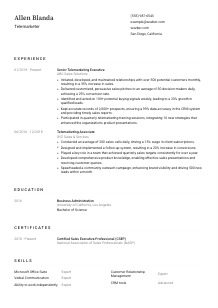
For telemarketing roles, the top of the resume should feel businesslike and easy to act on. This section does not need personality flourishes. It needs clean contact information, a job title that matches the role, and any location detail that removes friction for a fast-moving sales hire.
Use your full name as the most visible text on the page. Keep the formatting simple and professional so the hiring manager can identify you quickly before moving into your call-based sales background.
Place "Telemarketer" directly below your name when that is the role you are pursuing. Matching the job title helps frame the rest of the resume around outbound calling, lead qualification, follow-up activity, and sales conversion rather than general sales or service work.
Include a reliable phone number and a professional email address. For a phone-heavy job, this matters more than usual. If your voicemail greeting is unclear or your email looks casual, fix that before you apply.
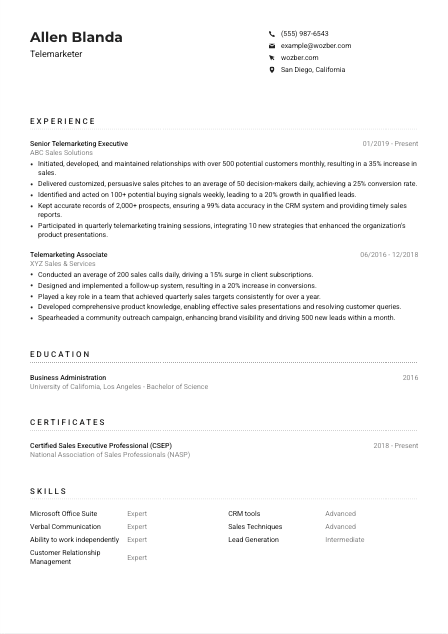
If the employer requires candidates to be based in a specific area, include that city and state in your personal details. In the example, listing "San Diego, California" directly supports a stated requirement without forcing the reader to guess about relocation.
A LinkedIn profile can be useful if it supports your sales history with matching dates, recommendations, or additional context on lead generation and client outreach. Skip personal links that do not strengthen your case for a call-centered sales role.
These details should answer the practical questions first: who you are, how to reach you, whether you are applying for the right role, and whether location is already covered. That keeps the reader focused on your sales track record.




This is the section hiring managers will read hardest. Telemarketing employers are looking for volume, consistency, conversion, CRM discipline, and the ability to keep momentum without constant supervision. Your bullets should show how you worked the phone, what kind of prospects you reached, and what business results followed.
Mark the duties and requirements that define daily performance. In this posting, that includes building relationships by phone, delivering persuasive pitches, spotting buying signals, scheduling follow-ups, updating CRM records, and hitting sales targets. Those points should shape which achievements you feature first.
List jobs in reverse chronological order with title, company, and dates. For telemarketing roles, clear progression matters. A move from associate-level calling to a senior telemarketing or inside sales position can show stronger quotas, more complex prospecting, or greater ownership of follow-up pipelines.
Focus each bullet on work that sounds native to outbound sales. Good verbs here include initiated, qualified, converted, scheduled, updated, and closed. The example does this well with lines about maintaining relationships with more than 500 potential customers monthly and delivering customized pitches to 50 decision-makers a day. Those details immediately connect to the work described in the posting.
Telemarketing resumes benefit from metrics that hiring teams actually use: call volume, conversion rate, qualified leads, meetings booked, subscription growth, CRM accuracy, or quota attainment. Numbers such as "200 sales calls daily," "25% conversion rate," or "99% data accuracy" are more convincing than general claims about being results-driven.
Keep the spotlight on outreach, persuasion, follow-up, product knowledge, and record keeping. If an accomplishment does not help prove your ability to perform in a fast-paced phone sales environment, trim it or rewrite it so the sales outcome is clear. Even broader work, like outreach campaigns, should tie back to leads, pipeline growth, or revenue impact.
After reading your experience section, the employer should be able to picture your pace on the phone, your comfort speaking with buyers, and your habit of turning activity into measurable sales results. That is the standard this section needs to meet.
Education usually plays a supporting role for telemarketing positions, but it still helps when it adds business context, communication training, or evidence of discipline. Keep it concise and let it support the sales story instead of competing with your experience.
List your degree or diploma, school, and graduation year if appropriate. Telemarketing roles often prioritize sales performance over formal education, but a completed program still adds credibility and shows follow-through.
Present your education in a straightforward structure so it is easy to read in seconds. Degree, field of study, institution, and year are usually enough. The sample's Bachelor of Science in Business Administration is a good example of relevant but compact presentation.
If your coursework or field of study connects to sales, marketing, communication, or customer behavior, make that visible. A business-related degree can reinforce your understanding of buyer needs, market positioning, and commercial conversations.
If you do not yet have much telemarketing experience, use education to show speaking, persuasion, or commercial exposure. Student organizations, sales competitions, marketing projects, or customer-facing internships can help bridge that gap.
If you have completed sales workshops, CRM training, or product-focused courses, decide whether they fit better here or in the certificates section. Use whichever placement keeps your resume easier to scan and makes your professional development visible.
Education should reinforce your commercial foundation without taking attention away from call performance and sales outcomes. Keep it tidy and relevant.
Certificates can help in telemarketing when they point to real sales training, structured development, or familiarity with recognized sales standards. They are especially useful when the job posting names a credential directly or mentions ongoing training as part of the role.
When a job ad calls out a certificate, treat that as a tailoring opportunity. Here, familiarity with the CSEP credential is listed as a plus, so anyone who has earned it or is actively pursuing it should include it clearly.
Choose certifications that support phone selling, lead management, negotiation, CRM use, or account development. A certificate should strengthen your case for handling prospect conversations and sales workflow, not just fill space.
Include the completion date or indicate that the credential is current when relevant. In the example, showing CSEP with an active date range gives the employer a quick sense of continued professional standing.
Telemarketing changes with scripts, buyer behavior, product positioning, and CRM processes. If you have recent coursework in sales techniques, prospecting, objection handling, or software tools, include it to show that your approach is current rather than outdated.
This section works best when it shows that your sales skills are being sharpened on purpose. A relevant credential can support your phone experience and make your professional development easier to trust at a glance.
The skills section should read like the toolkit behind your call results. For telemarketing, that means a mix of phone communication, sales execution, software fluency, and self-management. Keep it focused on the abilities that directly support prospecting, CRM discipline, and target attainment.
Use the job description to identify the exact skills worth featuring. In this case, that includes CRM tools, Microsoft Office Suite, verbal communication, independent work, and consistent sales performance. Those terms help align your resume with both the hiring manager's expectations and ATS screening.
List tools and capabilities that support daily telemarketing work. CRM proficiency matters because accurate records, follow-up timing, and pipeline visibility all depend on it. Communication matters because your value is delivered through live conversations, objections, and closing language. The example balances both by pairing software skills with verbal communication and sales techniques.
Skip vague entries that could appear on any resume unless they are tied to the role's core work. Prioritize skills such as lead generation, objection handling, call scripting, qualification, CRM data management, and meeting sales targets over generic labels that say little about how you actually perform.
Your skills list should support the experience section, not repeat it word for word. When chosen well, it confirms that you have both the phone presence and the systems discipline needed to perform in a target-driven sales seat.
Language ability matters more in telemarketing than in many office roles because every conversation depends on clarity, pace, listening, and trust. If the job requires a specific language or your market includes multilingual prospects, this section can strengthen your application quickly.
If the posting requires English, list it clearly with an honest proficiency level. For this role, English competency is mandatory, so it should appear before any secondary languages.
List the languages most relevant to the customer base first and state your level for each one. In some markets, Spanish can be especially valuable for outbound sales and follow-up calls, so including it can widen your appeal when it reflects real working ability.
Extra languages can be worth listing if they help you speak with more prospects, support regional campaigns, or build rapport with a broader customer mix. Keep the focus on practical communication value rather than just variety.
Do not overstate your level. In telemarketing, language gaps show up fast during live calls. Use terms such as Native, Fluent, Conversational, or Basic only if they reflect what you can actually handle in a sales conversation.
If your background includes calling across regions, supporting diverse neighborhoods, or working multilingual lead lists, make that clear elsewhere in the resume as well. The language section is strongest when it supports a real outreach context.
For a role built on spoken interaction, language skills can directly affect reach, rapport, and conversion. List them only when they are real and usable on the phone.
Your summary should read like the top line of a sales profile. In a few sentences, show your years of experience, the kind of environment you have worked in, and the results or strengths that matter most for outbound calling and lead conversion. Keep it direct and specific.
Before writing, identify the two or three qualities the employer cares about most. Here, that is likely phone-based sales experience, persuasive verbal communication, CRM use, and the ability to meet targets independently. Those themes should shape every line.
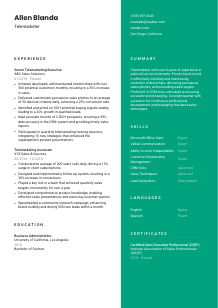
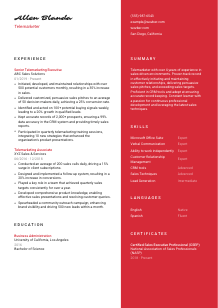
Start with a clear statement of who you are and how long you have worked in relevant sales settings. The example summary opens with "Telemarketer with over 4 years of experience in sales-driven environments," which immediately places the candidate in the right category.
Choose a few strengths that map directly to the role, such as building prospect relationships, delivering customized pitches, managing follow-up activity, and keeping CRM records accurate. These points work better than broad descriptors because they reflect actual workflow.
Aim for a short paragraph that can be read in one pass. Three to five lines is enough to establish your phone sales background, highlight your strongest value, and set up the more detailed metrics in the experience section.
By the end of the summary, the reader should already understand your level, your sales environment, and the kind of results you are used to producing on the phone. If that is clear, the rest of the resume has a strong opening.
A telemarketer resume works when it makes your sales process visible: the volume you handle, the quality of your conversations, the discipline of your follow-up, and the results you deliver in CRM-tracked environments. Each section should support that picture.
Use Wozber's free resume builder to turn that experience into an ATS-friendly resume format that reflects the language of the job posting without losing the specifics of your own sales record. When the resume is tailored well, hiring teams can quickly see that you can speak with prospects confidently, manage pipeline activity, and produce consistent targets-driven results.




