



Use Wozber and land your dream job
Create Resume
No registration required
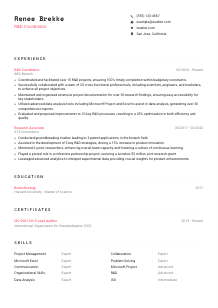
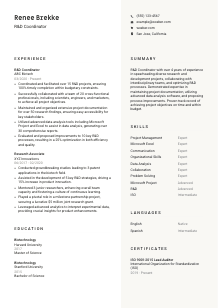
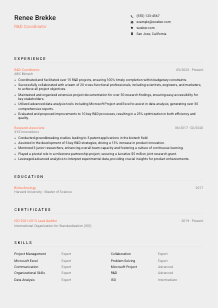
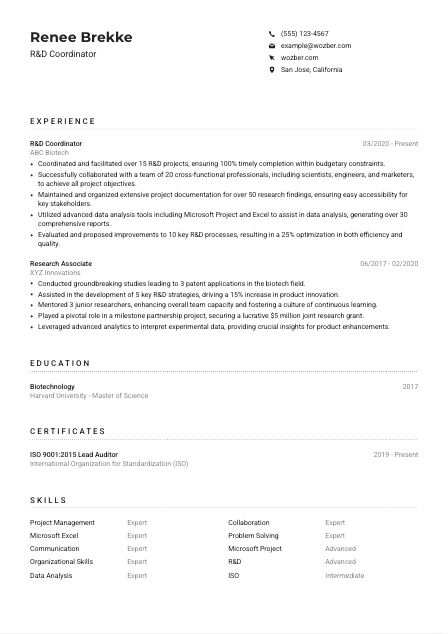
Juggling research breakthroughs, but your resume seems uncharted? Check out this R&D Coordinator resume example, created with Wozber free resume builder. It shows how to map your coordination proficiencies to match job blueprints, putting your career on the innovation expressway!
R&D coordination sits where research timelines, technical teams, and operational discipline meet. Hiring teams want to see that you can keep projects moving, maintain clean documentation, support data-driven reporting, and improve how work gets done when scientists, engineers, and business partners all need different things from the same project.
That becomes much easier to show when your resume is tailored to the posting's language and priorities. Wozber's free resume builder helps structure an ATS-compliant resume around the work that matters most, so project tracking, reporting, process improvement, and cross-functional coordination are immediately visible instead of buried in generic research experience.
For an R&D Coordinator, the header should read like a clean project record: accurate, current, and easy to act on. Keep this section simple, professional, and aligned with any practical filters in the job ad.
Use your full name as the most visible text in the header so it is easy to find in a recruiter inbox, ATS record, or interview schedule. A clean presentation works best for coordination roles where precision and professionalism matter.
Place "R&D Coordinator" beneath your name when that is the role you are pursuing. It immediately connects your profile to the opening and helps frame the rest of your resume around project coordination, reporting, and research support rather than broader lab or analyst work.
List a phone number you answer reliably and a professional email address you check often. R&D hiring often moves through interview rounds with technical and cross-functional stakeholders, so missed messages can slow the process.
If the employer specifies a city or on-site requirement, include your location clearly in the header. In this example, listing San Jose, California helps remove doubt around local availability for a role that requires presence in that market.
Include a LinkedIn profile or professional site if it supports your resume with publications, project work, certifications, or career history. Make sure the content matches your resume, especially titles, dates, and technical focus.
Skip details such as age, marital status, gender, or a full street address unless they are specifically requested. For this role, hiring value comes from your coordination background, reporting skills, software proficiency, and quality-minded project support.
A clean personal details section removes friction at the start. It should confirm who you are, how to reach you, and, when relevant, that you meet practical requirements such as location for the role.




This section carries the most weight for an R&D Coordinator because the role is built around execution. Your bullets should show how you kept projects on schedule, worked across functions, handled documentation, supported analysis, and improved processes without losing sight of budget or quality standards.
Start by identifying the work patterns in the posting. For this role, that includes coordinating R&D projects, collaborating with scientists and engineers, organizing research records, assisting with data analysis, and improving process efficiency. Shape your bullets around those functions so your experience reads as directly transferable.
List your roles from most recent to oldest and make each entry easy to scan. Include job title, employer, and dates so reviewers can quickly understand your level of responsibility and whether your background leans more toward coordination, research support, or hands-on scientific work.
Each role should show what changed because of your work. Good R&D Coordinator bullets often cover delivery against deadlines, budget discipline, reporting output, document control, process improvements, and coordination across technical and commercial teams. The sample resume does this well by showing completed projects, report volume, and documented process gains instead of only saying "responsible for coordination."
Numbers help hiring teams judge scope quickly. Use metrics that fit the job, such as number of projects coordinated, size of cross-functional team, reports produced, records maintained, budget adherence, turnaround time, or efficiency improvements. In the example, "15 R&D projects," "20 cross-functional professionals," and a "25% optimization" give a much clearer picture of capability than broad claims alone.
Trim bullets that do not strengthen your case for R&D coordination. If you have pure research, lab, or analyst experience, keep the parts that connect to project execution, documentation, reporting, process improvement, stakeholder coordination, or quality standards. Relevance matters more than giving equal space to every past responsibility.
A hiring manager should be able to scan this section and understand your project scope, coordination style, and operating discipline. When your bullets show timelines, collaboration, reporting, and process results, your experience reads like someone ready to support active R&D programs from day one.
Education matters here because the role sits close to scientific and engineering teams. Your degree section should confirm that you have the technical foundation to follow research work, communicate with specialists, and keep project activity organized in a credible way.
Check the posting for the minimum academic requirement and make sure it is easy to find. Here, a bachelor's degree in science, engineering, or a related field is the baseline, so that information should appear clearly without forcing the reader to search for it.
List each entry with degree, field, institution, and, if useful, graduation year. Keep the structure consistent so the section is easy to scan. For technical coordination roles, clarity matters more than decorative formatting.
If you are earlier in your career, relevant coursework, capstone projects, or research projects can help bridge the gap to professional experience. Focus on material tied to experimental design, data analysis, quality systems, product development, or project coordination rather than listing every academic detail.
Honors, research recognition, or specialized academic training are worth adding when they reinforce the role's technical demands. For example, a thesis, lab research award, or coursework tied to quality systems can add useful context for R&D-facing positions.
If you already have several years in R&D or project coordination, your education section can stay brief. If you are transitioning from academia or building your first coordination-focused resume, give a little more space to the academic work that shows organization, analysis, and collaboration in technical settings.
This section does not need to do all the persuasive work, but it should clearly support your credibility. A relevant degree tells employers you can operate comfortably in research-focused environments and communicate with the teams driving the work.
Certifications are especially useful in R&D settings when they reinforce process discipline, quality awareness, or structured project work. They are not always required, but the right one can strengthen your profile quickly.
Even when a job description does not list a mandatory certification, it may point to areas where a credential helps. In this case, familiarity with ISO or quality control standards makes certifications tied to quality systems more relevant than unrelated learning badges.
List certifications that support the actual work of the role, such as ISO standards, quality auditing, project management, regulated documentation, or process improvement. The sample's ISO 9001:2015 Lead Auditor credential is a strong illustration because it directly supports quality-minded R&D coordination.
Show when the certification was earned and, if applicable, whether it is active. That helps employers understand whether your knowledge is current, especially for standards-based or compliance-linked credentials.
If you want to move deeper into R&D operations, quality systems, or program coordination, pursue certifications that support those paths. A targeted certificate can strengthen your resume when it reflects the workflows you actually manage, not just general professional development.
The best certifications for this role add practical value to your story. They show that you understand structured work, controlled documentation, and quality expectations that often sit alongside research delivery.
An R&D Coordinator skills section should reflect how the work gets done. That means combining project tools, analysis capability, documentation discipline, and communication skills that help technical teams stay aligned and projects stay on track.
Read the job description closely and extract both software and workflow skills. For this role, that includes project management, Excel, Microsoft Project, data analysis, communication, organization, and familiarity with ISO or quality control standards.
Put the skills closest to daily execution first. For an R&D Coordinator, project tracking, data handling, documentation, and cross-functional collaboration should usually appear before broader traits like problem solving. The example skill list works well because it gives priority to project management, Excel, organizational ability, and data analysis.
Use a format that lets hiring teams and ATS software identify key terms quickly. Grouping highly relevant tools and capabilities in a simple list improves ATS optimization and helps reviewers immediately connect your background to the role's operating needs.
This section should read like the working toolkit behind your experience. When the right tools and coordination strengths appear in the right order, employers can quickly picture how you would support timelines, reporting, and cross-functional execution.
R&D coordination depends on clear communication because project updates, research notes, reporting, and stakeholder follow-up all rely on precise language. Include languages here when they support the communication demands of the role.
If the posting specifies language proficiency, list it clearly and use an accurate level. This role calls for strong verbal and written English, so English should appear prominently in the section.
Lead with the language most relevant to reporting, meetings, and written documentation. In many R&D environments, that means English first because project records, management reports, and cross-functional communication depend on it.
Additional languages are helpful when they are real working skills and can support broader team communication, vendor interaction, or international collaboration. They are a useful extra, but they should not overshadow the language required to do the core job well.
Choose labels that communicate your ability honestly so employers can judge how you would handle documentation, meetings, or stakeholder communication.
For most R&D Coordinator resumes, languages are supporting information, not a headline qualification. Include them when they add value, especially if the role involves broad collaboration, but keep the emphasis on the communication standard that the posting actually requires.
Used well, this section confirms that you can handle the written and verbal communication the role depends on. Accuracy matters here, especially for positions built around documentation, reporting, and coordination across teams.
Your summary should quickly position you in the intersection of project coordination and research support. A hiring manager should come away knowing your level of experience, the kind of R&D environment you have worked in, and the operational strengths you bring.
Pull the recurring themes from the posting before you write. For this role, the summary should speak to project coordination, cross-functional collaboration, data analysis support, documentation, and process improvement rather than sounding like a generic science profile.
Start with your title or closest equivalent, then add years of experience and domain context if it helps. "R&D Coordinator with 4+ years of experience" works because it establishes both role alignment and seniority in one line.
Mention the capabilities that matter most for the role and connect them to practical results. The sample summary works because it references diverse R&D projects, interdisciplinary collaboration, documentation, data analysis tools, and process improvement instead of relying on broad claims about being driven or detail-oriented.
Aim for a concise paragraph that can be read in seconds. Four to five lines is usually enough to cover your title, experience level, technical or operational focus, and one or two strengths that match the job description closely.
A focused summary helps the rest of your resume land faster. When it clearly establishes your coordination scope, technical environment, and process strengths, employers can read every later section in the right context.
You now have a clear framework for presenting yourself as an R&D Coordinator with the right mix of project control, research support, reporting discipline, and cross-functional collaboration. Use Wozber's free resume builder to organize that experience into an ATS-friendly resume template that keeps the most relevant work easy to scan.
For a final pass, use Wozber's ATS resume scanner to check alignment between your resume and the target posting, then tighten wording around tools, quality standards, documentation, and measurable project outcomes. Your finished resume should make one thing clear right away: you can keep R&D work moving accurately, efficiently, and on schedule.




