



Use Wozber and land your dream job
Create Resume
No registration required
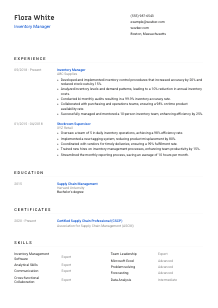
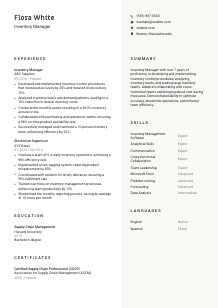
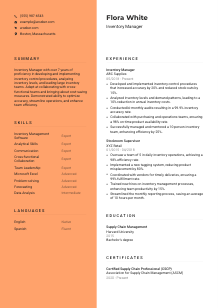
Mastering stock levels, but your resume looks out of order? Check out this Inventory Manager resume example, created with Wozber free resume builder. Learn how to align your organizing skills with job needs, ensuring your career moves with as much precision as your warehouse inventory!
Inventory managers are trusted with one of the easiest functions to notice when it goes wrong. Stock-outs disrupt sales, overstock ties up cash, and inaccurate counts ripple into purchasing, operations, and finance. Your resume should make it clear that you can keep inventory reliable through disciplined controls, sound analysis, and steady coordination across teams.
A tailored resume helps hiring teams quickly see whether your background is operational or truly inventory-led, especially when they scan for reorder planning, audit discipline, system use, and measurable accuracy gains. Wozber's free resume builder supports that process with ATS optimization that keeps role-specific terms and structure easy to read, so the resume shows where you improved inventory performance and how you managed the process behind it.
For inventory roles, the header should be clean and practical. Hiring teams want to confirm contact details, current professional identity, and any location requirement without digging through the page.
Use your full name in a larger, readable font at the top of the resume. Inventory work is built on accuracy and traceability, and even the first line should reflect that same discipline.
Place "Inventory Manager" under your name when that is the role you are pursuing. It immediately frames your background around inventory control, stock analysis, team oversight, and process ownership rather than broader warehouse or operations support work.
List a phone number and professional email address that are current and error-free. If a hiring manager wants to discuss your experience with audits, forecasting, or inventory systems, you do not want a typo in your contact information to break that chain.
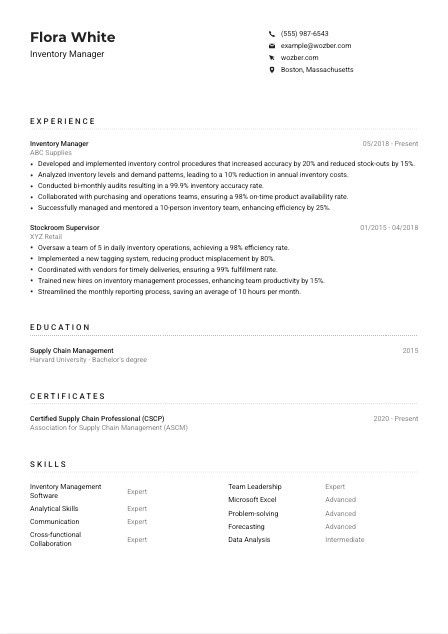
If a job specifies a location requirement, mirror it in your header. Here, "Boston, Massachusetts" helps confirm a stated requirement right away. Use this only when it is relevant to the opening, not as a rule for every inventory resume.
Include LinkedIn or a professional website if it supports your resume with matching job history, systems knowledge, or supply chain credentials. Wozber's free resume builder also helps keep those details consistent across documents, which matters when employers cross-check timelines and titles.
This section does not need flair. It needs precision. Clear personal details let the reader confirm who you are, where you are based when required, and whether your profile already lines up with the inventory management opening.




This is the section most likely to decide whether you move forward. Inventory leaders are usually hired on proof of operational control, accuracy improvements, forecasting judgment, and the ability to keep product available without carrying unnecessary stock.
Before writing bullets, identify the work the employer cares about most. For this opening, that includes inventory control procedures, reorder analysis, stock audits, collaboration with purchasing and operations, and team management. Those priorities should shape which accomplishments you feature first.
List positions in reverse chronological order and make each entry easy to scan. Include job title, employer, and dates so the reader can quickly place your level of responsibility and see whether you already have the 5+ years of inventory-related experience the role requests.
Inventory hiring managers look for outcomes, not task lists. Show what changed because of your work. The sample resume does this well with points like increasing inventory accuracy by 20% and reducing stock-outs by 15%, which ties process improvement directly to operational results.
Choose metrics that are native to the function: accuracy rate, stock-out reduction, carrying cost reduction, fulfillment rate, audit results, team productivity, or on-time product availability. A line such as "achieved 99.9% inventory accuracy through bi-monthly audits" tells the reader far more than "responsible for stock audits."
Prioritize bullets about cycle counts, demand analysis, lead times, replenishment logic, inventory valuation, ERP or inventory software use, and cross-functional planning. If you have broader operations experience, include only the parts that strengthen your case for managing inventory performance. The sample's collaboration with purchasing and operations is a good model because it connects teamwork to product availability.
Every bullet should help the reader picture you managing stock accuracy, replenishment, and daily execution with control. Wozber's free resume builder can help you organize those achievements in an ATS-friendly structure, but the real difference comes from choosing results that reflect how inventory performance is measured.
Education matters most here as a qualification check and as context for your technical grounding in supply chain or business operations. Keep it straightforward, especially when the job posting names a preferred field of study.
If the role asks for a bachelor's degree, make sure it is easy to find. When your degree is in Supply Chain Management, Business Administration, or a related area, that connection should be visible immediately because it matches the employer's stated requirement.
List your degree, field of study, school, and graduation year or date in a consistent format. This helps both ATS parsing and human review, especially when recruiters are checking minimum qualifications across a large applicant pool.
When your academic background aligns closely with the role, say so clearly. In the sample resume, a bachelor's degree in Supply Chain Management maps directly to the posting. That kind of alignment is helpful, though related degrees can work just as well when your experience supports them.
If you are early in your career or your experience is still developing, relevant coursework in logistics, forecasting, operations management, or data analysis can strengthen the section. For experienced inventory managers, this is usually optional unless the coursework is unusually relevant.
Projects, honors, or affiliations can earn space if they relate to supply chain planning, inventory optimization, analytics, or process improvement. Keep them brief and include them only when they support the role you are targeting.
This section should confirm that you meet the academic baseline and, where relevant, that your studies support inventory planning and operational analysis. Clear formatting is enough. Save the deeper proof for your experience section.
Certifications are not mandatory for every inventory manager opening, but they can reinforce your command of supply chain practices, inventory planning, and continuous improvement. They are especially useful when they add depth beyond your degree and job titles.
Even when a certification is not explicitly required, read the job description for clues. Openings that emphasize inventory controls, forecasting, valuation accuracy, and cross-functional coordination often respond well to recognized supply chain credentials.
Choose certifications that support the role rather than filling space. A credential such as Certified Supply Chain Professional fits well because it connects to planning, operations, and inventory decision-making. One relevant certification carries more weight than several generic ones.
Show when the certification was earned and whether it is current. That matters when the credential reflects active professional development or ongoing industry standards.
Inventory management changes with new systems, reporting practices, and planning methods. If you pursue additional training in ERP systems, Excel analysis, forecasting, or supply chain operations, update this section so employers can see that your methods are current.
Certifications work best when they support the kind of inventory environment you want to manage. Keep the section focused and relevant, and let it reinforce the operational judgment already shown in your experience.
Inventory resumes need a skills section that reflects both system fluency and day-to-day operating judgment. Hiring teams usually scan this area for software, analysis, reporting, collaboration, and leadership capabilities before they read deeper into your work history.
Start with the language already used in the job description. For this role, that includes inventory management software, Microsoft Excel, analytical ability, problem-solving, communication, and cross-functional collaboration. Those terms are likely to matter in both ATS screening and recruiter review.
Lead with the skills that affect stock accuracy and replenishment performance. Systems knowledge, Excel, forecasting, data analysis, audit discipline, and team leadership usually deserve more space than broad workplace traits. The sample resume handles this well by featuring software, Excel, forecasting, and leadership together.
Do not crowd the section with every tool or trait you have ever used. Choose the skills that best support your experience in inventory control, demand planning, reporting, and coordination with purchasing or operations. A shorter list with real relevance is much stronger than a long, generic one.
A hiring manager should be able to scan this section and recognize the core inventory toolkit right away. Wozber can help align your wording with the job description for better ATS optimization, while your final list should stay grounded in skills you actually use.
Language ability is usually a secondary factor for inventory roles, but it can matter when the posting specifically mentions communication standards or when the business works across multilingual teams, vendors, or regional operations.
If the employer asks for strong or superior English, make that visible in your Languages section. In this case, English is a stated requirement, so it should be listed clearly and at an appropriate proficiency level.
Put the required language first, then add any additional languages that could support vendor communication, team supervision, or broader supply chain coordination. This keeps the section aligned with the actual needs of the role.
Extra languages are not essential for every inventory manager job, yet they can still strengthen your profile in organizations with diverse teams or international suppliers. Spanish, for example, may be useful in some operations environments, even if it is not a requirement.
Use clear labels such as "Native," "Fluent," or "Intermediate." Avoid vague descriptions. Inventory management relies on accurate communication around counts, shipments, discrepancies, and procedures, so clarity here matters.
Unless language ability is central to the role, do not let this section overshadow your operational qualifications. Treat it as supporting information that adds context to your communication range.
For most inventory roles, English proficiency is the main point to confirm. Any additional languages should strengthen the picture of how you communicate across teams, suppliers, or sites without distracting from your inventory expertise.
Your summary should quickly establish the level and type of inventory work you handle. In a few lines, it needs to connect years of experience with the core outcomes employers care about: accurate stock records, sound replenishment decisions, cost control, and reliable product availability.
Start with a direct professional identity such as "Inventory Manager with 7+ years of experience." That immediately tells the reader whether your background matches the seniority of the opening.
Choose two or three points that reflect the posting's priorities. For this example, good summary material includes improving inventory accuracy, reducing stock-outs or inventory costs, and leading an inventory team. The summary should echo the parts of your background that matter most for the target role.
Avoid generic claims about being results-driven or detail-oriented unless they are backed by operational context. Phrases tied to inventory control procedures, demand analysis, audits, forecasting, or cross-functional coordination carry more weight because they describe actual work.
Close with a line that clarifies what your work delivers, such as more reliable inventory accuracy, smoother operations, stronger team execution, or lower carrying costs. The sample summary does this effectively by tying experience to optimization, efficiency, and cost-saving measures.
When this section is written well, the reader immediately understands your level, your operating strengths, and the results you tend to deliver. Wozber's free resume builder can help you refine the wording for ATS alignment, while your summary should keep the focus on inventory performance and leadership.
An effective Inventory Manager resume makes the hiring team's job easier in a practical way. They should be able to see your command of stock accuracy, replenishment logic, audits, systems, and team leadership without hunting through generic bullets.
Use Wozber's free resume builder to shape that experience into an ATS-compliant resume with clear structure and job-aligned language. Once the resume is tailored, it should leave little doubt that you can run inventory with control, accuracy, and sound operational judgment.




